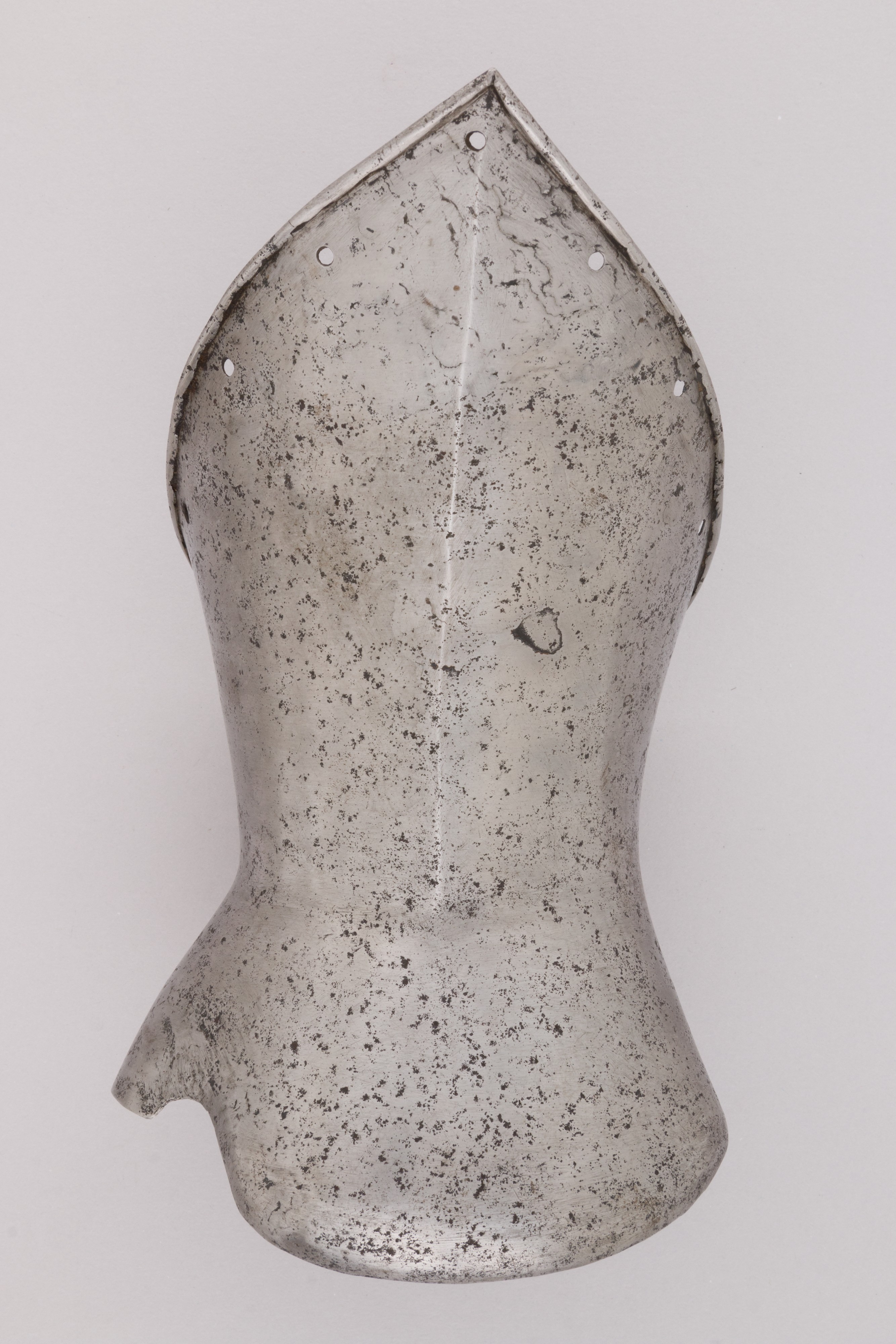
Left Gauntlet: A Standalone Study in Italian Steel
The object under examination is a single left gauntlet, Italian in origin, executed in steel. It arrives at the Lab without its counterpart, without provenance documentation, and without the contextual scaffolding of a complete armour. This absence is not a limitation but a methodological gift. Divorced from the imperative of the full harness, the gauntlet becomes a self-contained treatise on the intersection of metallurgy, anatomy, and the Renaissance culture of the hand. Katherine Fashion Lab treats it here as a standalone study: an artefact whose value lies precisely in its isolation.
Material Integrity: Steel as a Language of Intent
The choice of steel is the first and most consequential design decision. In the Italian tradition of the fifteenth and sixteenth centuries, steel was not merely a protective medium; it was a statement of technical ambition. Unlike the softer iron used in mass-produced munitions-grade armour, steel — particularly the medium-carbon variety that Italian smiths refined through repeated folding and carburisation — allowed for a thinner, lighter, and more responsive plate. The gauntlet’s material thus encodes a hierarchy of use: this was not the equipment of a common soldier but of a patron who could commission work where weight was subordinated to articulation.
The metallurgical signature of Italian steel gauntlets from the High Renaissance is a deliberate compromise between hardness and ductility. The smith needed a surface hard enough to deflect a blade yet a core resilient enough to absorb impact without cracking. This dual requirement dictated the forging process: a gradual, low-temperature anneal followed by selective hardening of the striking surfaces — the knuckles, the cuff, and the metacarpal plates. The left gauntlet, in particular, reveals this logic because the left hand was typically the shield hand, the hand that received blows rather than delivered them. Its steel is therefore often marginally thicker at the cuff and backplate than its right counterpart, a subtle asymmetry that only a standalone study can fully appreciate.
Anatomy as Armature: The Italian Articulation
What distinguishes Italian gauntlets from their German or Flemish contemporaries is the extent to which they mimic the hand’s natural range of motion. The German “mitten” gauntlet, for instance, prioritised protection over dexterity, often encasing the fingers in a single rigid or semi-rigid shell. The Italian school, by contrast, pursued a segmented approach: overlapping lames for the fingers, a separate thumb defence, and a wrist articulation that allowed for flexion and extension without exposing the joint.
The left gauntlet in this study demonstrates this philosophy through its laminated finger plates. Each finger is composed of between four and seven overlapping scales, riveted to an internal leather strip. This construction permits the hand to close into a fist — to grip a rein, a sword hilt, or a lance — while maintaining continuous steel coverage. The thumb, the most vulnerable digit in combat, is protected by a separate articulated cuff that floats above the palm, allowing opposition without compromising the plate’s integrity. The knuckle plate, or metacarpal, is typically domed and fluted, a feature that serves both structural and aesthetic purposes: fluting increases rigidity without adding weight, and it catches light in a way that transforms the gauntlet from a tool into an ornament.
The cuff, or bell, is the architectural anchor of the piece. In Italian examples, it flares outward in a gentle trumpet shape, designed to overlap the vambrace of the forearm. This overlap is not merely mechanical; it is a deliberate visual gesture, a tapering line that draws the eye from the hand upward along the arm. The cuff’s edge is often rolled or thickened, a detail that prevents the steel from cutting into the wearer’s wrist during violent motion. On the left gauntlet, the cuff frequently bears the maker’s mark — a punched or engraved stamp that, in the absence of a full harness, becomes the primary evidence of origin.
Surface as Narrative: Etching, Bluing, and the Aesthetics of Restraint
Italian steel of this period was rarely left plain. The surface treatment of a left gauntlet tells us as much about its patron as its construction tells us about its smith. The most common decorative techniques were etching, bluing, and gilding. Etching, achieved through the application of acid-resistant wax and a corrosive bath, allowed for intricate foliate or arabesque patterns that ran along the cuff and knuckle plate. Bluing, a controlled oxidation process, produced a deep, lustrous blue-black that contrasted with the bright steel of the edges. Gilding, reserved for the most luxurious commissions, added gold leaf or amalgam to the etched recesses, creating a polychrome effect that was as much about signalling wealth as about beautifying the object.
The left gauntlet in this study, if it retains any of its original surface treatment, reveals a deliberate restraint. Italian armourers of the highest tier — the Missaglia, the Negroli, the Seusenhofer — understood that over-decoration could compromise structural integrity. Acid etching, if applied too aggressively, thins the steel and creates stress risers. Gilding, if poorly executed, can mask cracks. The finest left gauntlets therefore employ decoration as a secondary language, subordinate to the primary grammar of form and function. The etching follows the lines of articulation; it does not fight them. The bluing is deepest in the recesses, where it will not be abraded by the shield or the reins. This is a surface that rewards close, slow looking.
Standalone Value: What the Absence of the Right Gauntlet Reveals
To study a left gauntlet without its right counterpart is to confront the object’s essential asymmetry. The left hand in combat was the defensive hand, the hand that held the shield, the reins, or the dagger. It was the hand that absorbed impact, that parried, that protected the body’s centre line. The steel of the left gauntlet is therefore a record of violence received rather than delivered. Its dents, its scratches, its replaced rivets — all of these are evidence of a specific biography, a specific set of encounters.
In the absence of the right gauntlet, we are forced to read the left on its own terms. We cannot compare the two for symmetry of decoration or wear. We cannot assume that the pair was made by the same hand or even in the same decade. The standalone study thus becomes an exercise in radical particularity. The left gauntlet is not half of a whole; it is a whole in itself, a complete statement about how Italian steelworkers understood the relationship between the human hand and the violence it was asked to withstand. At Katherine Fashion Lab, we treat it as such: a singular object, a singular argument, a singular beauty.