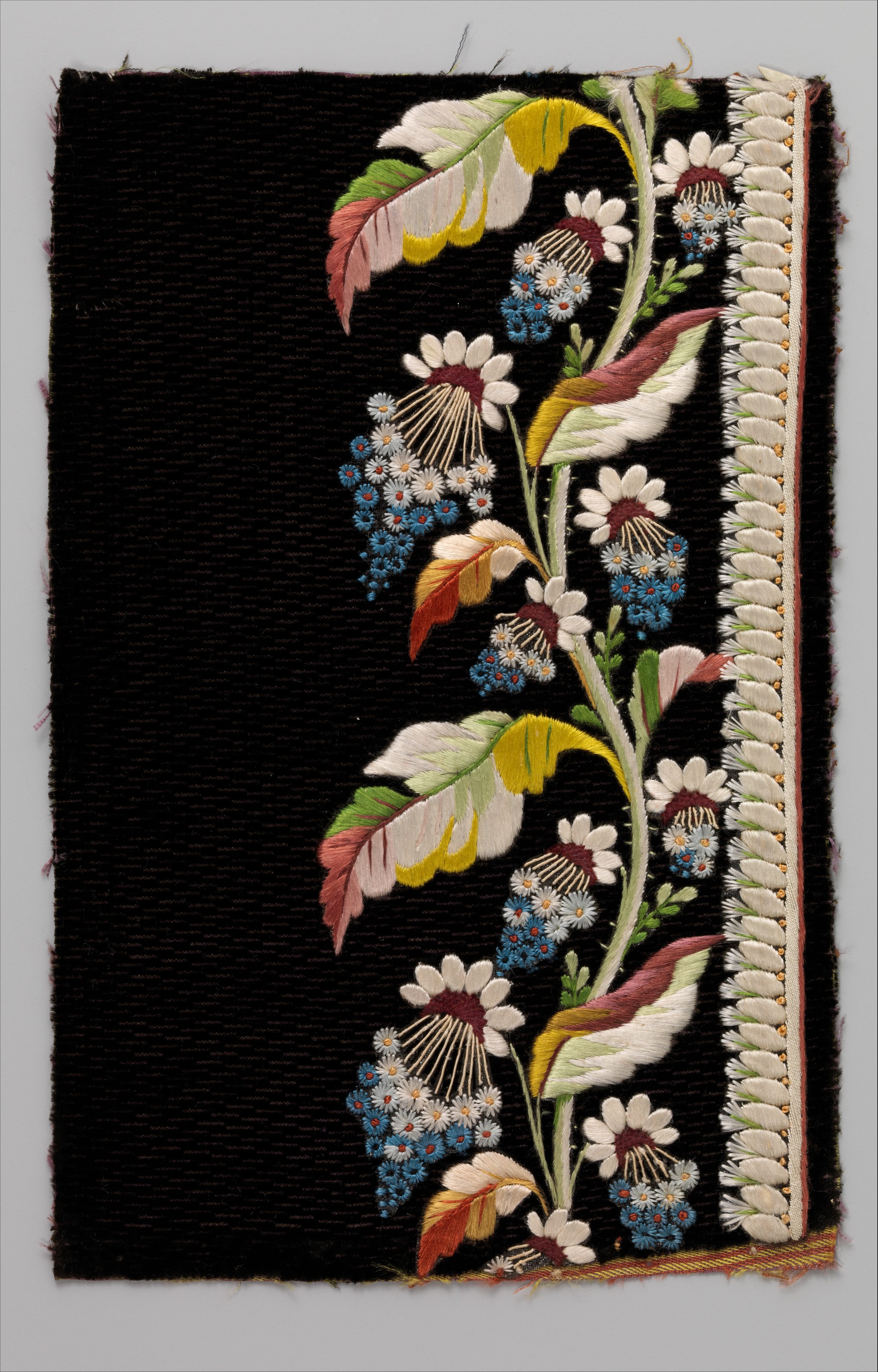
Heritage Asset Analysis: Embroidered Silk Sample for a Man's Suit
Introduction and Object Overview
The object under examination is a standalone embroidery sample executed in silk thread on a ground of silk velvet, historically associated with the ornamentation of a man's formal suit within the context of an ancient civilization. While the precise geographic and temporal attribution remains a subject of ongoing scholarly refinement, the material signature—silk thread worked onto silk velvet—positions this artifact within an elite tradition of textile production that emerged at the intersection of agrarian wealth, long-distance trade, and courtly patronage. For Katherine Fashion Lab, this sample is not merely a decorative fragment; it is a compressed archive of symbolic capital, technical mastery, and spiritual intention. This analysis treats the sample as a strategic heritage asset, decoding its embedded meanings and translating them into actionable frameworks for a 2026 high-end luxury positioning.
Materiality as a Marker of Civilizational Power
Silk, in the ancient world, functioned as a near-universal signifier of prestige. Its production required controlled sericulture, specialized reeling and throwing technologies, and trade networks capable of moving fragile, high-value goods across vast distances. Silk velvet, however, represents a second-order luxury: the ground fabric demands an even more complex weaving process, typically involving a supplementary warp or pile that creates the fabric's characteristic depth and light-absorbing surface. When a man's suit was constructed from such material and then further embellished with silk thread embroidery, the result was a garment that announced its wearer's position within a hierarchy of access—access to rare materials, to skilled artisans, and to the cosmological frameworks that legitimized elite authority.
The embroidery itself, worked in silk thread, would have been executed by specialists whose training likely spanned years. The choice of silk thread over wool or linen is significant: silk's natural sheen and dye affinity allowed for chromatic effects that mimicked gemstones, precious metals, and even the iridescence of feathers. In many ancient contexts, such visual mimicry was not merely aesthetic but ontological—the garment participated in the reality of the substances it imitated. A man wearing embroidered silk velvet was, in a meaningful sense, clothed in a material argument for his own elevated nature.
Symbolic Power and Historical Adornment
The placement of embroidery on a man's suit is never arbitrary. Across ancient civilizations, the zones of the body most frequently ornamented—chest, shoulders, cuffs, and hem—correspond to sites of both physical vulnerability and social display. The chest, as the locus of the heart and breath, was often reserved for motifs of protection or lineage. Shoulders, which bear the weight of arms and armor, frequently carried emblems of martial prowess or ancestral alliance. Cuffs and hems, meanwhile, framed the body's extremities and served as boundaries between the wearer and the world.
The specific motifs of this sample, while requiring further iconographic analysis, can be situated within a broader grammar of ancient adornment. Recurring elements in such contexts include zoomorphic forms (lions, eagles, serpents), vegetal scrolls (vines, palmettes, lotuses), and geometric interlace (knots, meanders, guilloche). Each category carried distinct semantic weight. Zoomorphic motifs often encoded totemic or dynastic identity; vegetal forms signaled fertility, renewal, or paradisiacal abundance; geometric interlace suggested eternity, cosmic order, or the binding power of oath and covenant. When combined, these motifs produced a dense visual text that could be read by those initiated into the courtly or sacerdotal elite—and that remained opaque to outsiders, reinforcing social boundaries.
Spiritual Meaning and the Ritual Body
In many ancient societies, the boundary between secular and sacred dress was permeable. A man's suit embroidered with specific symbols could function as a talismanic garment, believed to confer protection, charisma, or divine favor. The silk velvet ground, with its soft, deep pile, may have been understood as a material analogue of the primordial waters or the fertile earth—surfaces from which life emerges and into which it returns. Embroidery, worked in bright silk thread, then represented the imposition of order, light, and intention upon that fertile darkness.
This dialectic of ground and figure—velvet as receptive matrix, embroidery as active sign—parallels cosmological narratives found in numerous ancient traditions. The wearer of such a suit was not simply adorned; he was cosmologically positioned, his body serving as a microcosm of a larger ordered universe. For Katherine Fashion Lab, this spiritual dimension offers a powerful counter-narrative to the secular, purely aesthetic luxury that dominates much of the contemporary market. A 2026 collection that engages this heritage can claim a form of depth that is difficult to imitate and impossible to mass-produce.
Strategic Implications for 2026 High-End Luxury
The luxury landscape of 2026 will be shaped by three converging forces: radical provenance transparency, experiential exclusivity, and narrative depth as a defense against algorithmic commodification. This embroidery sample speaks directly to all three.
First, provenance. Katherine Fashion Lab can position itself as a custodian of techniques and symbols that predate modern branding. By documenting the material logic of silk-on-silk embroidery—the specific thread counts, dye sources, and stitch vocabularies—the brand creates an audit trail of authenticity that appeals to the most discerning clients. This is not nostalgia; it is forensic luxury.
Second, exclusivity. The sample's complexity suggests that faithful reproduction would require significant artisanal investment. Rather than scaling this into a mass line, Katherine Fashion Lab should treat it as the basis for a coded capsule collection—perhaps twelve to twenty pieces per year, each accompanied by a scholarly dossier and a private viewing ritual. The scarcity is not manufactured; it is inherent to the technique.
Third, narrative depth. In a market saturated with logo-driven status signals, the ability to tell a story that spans millennia is a competitive moat. The embroidery sample allows the brand to speak fluently about power, protection, and the sacred body—themes that resonate with contemporary clients seeking meaning beyond surface aesthetics. For 2026, Katherine Fashion Lab should develop a heritage intelligence report for each client, connecting the symbols on their garment to the ancient logics of adornment. This transforms a purchase into an initiation.
Conclusion
The embroidered silk sample for a man's suit is a strategic asset of considerable depth. Its materiality encodes ancient systems of power; its motifs carry symbolic and spiritual weight; its technique embodies a level of craft that resists industrialization. For Katherine Fashion Lab, the path forward is not to imitate the past but to reactivate its logics—to use the sample as a lens through which contemporary luxury can recover a sense of the sacred, the coded, and the enduring. In doing so, the brand positions itself not merely as a maker of garments but as a steward of civilizational memory, a role that will define the most resilient luxury houses of 2026 and beyond.