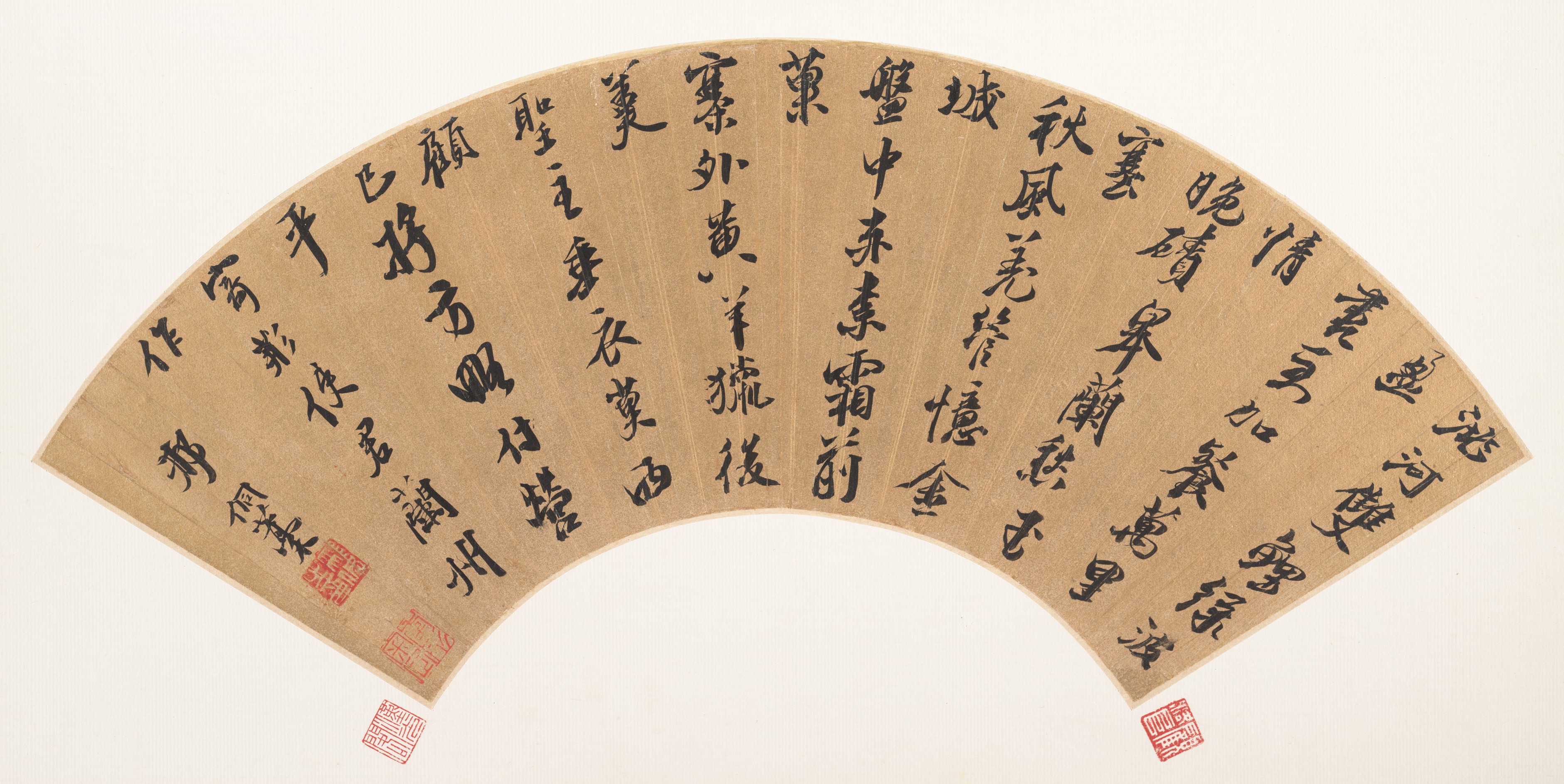
Poem on Lanzhou: A Study in Literati Materiality and the Aesthetics of Restraint
Within the rarefied discourse of Chinese literati art, the folding fan occupies a position of singular complexity. It is at once a utilitarian object and a vehicle for the most intimate expressions of scholarly sensibility. The work under examination here—a folding fan mounted as an album leaf, executed in ink on gold paper, bearing a poem on Lanzhou—exemplifies the sophisticated interplay between material, format, and intellectual content that defines the highest achievements of late imperial Chinese aesthetic culture. As a standalone study, this piece invites close reading not merely as a document of poetic expression but as a meditation on the relationship between surface and inscription, between the ephemeral and the enduring.
The Album Leaf as Curatorial Statement
The decision to mount a folding fan as an album leaf represents a deliberate act of preservation and recontextualization. In its original form, a folding fan is an object of use—carried, unfolded, displayed briefly, then folded away. Its very structure militates against permanence: the pleated paper or silk is subject to wear along the folds, and the arc of the ribs imposes a curvature that resists flat viewing. By removing the fan from its functional armature and mounting it as an album leaf, the collector or curator transforms it from a performative object into a contemplative one. The poem on Lanzhou is thus liberated from the mechanics of display and allowed to exist as a pure surface for aesthetic absorption.
This act of mounting is not neutral. It asserts that the artwork's value resides in its visual and calligraphic content rather than in its utility. The album leaf format—typically a rectangular page bound or housed in a protective case—invites sequential viewing alongside other works, creating a dialogue between pieces. Yet this particular leaf, as a standalone study, must be understood on its own terms. The gold paper ground is no mere support; it is an active participant in the composition, lending a warm, luminous field against which the black ink achieves heightened contrast and a sense of gravitas.
Ink on Gold Paper: Materiality as Meaning
The choice of gold paper for a poem on Lanzhou is significant. Gold paper, often prepared with a thin layer of gold leaf or a gold-flecked wash, was a luxury material reserved for special occasions or for works intended as gifts or tributes. Its use here elevates the poem from casual notation to ceremonial declaration. The ink, applied with a brush whose fibers respond to the slightest pressure, records not only the text but the rhythm of the calligrapher's breath and the cadence of his arm. On gold paper, every hesitation, every acceleration of the brush, is amplified. The material demands confidence; it forgives nothing.
The interplay of ink and gold also carries cosmological resonance. In Chinese aesthetic theory, gold is associated with the yang principle—radiant, hard, enduring—while ink is linked to yin—receptive, fluid, transformative. Their union on the album leaf creates a microcosm of balanced forces. The poem on Lanzhou, whatever its specific content, is thus framed within a metaphysical schema that underscores the literati's concern with harmony and cosmic order. The calligrapher does not merely write; he negotiates between opposing energies, seeking a dynamic equilibrium that is the hallmark of the scholar's art.
Lanzhou as Poetic Topos
Lanzhou, situated on the Yellow River in present-day Gansu Province, has long occupied a liminal space in the Chinese cultural imagination. Historically a frontier garrison town and a critical node on the Silk Road, it represented the boundary between the settled, agrarian heartland and the vast, unpredictable reaches of the northwest. For literati poets, Lanzhou was not merely a geographic location but a topos—a site of exile, of military vigilance, of encounter with the other. To write a poem on Lanzhou was to engage with themes of distance, duty, and the melancholy of separation from the cultural center.
The poem itself, though its specific lines are not reproduced here, would have been composed in one of the classical forms—perhaps a regulated verse or a quatrain—with strict tonal patterns and rhyme schemes. The calligrapher, likely the poet himself or a later admirer, would have chosen a script style appropriate to the content. A poem of solemn reflection might be rendered in regular script, its characters upright and measured; a poem of wistful longing might appear in running script, its strokes connected and flowing. The gold paper ground remains constant, but the ink's behavior reveals the emotional register of the text.
Standalone Study: Autonomy and Context
To treat this fan-mounted album leaf as a standalone study is to acknowledge its autonomy while remaining alert to its historical embeddedness. It is autonomous in that it can be appreciated without reference to a larger album or suite; its visual and calligraphic qualities are self-sufficient. Yet it is embedded in that its meaning depends on knowledge of the fan format, the gold paper's connotations, the poetic tradition of Lanzhou, and the literati culture that produced it. The curator's task is to hold these dimensions in productive tension—neither reducing the work to mere illustration of context nor ignoring the context in favor of pure formalism.
In the final analysis, this Poem on Lanzhou is a testament to the Chinese literati's ability to invest even the most modest of formats with profound intellectual and aesthetic significance. A folding fan, when mounted as an album leaf and inscribed on gold paper, becomes a site of convergence: poetry and calligraphy, materiality and meaning, the local and the universal. It invites the viewer to slow down, to read not only the characters but the spaces between them, and to recognize that in the economy of literati art, restraint is not absence but the highest form of presence.