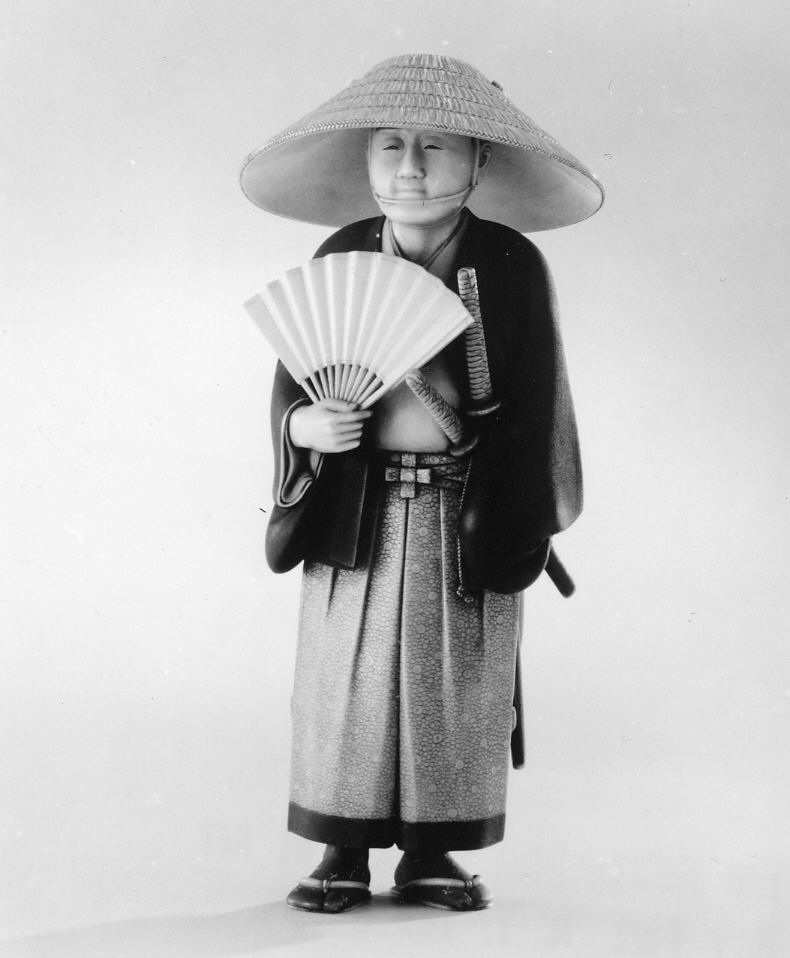
Heritage Asset Analysis: Standing Man in Long Robes with Two Swords in His Sash
Object Identification and Material Context
The subject of this analysis is a Japanese carved ivory figure depicting a standing man dressed in long, flowing robes, with two swords (daishō) secured in his sash. The figure belongs to the okimono tradition—a class of decorative, freestanding carvings produced during the late Edo and Meiji periods (roughly 1868–1912). The medium of ivory is significant: it was prized for its density, translucency, and capacity to hold fine detail, allowing artisans to render textile folds, facial expression, and the curvature of sword mounts with remarkable precision. In the context of Katherine Fashion Lab's heritage portfolio, this object represents a convergence of material rarity, artisanal mastery, and layered cultural symbolism.
Symbolic Power: The Swords as Status and Restraint
The presence of two swords in the figure's sash is the object's most potent symbolic anchor. In feudal and early modern Japan, the wearing of the daishō—the paired long and short swords—was a privilege reserved for the samurai class. More than a weapon, the daishō functioned as a visible declaration of rank, duty, and social identity. The swords were not merely tools of combat; they were moral objects, often treated as the "soul" of the warrior and passed down through generations as heirlooms.
Critically, the figure is standing—not in combat, not in ceremony, but in a posture of composed stillness. This stillness is itself a statement of power. In Japanese aesthetic and ethical traditions, true authority is expressed through restraint, not aggression. The swords remain sheathed and secured, suggesting that the figure's strength is potential rather than enacted. For a luxury brand, this translates into a nuanced narrative: power that is worn lightly, carried with discipline, and communicated through silhouette rather than spectacle.
Historical Adornment: Robes, Sash, and the Language of Dress
The figure's long robes are not incidental drapery; they are a coded system of adornment. In Edo-period Japan, clothing communicated far more than personal taste. Fabric type, pattern, layering, and the way a sash was tied could indicate occupation, season, regional affiliation, and even political allegiance. The long robe (often a kimono or hakama combination) creates a vertical, monolithic silhouette that emphasizes dignity and stability.
The sash (obi) performs a dual function. Practically, it secures the robes and supports the swords. Symbolically, it acts as a horizontal axis that anchors the figure's verticality, creating a balanced, architectural composition. The swords inserted into the sash are not hidden; they are integrated into the garment itself, making adornment and armament inseparable. This integration is a key insight for contemporary luxury strategy: accessories should not feel appended to a look but structurally essential to it.
The ivory medium further amplifies this logic. Ivory's warm, creamy tone and subtle grain create a softness that contrasts with the implied hardness of the swords. The material choice humanizes the warrior, transforming a symbol of martial power into an object of contemplation and connoisseurship. In the Meiji period, such okimono were often produced for export, positioning Japanese craftsmanship as a global luxury good. The object therefore carries a double heritage: domestic samurai symbolism and international market ambition.
Spiritual Meaning: Presence, Discipline, and the Void
Beyond social rank, the figure resonates with spiritual traditions. The standing posture evokes zazen (seated meditation) in its emphasis on uprightness and stillness, even while standing. The swords can be read through the lens of Zen: they represent the cutting away of illusion, the discipline of the mind, and the acceptance of mortality. The figure does not display the swords aggressively; he simply carries them. This is the aesthetic of shibui—understated, unobtrusive beauty that reveals itself slowly.
There is also a spatial spirituality at work. The figure occupies space quietly, without dramatic gesture. In Japanese spatial theory, emptiness (ma) is not absence but potential. The ivory carving, though small, commands its surrounding void. For a luxury brand, this suggests that spiritual meaning can be communicated through what is not shown: the unsheathed blade, the untaken action, the unspoken intention.
2026 Luxury Strategy: From Heritage Object to Brand Proposition
For Katherine Fashion Lab, this object offers a strategic framework for 2026 high-end positioning. Three principles emerge.
First, disciplined power. The daishō-wearing figure models authority that is contained. In a market saturated with loud logos and maximalist branding, the counter-position is restrained strength: precise tailoring, weighted fabrics, and accessories that imply capability rather than announce it. The two swords become a metaphor for dual functionality—garments that serve both ceremony and utility.
Second, integrated adornment. The sash-and-sword system demonstrates that the most powerful accessories are those that complete the architecture of the body. For 2026, Katherine Fashion Lab can develop belts, sashes, and harnesses that are not decorative add-ons but structural elements of the silhouette. The ivory figure teaches that ornament and function should be indistinguishable.
Third, material storytelling. Ivory is now ethically restricted, but its heritage role remains instructive. The lesson is not to use ivory but to understand why it mattered: rarity, tactility, and the ability to hold detail. In 2026, comparable luxury materials—responsibly sourced cashmere, vegetable-tanned leather, recycled precious metals—can carry the same narrative of provenance and permanence. The object's Meiji-era export context also offers a blueprint for cultural translation: honor the source culture while addressing a global clientele.
Conclusion
The Standing Man in Long Robes with Two Swords in His Sash is more than an antique okimono. It is a compact treatise on symbolic power, historical adornment, and spiritual restraint. For Katherine Fashion Lab, its strategic value lies in the way it resolves apparent opposites: weapon and garment, stillness and strength, local tradition and international ambition. As the luxury sector moves toward 2026, brands that can translate such heritage assets into coherent design principles—rather than superficial references—will define the next era of high-end cultural authority.