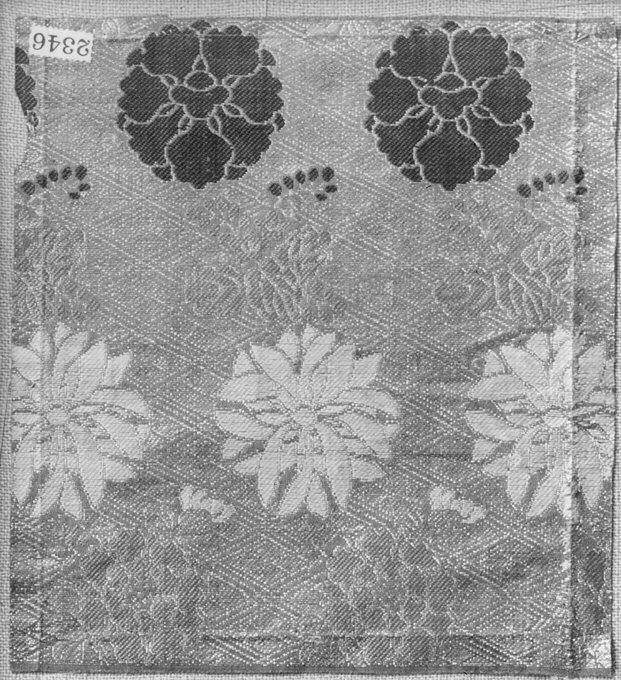
Piece: A Study in Japanese Couture Discipline
In the lexicon of contemporary couture, the term piece carries a weight that exceeds its modest syllable count. It denotes singularity, intentionality, and the refusal of the redundant. Within the Japanese atelier tradition, a piece is not merely a garment but a resolved argument — a thesis on proportion, material, and restraint. The object under examination here, a standalone study in silk and metallic thread, exemplifies this philosophy with uncommon rigor. It is a work that rewards slow looking, and it punishes the viewer who mistakes quietness for absence.
Japan's relationship with silk is not incidental; it is civilizational. From the sericulture practices of the Edo period to the post-war reinvention of the kimono as a site of modernist experimentation, Japanese makers have treated silk as a living surface rather than a passive fabric. The metallic thread introduced into this piece does not announce itself as luxury in the Western sense — it does not glitter for attention. Instead, it behaves as a structural counterpoint, a filament of tension woven into an otherwise fluid ground. This is a distinctly Japanese negotiation: ornament subordinated to architecture.
Material Logic: Silk as Ground, Metal as Argument
The silk in this piece operates on multiple registers. At the macro level, it provides drape — that elusive quality in which gravity and fluidity reach an accord. At the micro level, its weave structure determines how light behaves across the surface. Japanese silk, particularly in the habutai and rinzu families, is often characterized by a controlled luster: reflective without being glossy, matte without being flat. This piece exploits that middle register deliberately, allowing the metallic thread to function as a kind of punctuation rather than decoration.
The metallic thread itself deserves close analysis. In Western couture, metallic elements are frequently deployed as spectacle — think of the gilded embroideries of Parisian houses in the 1980s, where gold thread signified opulence as an end in itself. Here, the logic is inverted. The metal is thin, almost filamentary, and it is integrated into the weave rather than applied on top. This integration matters because it changes the garment's relationship to movement. When the silk shifts, the metallic thread catches light in discrete, fleeting intervals — a phenomenon closer to the shimmer of water than to the flash of jewelry. The piece thus refuses static viewing. It must be worn, or at least handled, to be understood.
Construction and the Ethics of Restraint
Japanese couture, particularly in the lineages influenced by Issey Miyake, Yohji Yamamoto, and Rei Kawakubo, has long treated construction as a form of ethics. Seams are not hidden out of shame but resolved out of respect. In this piece, the construction follows that discipline. The silhouette is deliberately unresolved — it does not cling, nor does it balloon. Instead, it creates a zone of negotiation between body and fabric, allowing the wearer's movement to complete the design. This is a collaborative model of couture, one in which the maker surrenders final authorship to the act of wearing.
The metallic thread reinforces this ethic. Because it is woven rather than embroidered, it cannot be removed without destroying the cloth. It is inseparable from the piece's identity. This inseparability is a statement: ornament is not an accessory to structure but a constituent of it. In an era when fashion increasingly treats embellishment as a detachable value-add — a logo, a hardware plate, a seasonal graphic — this piece insists on integration. Nothing here can be subtracted without loss.
Standalone Status and the Question of Context
The designation of this work as a standalone study is significant. It removes the piece from the narrative comforts of a collection, where meaning is often supplied by adjacency — the runway, the lookbook, the seasonal theme. A standalone piece must generate its own context. It must be legible without a supporting cast. This is a severe test, and it is one that Japanese couture has historically passed with distinction, precisely because its makers have tended to treat each garment as a complete proposition rather than a fragment of a marketing story.
Viewed in isolation, the piece reveals its internal hierarchies. The silk establishes the ground condition; the metallic thread introduces interruption; the cut determines how both are experienced in motion. There is no hierarchy of importance here, only a sequence of dependencies. Remove the metal thread and the silk becomes inert. Remove the silk and the metal has no body to animate. Remove the cut and both become yardage. The piece is, in this sense, a system — and like all well-designed systems, it is greater than the sum of its components.
Conclusion: The Discipline of the Unfinished
What distinguishes this piece within the broader landscape of global couture is its comfort with incompletion. It does not seek to resolve every tension it introduces. The metallic thread remains slightly restless; the silhouette remains slightly open; the surface remains slightly unpredictable under changing light. This is not a failure of resolution but a deliberate withholding — a recognition that couture's highest function is not to conclude but to sustain attention.
For the collector or student of Japanese fashion, this piece offers a compact education. It demonstrates that silk and metallic thread, when handled with discipline, can produce an object that is simultaneously austere and sensuous, traditional and forward-looking, standalone and self-sufficient. It is a piece in the fullest sense of the word: not a fragment of a larger argument, but an argument entire.