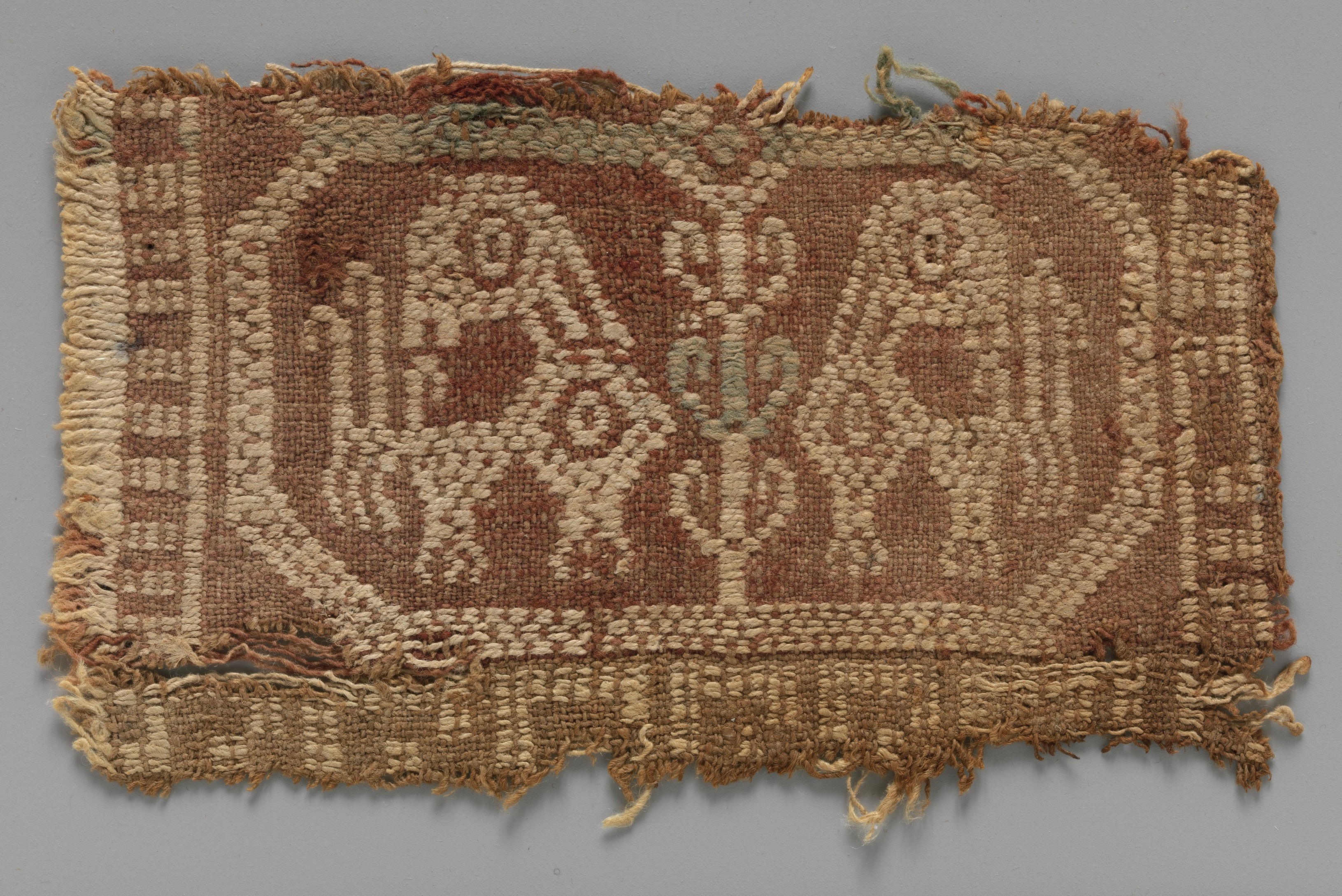
Heritage Asset Analysis: Textile Fragment with Birds
Object Overview and Material Composition
The textile fragment under examination—a plain-weave linen ground with cotton brocaded bird motifs—represents a rare convergence of material innovation and symbolic density within ancient textile production. Its technical construction reveals a sophisticated understanding of fiber blending: linen, derived from flax and associated with ritual purity across Mediterranean and Near Eastern cultures, serves as the structural foundation, while cotton, a relatively rare and imported fiber in many ancient economies, supplies the decorative supplementary weft. The brocading technique itself is significant. Unlike embroidery, which is applied after weaving, brocading integrates ornamentation into the fabric structure during production, demanding precise tension control and pattern coordination. This implies a specialized workshop environment, likely court- or temple-affiliated, where weavers operated under centralized patronage. The fragment's survival—despite the inherent fragility of both linen and cotton under burial conditions—suggests either deliberate preservation or deposition within a protected architectural context, such as a tomb or sanctuary. For Katherine Fashion Lab, the material narrative offers an immediate luxury positioning: the union of two fibers with distinct geographic and spiritual biographies, executed through a technique that renders ornament inseparable from structure.
Symbolic Power of Avian Motifs in Ancient Adornment
Birds occupy a privileged position in the symbolic economies of ancient civilizations, functioning simultaneously as messengers, psychopomps, and emblems of sovereignty. In Egyptian, Mesopotamian, and Aegean contexts, avian imagery appears on textiles, wall paintings, and funerary objects with remarkable consistency. The specific birds depicted on this fragment—likely waterfowl, cranes, or raptors depending on regional attribution—carry layered meanings. Waterfowl often signify the soul's journey across primordial waters; cranes denote longevity, vigilance, and aristocratic refinement; raptors embody martial power and divine sanction. The repetition of the motif across the plain-weave ground suggests a rhythmic, almost liturgical function: the textile may have served as a ritual garment, a temple hanging, or a funerary shroud. Crucially, the brocaded bird is not merely decorative but performative. Wearing or displaying such a textile enacted a claim to cosmic order, aligning the bearer with celestial hierarchies. This is the essence of historical adornment: clothing as ontological statement, not merely aesthetic choice. The fragment therefore documents an early instance of what Katherine Fashion Lab terms "symbolic luxury"—the capacity of a garment to encode metaphysical propositions within its physical structure.
Spiritual Meaning and Ritual Function
The spiritual dimension of this textile extends beyond iconography into the realm of material agency. In many ancient belief systems, linen possessed inherent purity due to its association with flax, a plant requiring meticulous processing and associated with light, fertility, and resurrection. Cotton, by contrast, introduced an element of exoticism and softness, its origins in the Indus Valley or Nubia linking the textile to long-distance trade networks and, by extension, to cosmopolitan prestige. The combination of these fibers in a single cloth may have been understood as a microcosm of cosmic union: the local and the foreign, the ascetic and the luxurious, the durable and the delicate. The bird motif, brocaded in cotton against the linen ground, thus becomes a spiritual technology—a visual and tactile invocation of flight, transcendence, and divine favor. Such textiles were often buried with the deceased or donated to temples, functioning as votive offerings that mediated between human and divine realms. For contemporary luxury strategy, this spiritual provenance offers a powerful counter-narrative to secular consumption: the garment as talisman, the collection as consecrated object.
Strategic Implications for 2026 High-End Luxury Positioning
As Katherine Fashion Lab prepares its 2026 strategic roadmap, this fragment provides a blueprint for heritage-driven differentiation. The luxury market is increasingly polarized between techno-minimalism and maximalist heritage storytelling. This textile fragment belongs decisively to the latter, yet its appeal is not merely nostalgic. Three strategic vectors emerge. First, material authenticity: the linen-cotton brocade offers a tangible alternative to synthetic blends, aligning with the premiumization of natural fibers and the growing consumer demand for provenance transparency. Second, symbolic density: the avian motif can be reinterpreted through modern iconography without losing its ancient resonance, creating a signature visual language that is both archival and contemporary. Third, ritual function: by framing garments as objects of spiritual or psychological significance—rather than mere commodities—the brand can access the growing "meaning economy," where consumers invest in pieces that narrate identity, protection, and transcendence. The 2026 collection could deploy this fragment as a capsule narrative: limited-edition brocaded textiles produced in partnership with heritage weaving ateliers, each accompanied by a provenance dossier detailing the original motif's symbolic grammar. Pricing strategy should reflect scarcity, craft intensity, and cultural capital, positioning the pieces at the apex of the brand's pyramid. In an era of algorithmic ubiquity, the ancient bird—brocaded in cotton on linen—reminds us that true luxury is not speed but endurance, not visibility but meaning.