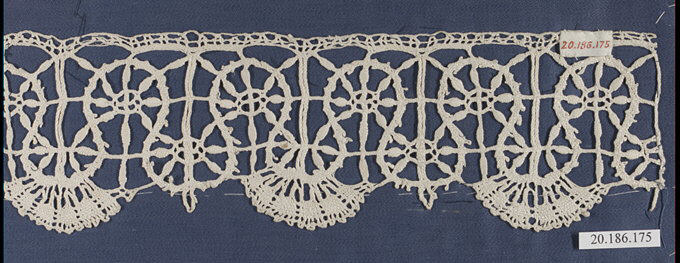
Edging as Couture Grammar: Bobbin Lace and the Architecture of the Boundary
In the lexicon of haute couture, the edge is never merely a terminus. It is a statement of intent—a threshold where the garment negotiates its relationship with the body, the air, and the gaze. Katherine Fashion Lab's standalone study, Edging, examines this liminal space through the lens of bobbin lace, a textile tradition whose global heritage spans Flemish bobbins, Venetian pillows, and Cantonese silk filigree. What emerges is not a history of trim, but a rigorous inquiry into how couture constructs meaning at its outermost boundaries.
The study positions edging as a structural grammar rather than a decorative afterthought. In couture, the edge is where the hand of the maker is most legible—where tension, rhythm, and repetition become visible. Bobbin lace, with its thousands of interlaced threads wound on wooden bobbins, is the ultimate expression of this logic. Each pin placed on the pillow is a decision; each crossing is a negotiation between structure and fluidity. The result is an edge that does not simply finish a garment but actively shapes its silhouette, weight, and movement.
Global Heritage: The Cartography of a Craft
Bobbin lace is often mischaracterized as a European invention, yet its global heritage is far more complex. The technique—interlacing multiple threads wound on bobbins over a pinned pattern—emerged independently in several cultures, from the fishing communities of Flanders and Italy to the silk workshops of China and the needlework traditions of South America. What unites these disparate origins is a shared preoccupation with the edge: the hem, the cuff, the collar, the veil.
In 16th-century Venice, bobbin lace was a marker of aristocratic status, its density and intricacy signaling both wealth and leisure. In Flanders, it became a communal craft, with women working in groups around a single pillow, their bobbins clacking in a rhythm that was both economic and social. In China, silk bobbin lace was adapted to local aesthetics, incorporating motifs of clouds, dragons, and peonies that European lacemakers later appropriated without acknowledgment. Katherine Fashion Lab's study refuses this erasure. It treats bobbin lace as a global inheritance—a technology of edging that carries within it the fingerprints of multiple civilizations.
This heritage matters because it reframes edging as a site of cultural exchange rather than isolated tradition. When a couture atelier in Paris applies a strip of Chantilly lace to a silk organza gown, it is participating in a conversation that began centuries ago in Bruges, Burano, and Canton. The edge is never neutral. It is a carrier of memory.
Materiality: The Physics of Bobbin Lace
To understand edging in couture, one must understand the material itself. Bobbin lace is not woven, knitted, or embroidered. It is built thread by thread, with each bobbin acting as an independent agent. The lacemaker's hands move in a choreography of twist, cross, and pin, creating a fabric that is simultaneously rigid and porous, opaque and transparent. This duality is precisely what makes bobbin lace so compelling as an edging material.
Unlike a simple hem, which terminates a garment with a line, bobbin lace creates a transitional zone. It softens the boundary between fabric and air, between body and environment. In couture, this zone is where the garment becomes atmospheric. A bobbin lace edge on a silk crepe dress does not just finish the sleeve—it extends the garment's presence into space, creating a halo of texture that moves with the wearer.
The study identifies three material properties that make bobbin lace uniquely suited to edging:
1. Structural Memory. Bobbin lace retains the tension of its making. Unlike cut fabric, which can fray or distort, lace holds its shape through the integrity of its interlocking threads. This makes it ideal for edges that must maintain their geometry over time.
2. Variable Density. A skilled lacemaker can transition from dense, opaque sections to open, gossamer-like areas within a single strip. This allows couture designers to modulate the visual weight of an edge, creating gradients of coverage that guide the eye and shape the silhouette.
3. Directional Fluidity. Bobbin lace can be worked in curves, scallops, and points, following the contours of a garment rather than imposing a rigid line. This makes it an ideal material for edging necklines, armholes, and hems that must conform to the body's architecture.
Edging as Couture Methodology
Katherine Fashion Lab's study argues that edging is not a final step in garment construction but a methodology that informs the entire design process. When a couturier begins with the edge—with the lace that will define the garment's boundary—they are working backwards from the perimeter, allowing the edge to dictate the interior. This inversion of traditional construction challenges the hierarchy of fabric over trim, center over margin.
In practical terms, this means that bobbin lace edging is not applied after the garment is sewn. It is integrated into the pattern from the outset. The lace's width, density, and pattern determine the seam allowances, the drape, and even the choice of underlying fabric. A dense Flemish lace edge might require a heavier silk to support its weight, while a delicate Bedfordshire lace might demand a featherweight organza that will not overwhelm its transparency.
This approach has precedent in historical couture. Charles Frederick Worth, often credited as the father of haute couture, used lace edging as a structural element in his crinoline gowns, allowing the lace to define the hem's flare. Cristóbal Balenciaga, by contrast, treated edging as a sculptural device, using stiffened lace to create architectural collars and cuffs that stood away from the body. Katherine Fashion Lab's study situates bobbin lace within this lineage while pushing it forward, proposing that edging can be a generative principle rather than a finishing touch.
The Edge as Manifesto
Ultimately, Edging is a study of limits—and of the power that resides in testing them. Bobbin lace, with its global heritage and material complexity, offers a way to think about couture that is both historically grounded and formally adventurous. The edge is not where the garment ends. It is where the garment begins to speak.
In a fashion landscape increasingly dominated by digital reproduction and synthetic materials, Katherine Fashion Lab's focus on bobbin lace edging is a deliberate act of resistance. It insists on the value of the hand, the specificity of heritage, and the intelligence of the boundary. The edge, after all, is the first thing the eye encounters and the last thing it remembers. To master the edge is to master the entire garment. This study does not simply analyze that mastery—it demands it.