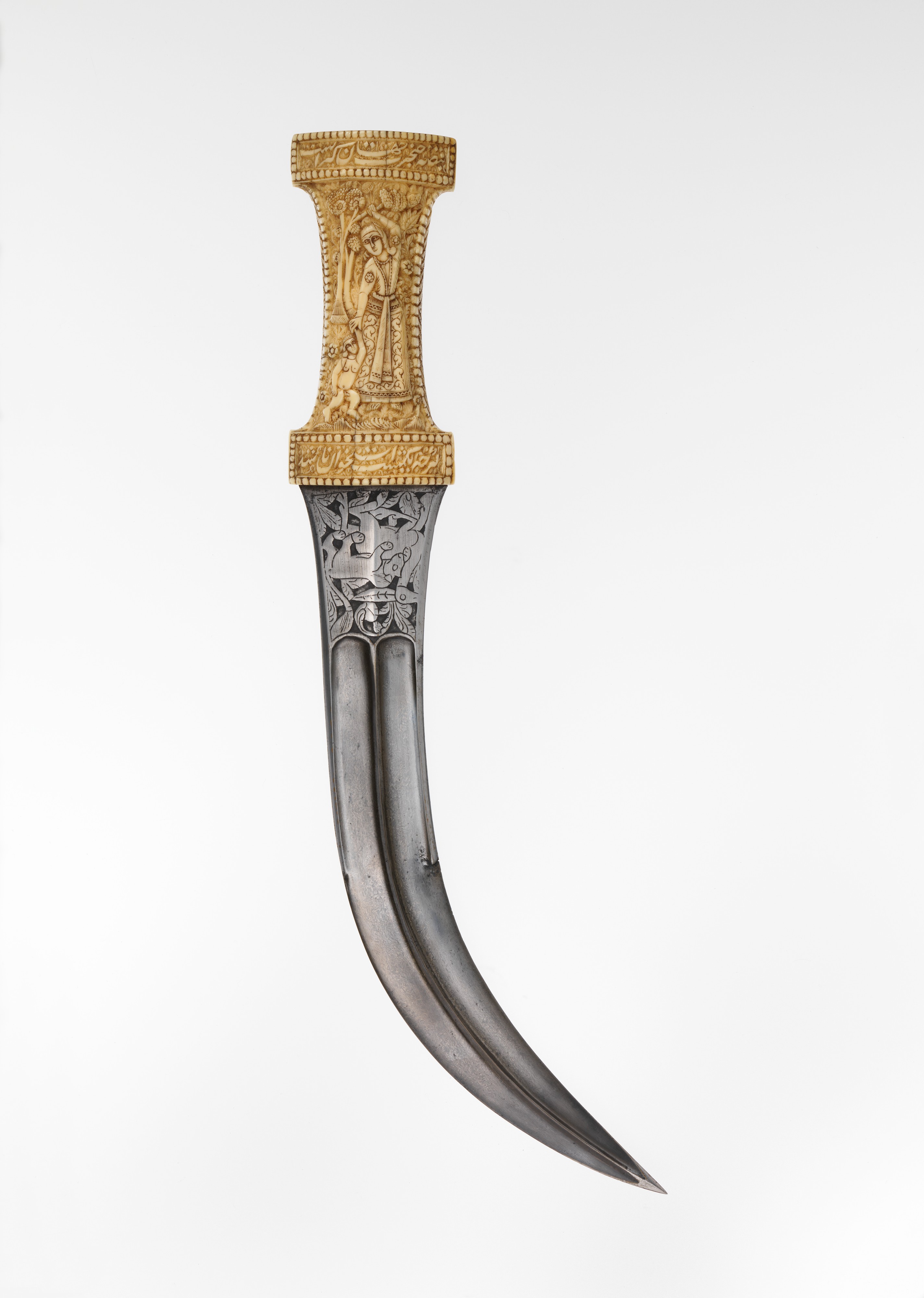
Heritage Asset Analysis: The Iranian Jambiya as a Vehicle for Symbolic Authority and Luxury Market Positioning
Introduction: A Blade Beyond Utility
The dagger known as the jambiya is conventionally associated with the Arabian Peninsula and the broader Islamic world, yet its Iranian lineage reveals a distinct and under-leveraged heritage asset. Within the Persian cultural sphere, the curved double-edged dagger—often termed khanjar in Farsi—evolved as both a functional sidearm and a potent emblem of masculine honor, spiritual guardianship, and courtly refinement. Constructed from steel and ivory, this object occupies a rare intersection of martial utility, sacred symbolism, and material luxury. For Katherine Fashion Lab, the Iranian jambiya offers a strategic standalone research platform: a single artifact capable of anchoring a narrative around power, protection, and the aesthetics of restraint. This analysis examines its symbolic, historical, and spiritual dimensions, and translates those findings into a 2026 luxury strategy.
Historical Adornment and the Semiotics of Steel and Ivory
The Iranian jambiya emerged from a long tradition of Persian metalwork that reached its zenith under the Safavid dynasty (1501–1736). Unlike the broader jambiya family, which favors a short, curved blade worn at the waist, Persian examples often display a more elongated profile, a pronounced central ridge, and a hilt carved from walrus or elephant ivory. The pairing of steel and ivory was never accidental. Steel represented the element of farr—divine glory and martial legitimacy—while ivory signaled purity, rarity, and access to distant trade networks stretching from the Indian Ocean to the Caucasus.
Adornment on these daggers was governed by a grammar of hierarchy. Gold inlay (koftgari) on the blade’s spine, niello silver on the scabbard mounts, and carved ivory hilts with geometric or floral motifs communicated the owner’s rank. In Qajar-era portraiture, the jambiya appears not as a weapon drawn for combat but as a static accoutrement—worn diagonally across the sash, its hilt angled forward to catch the light. This positioning is critical for heritage strategy: the object was designed to be seen before it was used. Its power was performative, not merely ballistic.
Symbolic Power: Honor, Guardianship, and the Masculine Ideal
In Persian cultural codes, the dagger carried meanings that transcended self-defense. It was a marker of javānmardi—a ethical ideal combining youth, generosity, and physical courage. To wear a jambiya was to declare one’s readiness to protect family, guest, and community. The blade’s curve, often compared to a crescent or a flame, linked the wearer to cosmic order: the crescent as a symbol of renewal, the flame as a sign of divine presence.
Symbolic power also operated through absence. A man of high status might carry an ornate jambiya but never draw it; the weapon’s restraint amplified its authority. This paradox—latent force expressed through stillness—is directly relevant to luxury branding. Contemporary high-end consumers do not seek weapons; they seek objects that encode discipline, heritage, and unspoken capability. The Iranian jambiya, with its ivory hilt worn smooth by generations of handling, offers a tactile narrative of inherited power.
Spiritual Meaning: Talismanic and Sufi Interpretations
Beyond honor, the jambiya functioned as a talisman. In Iranian folk Islam, steel was believed to repel malevolent spirits (jinn), and ivory was associated with protection during travel. Some daggers were engraved with Qur’anic verses, particularly the Ayat al-Kursi (Throne Verse), or with the names of Imams. These inscriptions transformed the object into a portable shrine—a spiritual companion rather than a mere tool.
Sufi symbolism adds another layer. The dagger’s dual edges represented the tension between zahir (the outward, manifest) and batin (the inward, hidden). To wield such a blade was to acknowledge that true power lies in balancing opposites: severity and mercy, action and contemplation. For a luxury brand, this spiritual dimension provides a rare opportunity to move beyond aesthetics into meaningful ritual. A jambiya-inspired object can be positioned as a talisman for the modern executive—a physical anchor for decision-making under pressure.
2026 Luxury Strategy: From Artifact to Aspirational Code
Katherine Fashion Lab’s 2026 strategy should treat the Iranian jambiya not as a product to reproduce, but as a semiotic reservoir. Three strategic pillars emerge:
1. Material Honesty and Ethical Provenance. The original pairing of steel and ivory raises contemporary ethical questions. For 2026, the brand should substitute responsibly sourced alternatives—reclaimed steel from historic blades, plant-based ivory (tagua or ivory nut), or certified vintage ivory via antique exemption. The narrative becomes one of translation, not extraction: preserving symbolic weight while aligning with ESG mandates.
2. The Power of the Concealed Edge. Luxury in 2026 favors understatement over ostentation. The jambiya’s design logic—a beautiful hilt that conceals a lethal blade—maps perfectly onto accessories that suggest capability without aggression. Consider a clutch or cuff whose clasp references the jambiya’s hilt geometry, or a fragrance bottle capped with a carved ivory-like finial. The consumer wears potential, not provocation.
3. Ritual and Inheritance. High-end clients increasingly seek objects with a story of transmission. The jambiya was often passed from father to son, accompanied by a spoken blessing. Katherine Fashion Lab can create a certificate of lineage for each piece, detailing the Iranian motif, the steel’s origin, and a suggested ritual for gifting. This transforms a purchase into an act of cultural stewardship.
Conclusion: A Blade for the Boardroom
The Iranian jambiya is a masterclass in symbolic economy. Its steel speaks of discipline; its ivory of rarity; its curve of cosmic balance; its concealment of restrained power. For Katherine Fashion Lab, the strategic opportunity lies not in nostalgia but in recontextualization. By 2026, the most valuable luxury objects will be those that carry spiritual and historical density without demanding literal use. The jambiya—worn, never wielded—offers precisely that model: an adornment of authority, a talisman of protection, and a heritage asset ready for its next century.