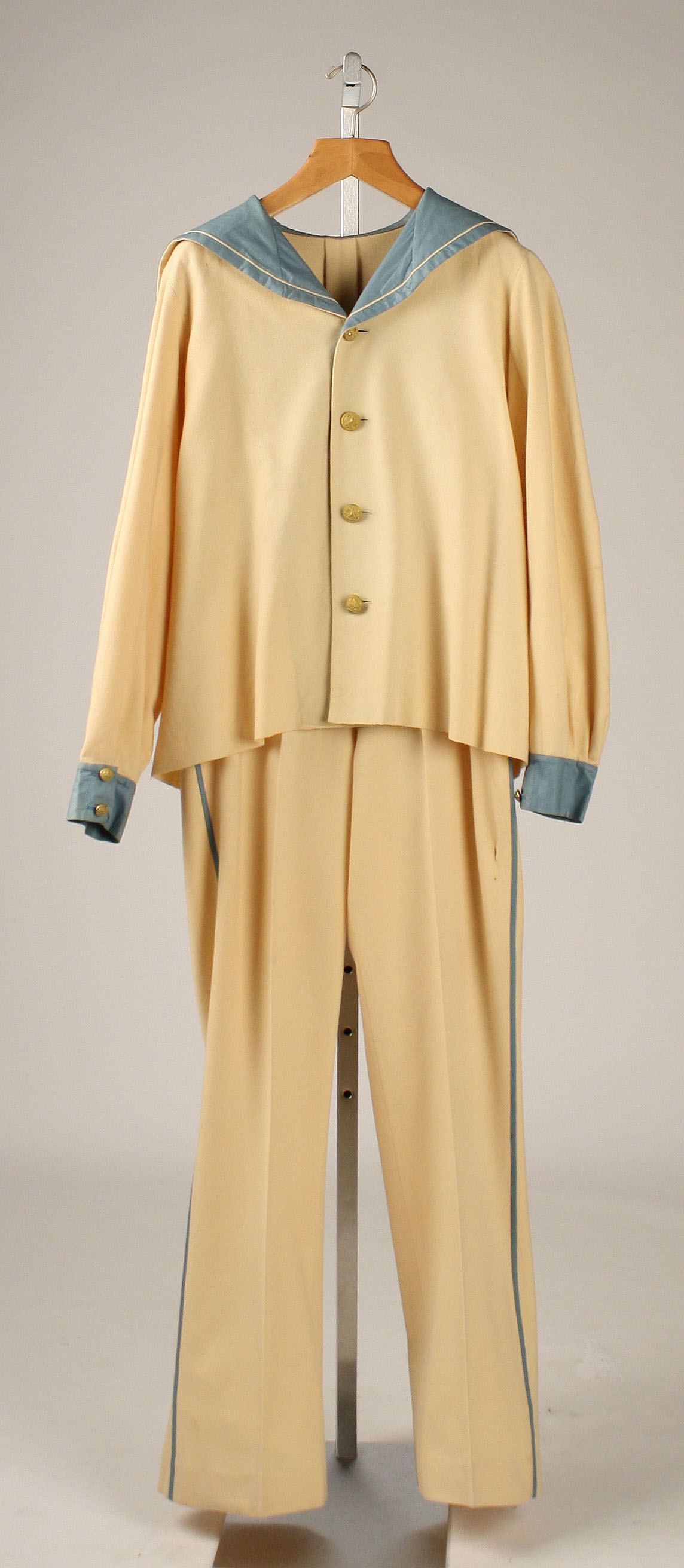
The Sailor Suit: An American Couture Study in Wool, Cotton, and Metal
The sailor suit occupies a singular position in the American sartorial imagination: a garment born of naval utility, refined by couture discipline, and ultimately democratized into one of the most enduring silhouettes in fashion history. Within the context of this standalone study, Katherine Fashion Lab examines the sailor suit not as a costume of nostalgia but as a rigorous exercise in structural design—an artifact whose three core materials, wool, cotton, and metal, articulate a precise dialogue between function, form, and cultural meaning.
Origins: From Quarterdeck to Couture Atelier
The sailor suit entered the American wardrobe through the obvious channel of the sea. Nineteenth-century naval uniforms, with their broad collars, boxy silhouettes, and practical fastenings, were engineered for the physical demands of maritime labor. Yet the garment's migration from ship to shore was accelerated by a distinctly American cultural mechanism: the elevation of the child as a symbol of national innocence. By the late nineteenth century, the sailor suit had become the definitive uniform of American childhood, photographed on the sons of presidents and the daughters of industrialists alike.
What distinguishes the American iteration from its British and Continental counterparts is its lack of aristocratic restraint. Where European versions often retained a decorative fussiness—elaborate embroidery, ribboned cuffs, miniature insignia—the American sailor suit was streamlined. It was a garment of republican simplicity, and it is precisely this restraint that made it legible to later couture designers, who recognized in its lines a ready-made vocabulary of modern minimalism.
Material Analysis: Wool, Cotton, Metal
The sailor suit's material triad is not incidental; it is the architecture of the garment itself.
Wool supplies the suit's structural authority. Historically, naval uniforms relied on heavy melton or broadcloth for their outer layers—fabrics dense enough to repel wind and spray, yet malleable enough to be tailored into the characteristic boxy torso and wide, flat collar. In couture applications, wool is the material that prevents the sailor suit from collapsing into mere playfulness. It gives the silhouette weight. A wool sailor suit is a garment that stands away from the body, maintaining its own geometry, and it is this self-supporting quality that elevates the style from costume to construction.
Cotton provides the counterpoint of softness and breathability. The classic sailor collar—the middy collar—is traditionally rendered in cotton drill or canvas, often in contrasting white against a navy ground. Cotton is also the material of the underlayers: the striped jersey, the soft shirt, the practical lining. In couture terms, cotton is the sailor suit's democratic conscience. It is the fabric of the everyday, the washable, the accessible—and its presence within an otherwise disciplined wool structure creates a tension that designers have exploited for over a century.
Metal is the quiet protagonist. The sailor suit's metal components—buttons, buckles, eyelets, and the occasional chain or whistle detail—are not ornamental afterthoughts. They are functional punctuation marks. Naval buttons were originally designed for grip and durability; in couture, they become the suit's jewelry. The gleam of brass or nickel against dark wool introduces a note of precision, a suggestion of the mechanical, the navigational, the exact. Metal is what prevents the sailor suit from becoming merely soft. It introduces hardness, reflection, and a faint industrial edge.
Design Language: The Collar, the Silhouette, the Signal
The sailor suit's genius lies in its collar. The broad, square flap at the back—historically designed to protect the neck from sun and rain—creates an unmistakable graphic line. In couture, this collar is a device of proportion: it widens the shoulders, frames the face, and introduces a horizontal axis that contrasts with the vertical drop of the torso. It is, in effect, a wearable frame.
The silhouette is equally deliberate. The sailor suit is not fitted; it is volumetric. It hangs from the shoulders with a calculated looseness, creating a shape that is at once childlike and authoritative. This paradox—innocence and command—is the suit's central tension, and it is why designers from Chanel to Yohji Yamamoto have returned to it. The sailor suit can be read as playful or as severe, depending on the fabric weight and the precision of the cut.
Finally, the suit functions as a signal. To wear a sailor suit is to invoke a set of associations: travel, discipline, youth, the sea, the nation. In American culture specifically, it carries the freight of both military service and childhood memory. Couture thrives on such layered references. The sailor suit offers them ready-made.
Cultural Resonance and Contemporary Relevance
The sailor suit's American journey is a study in appropriation and reinvention. What began as utilitarian naval dress became children's wear, then a staple of resort and summer collections, then a recurring motif in avant-garde fashion. Its materials—wool, cotton, metal—have remained remarkably constant, even as its meanings have multiplied.
In the contemporary landscape, the sailor suit persists as a garment of controlled nostalgia. It is not a relic; it is a template. Designers continue to mine its collar, its buttons, its boxy proportion, because these elements are structurally sound. They work. They communicate. They endure.
For Katherine Fashion Lab, the sailor suit represents a case study in how American design absorbs utility and transforms it into style. It is a garment built from three humble materials, yet capable of carrying the weight of history, memory, and formal invention. It is, in the truest sense, a couture object: simple in its parts, complex in its resonance.