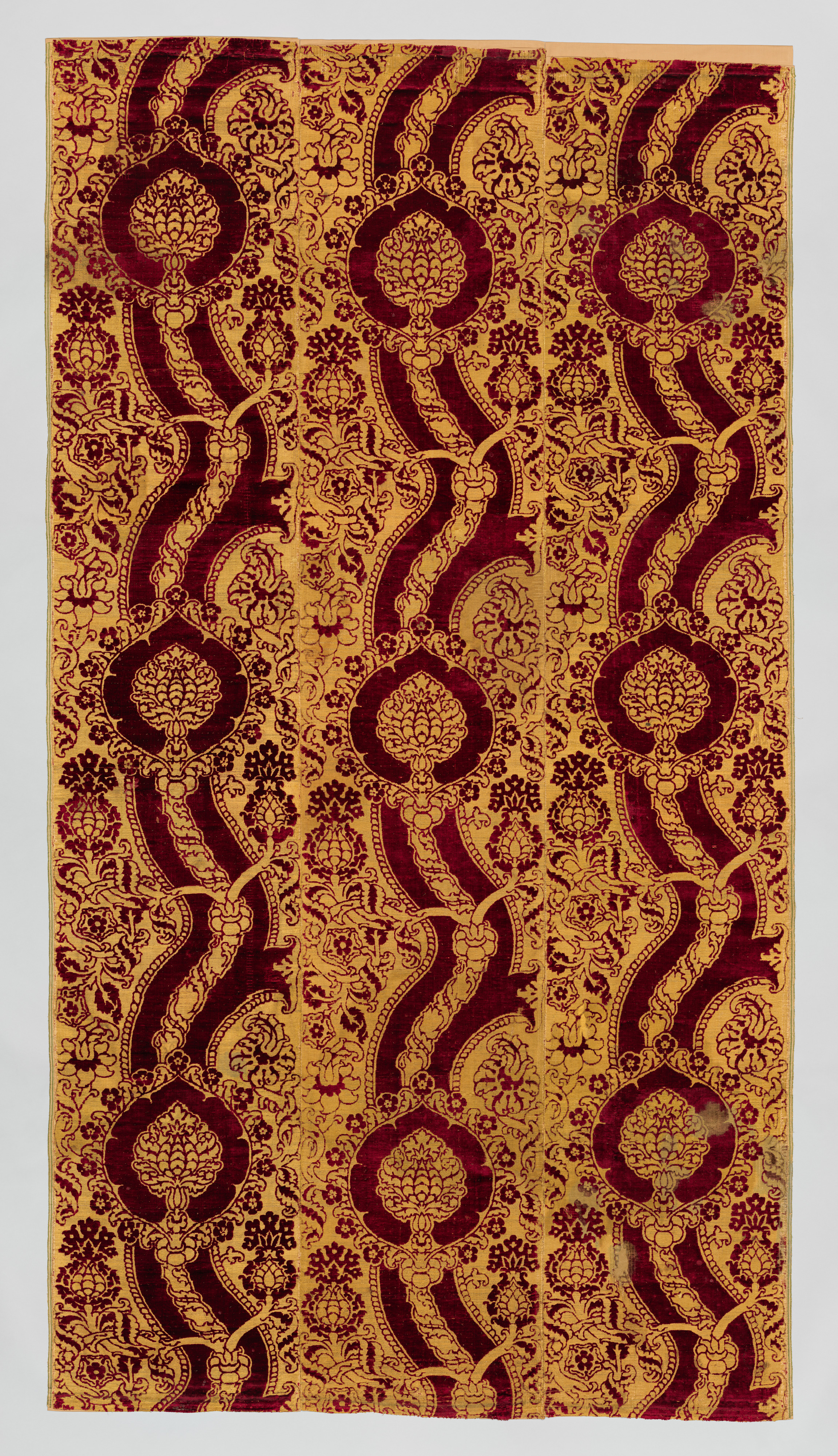
Furnishing Textile as Couture Proposition: A Study in Loom-Width Architecture
The distinction between furnishing textile and couture fabric has always been more institutional than material. What separates them is not fibre, weave, or finish, but the discipline of application: furnishing cloth is engineered to withstand the abrasion of bodies against bodies, light against surface, time against structure. When a furnishing textile is executed at the level of a three-loom-width velvet of cloth of gold with allucciolato effect and bouclé loops of gilded silver metal-wrapped threads, that institutional boundary dissolves. What remains is a study in textile as architecture — a material whose technical ambition and cultural provenance place it at the highest register of the applied arts.
Global Heritage and the Metal-Wrapped Thread Tradition
The use of metal-wrapped threads in furnishing and ceremonial cloth is one of the most persistent continuities in global textile history. From the silk-and-gold lampas of Byzantine and later Ottoman workshops, through the kinran of Japan and the zari brocades of the Indian subcontinent, to the tessuti d'oro of Italian Renaissance workshops and the silver-thread furnishing velvets of Spanish and Portuguese ateliers, the technique travels across geographies without losing its essential logic: a precious metal filament wound around a fibrous core, then woven into a ground cloth to produce luminosity that is structural rather than applied.
This is not gilding. It is not printing, foiling, or any surface treatment that sits atop the cloth. The metal is integrated at the point of interlacing. The cloth's shine is a function of its construction, which means it cannot flake, peel, or delaminate in the way surface finishes do. For furnishing applications, this is a decisive advantage: the textile's most conspicuous aesthetic property is also its most durable one. The global heritage of metal-wrapped weaving is therefore not merely decorative history. It is a technical inheritance that furnishing practice has consistently drawn upon precisely because the demands of the interior — light, wear, gravity, and time — reward construction over coating.
Three Loom Widths and the Architecture of the Cloth
The specification of three loom widths is the most consequential technical fact in this study. A single loom width of velvet, however elaborate, remains a panel. Three loom widths joined or woven as a coordinated set transform the textile into a spatial proposition. The cloth begins to behave less like a covering and more like a surface with its own proportions, seams, and structural rhythm.
In velvet, width is never neutral. The pile imposes directional behaviour: it catches light differently along the warp, shifts in tone with the angle of view, and reveals every join with unusual honesty because the nap direction must be carefully matched across panels. A three-width composition therefore demands that the weaver or the atelier control not only the density and height of the pile but its orientation across the full expanse. Where the widths meet, the allucciolato effect and the bouclé loops must continue without visible interruption in the design logic, even where a seam is physically present. The result is a furnishing textile that reads as a single field of gold while remaining, in its making, a coordinated assembly.
Allucciolato and the Optics of Living Gold
The allucciolato effect — the shimmering, flickering quality associated with certain historic velvets and brocades — is the optical signature of this cloth. In Italian textile vocabulary, the term evokes the restless, darting light of small golden particles moving across a dark or contrasting ground. It is an effect produced by the interaction of metal-wrapped weft, pile structure, and the angle of incidence of light. The cloth does not simply reflect; it scintillates.
In a furnishing context, this quality is transformative. A furnishing velvet of cloth of gold with allucciolato effect is never visually static. As daylight moves across a room, the surface responds — now deep and bronze, now brilliant and almost liquid. The textile becomes a light-modulating element within the interior, comparable in function to a polished stone or a gilded architectural moulding, but softer and more variable. This is where the couture sensibility becomes unmistakable: the cloth is designed to be seen in movement, to reward the eye that passes across it rather than the eye that stares at it head-on.
Bouclé Loops of Gilded Silver Metal-Wrapped Threads
Set against the velvet ground, the bouclé loops of gilded silver metal-wrapped threads introduce a second register of texture. Bouclé is a looped structure: the yarn is not cut but curled back upon itself, creating a surface of small, resilient rings. When the bouclé is itself formed from metal-wrapped thread, the loops become tiny architectural elements — each one a curve of gilded silver that catches light along its outer edge and holds shadow within its interior.
The juxtaposition is deliberate and sophisticated. Velvet pile offers depth and absorption; bouclé loops offer projection and relief. Where the pile softens and deepens the gold, the loops sharpen and articulate it. The cloth thus operates on two optical planes simultaneously: a velvet ground that glows, and a looped superstructure that glints. For furnishing use — upholstery, paneling, drapery — this dual structure provides both visual complexity and tactile variation, the kind of surface that rewards proximity as much as distance.
Couture Logic in a Furnishing Register
What ultimately distinguishes this textile is not any single technique but the integration of all of them under a couture discipline. Three loom widths require compositional control. Allucciolato requires optical control. Bouclé loops of gilded silver require structural control. Each element is demanding in isolation; together they constitute a material whose making is inseparable from its meaning.
In the context of Katherine Fashion Lab, this study stands as a standalone proposition: a furnishing textile that refuses the hierarchy in which couture is precious and furnishing is merely practical. The cloth of gold velvet with allucciolato and bouclé loops of gilded silver is both. It is precious because it is practical — because its beauty is built into its construction, and because its construction is equal to the demands of the interior. That is the highest standard to which any textile can be held, and it is the standard this cloth meets.