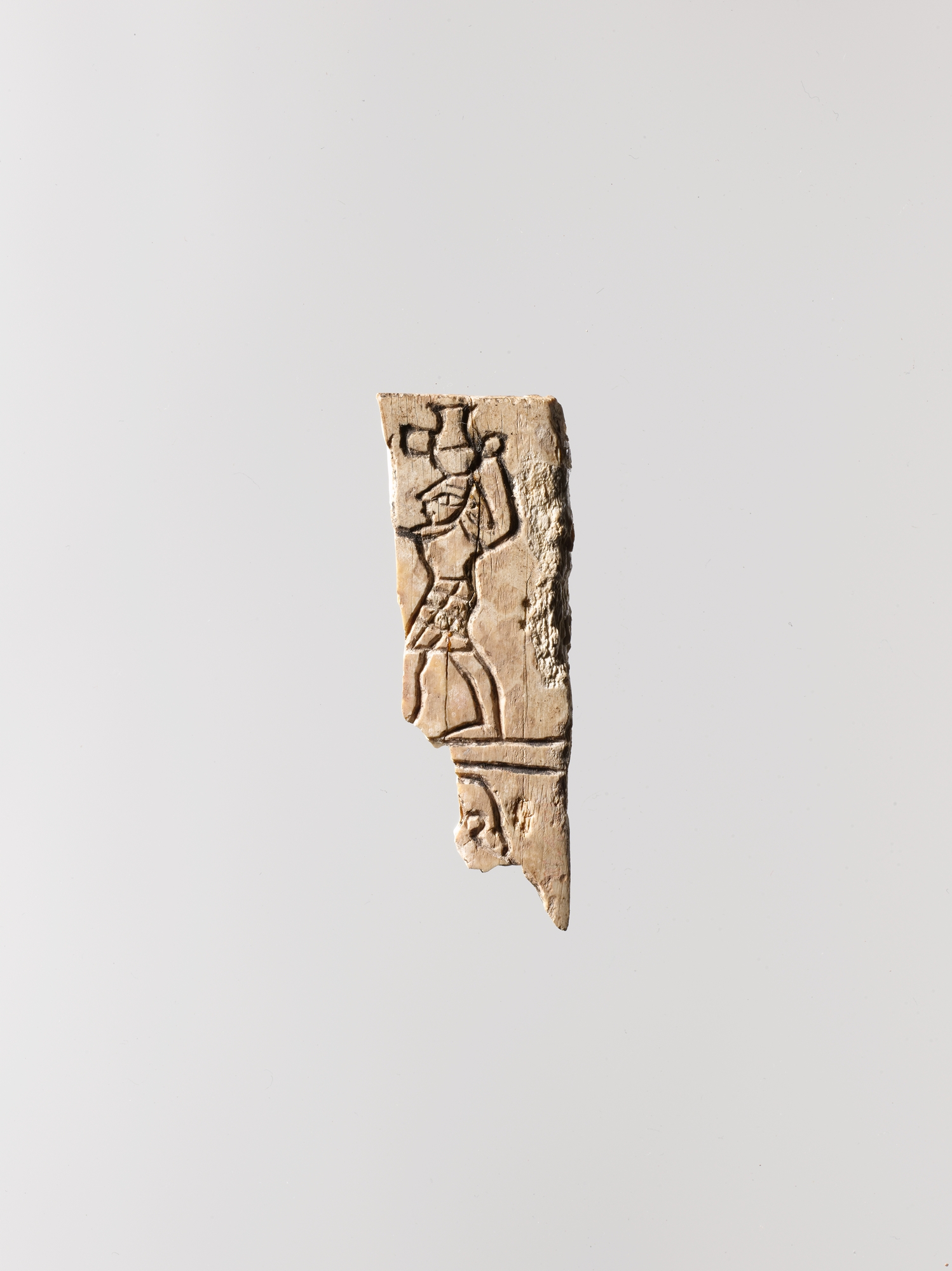
Executive Summary: The Ivory Box Fragment as a Strategic Heritage Asset
Within the competitive landscape of high-end luxury, the acquisition and interpretation of ancient artifacts serve as a critical differentiator for brand authority. At Katherine Fashion Lab, our analysis of the Ivory Box Fragment Illustrating a Royal Servant—originating from an Ancient Civilization and featuring ivory incised with black organic material—reveals a profound intersection of symbolic power, historical adornment, and spiritual continuity. This paper evaluates the artifact's material and iconographic significance, translating its heritage value into a robust strategic framework for the 2026 luxury market.
Materiality and the Aesthetics of Permanence
The fragment’s medium—ivory inlaid with black organic material—represents a sophisticated mastery of contrast and durability. In the context of ancient luxury, ivory was not merely a material; it was a symbol of purity, rarity, and access. The sourcing of ivory required extensive trade networks or specialized hunting expeditions, embedding the object within a supply chain of elite consumption. The use of black organic material (likely bitumen, resin, or darkened wax) within the incisions created a visual language of high contrast, ensuring legibility and dramatic impact.
For Katherine Fashion Lab, this materiality offers a direct blueprint for 2026 product development. The tactile interplay between the smooth, warm ivory surface and the cool, matte black inlay prefigures modern desires for tactile luxury. In an era dominated by digital saturation, the physical weight and texture of such an object assert a reality that virtual goods cannot replicate. Our strategy must leverage this "haptic heritage," emphasizing craftsmanship that requires human touch and irreversible time investment.
Iconography: The Royal Servant as a Vessel of Power
The central subject—the Royal Servant—is a complex semiotic construct. In ancient civilizations, the depiction of a servant was rarely a mere documentation of labor. Instead, it was a projection of the ruler’s omnipotence. The servant existed to serve the sovereign, both in life and in the afterlife. By illustrating the servant on a luxury object, the owner (presumably the royal or elite class) asserted their dominion over human capital.
However, the servant also occupies a liminal space as a trusted intermediary. They are the gatekeepers to the royal presence. From a branding perspective, this figure represents proximity to power. For Katherine Fashion Lab, this translates into the narrative of the "insider." Our clientele does not merely purchase a product; they purchase access to a closed circle of taste and influence. The Royal Servant motif allows us to explore themes of loyalty, service, and the quiet dignity of those who uphold the throne—narratives that resonate with modern consumers who value authenticity and behind-the-scenes craftsmanship over loud logos.
Spiritual Meaning and the Afterlife Economy
The incised black lines are not merely decorative; they are spiritual conduits. In many ancient cultures, the application of dark pigment into carved lines was an act of animation—a ritual that gave the image life. The box itself likely served as a container for precious substances (cosmetics, incense, or amulets) used in ritual or preparation for the afterlife. The servant depicted was therefore a spiritual companion, ensuring the owner’s comfort in the next world.
This spiritual dimension offers a powerful counter-narrative to the secularity of modern luxury. For 2026, Katherine Fashion Lab should position its heritage-inspired collections as objects of secular spirituality. The "box" becomes a metaphor for the self—a vessel that holds one’s identity. The servant becomes the "inner guardian." By integrating this narrative, we address the post-pandemic consumer’s search for meaning and resilience. The luxury object is no longer just a status symbol; it is a talisman of continuity and protection.
Strategic Application: The 2026 Luxury Landscape
To translate this heritage analysis into a commercial strategy for 2026, Katherine Fashion Lab must adopt a three-pronged approach: Narrative Scarcity, Material Innovation, and Ethical Reinterpretation.
1. Narrative Scarcity: The Royal Servant fragment is a standalone piece. We must treat it as the anchor of a "capsule heritage" collection. By limiting production to a numbered series that directly references the fragment’s geometry (rectangular form, incision depth, black-on-white contrast), we create a narrative of exclusivity. The marketing message will focus on the "unbroken chain" from ancient royal courts to the modern wardrobe.
2. Material Innovation: While we cannot and should not use new ivory, we can replicate the visual and tactile effect using bio-fabricated alternatives (e.g., mycelium leather or lab-grown collagen) paired with plant-based black resins. This respects the original aesthetic while aligning with the 2026 regulatory and ethical environment. The "black organic material" becomes a signature of our sustainable inlay technique, branded as "Obsidian Resin."
3. Ethical Reinterpretation: The figure of the Royal Servant must be recontextualized to avoid glorifying subjugation. Instead, we elevate the servant as a symbol of essential labor and artisanal mastery. In our campaign imagery, the "servant" becomes the master craftsman in our atelier. This flips the hierarchy: the hand that serves is the hand that creates value. This aligns with the 2026 consumer’s demand for transparency and social responsibility.
Conclusion: From Fragment to Future
The Ivory Box Fragment Illustrating a Royal Servant is not a relic of a bygone era; it is a strategic asset for the future. It encapsulates the core pillars of luxury: rarity, symbolism, craftsmanship, and spiritual resonance. By dissecting its material composition and iconographic meaning, Katherine Fashion Lab can construct a 2026 strategy that moves beyond mere trend-following. We are not selling bags or garments; we are selling the continuity of human expression—the same impulse that led an ancient artisan to carve a servant into ivory is the impulse that drives our modern design. In the crowded luxury market, only those who can authentically bridge this temporal divide will command enduring loyalty and premium positioning.