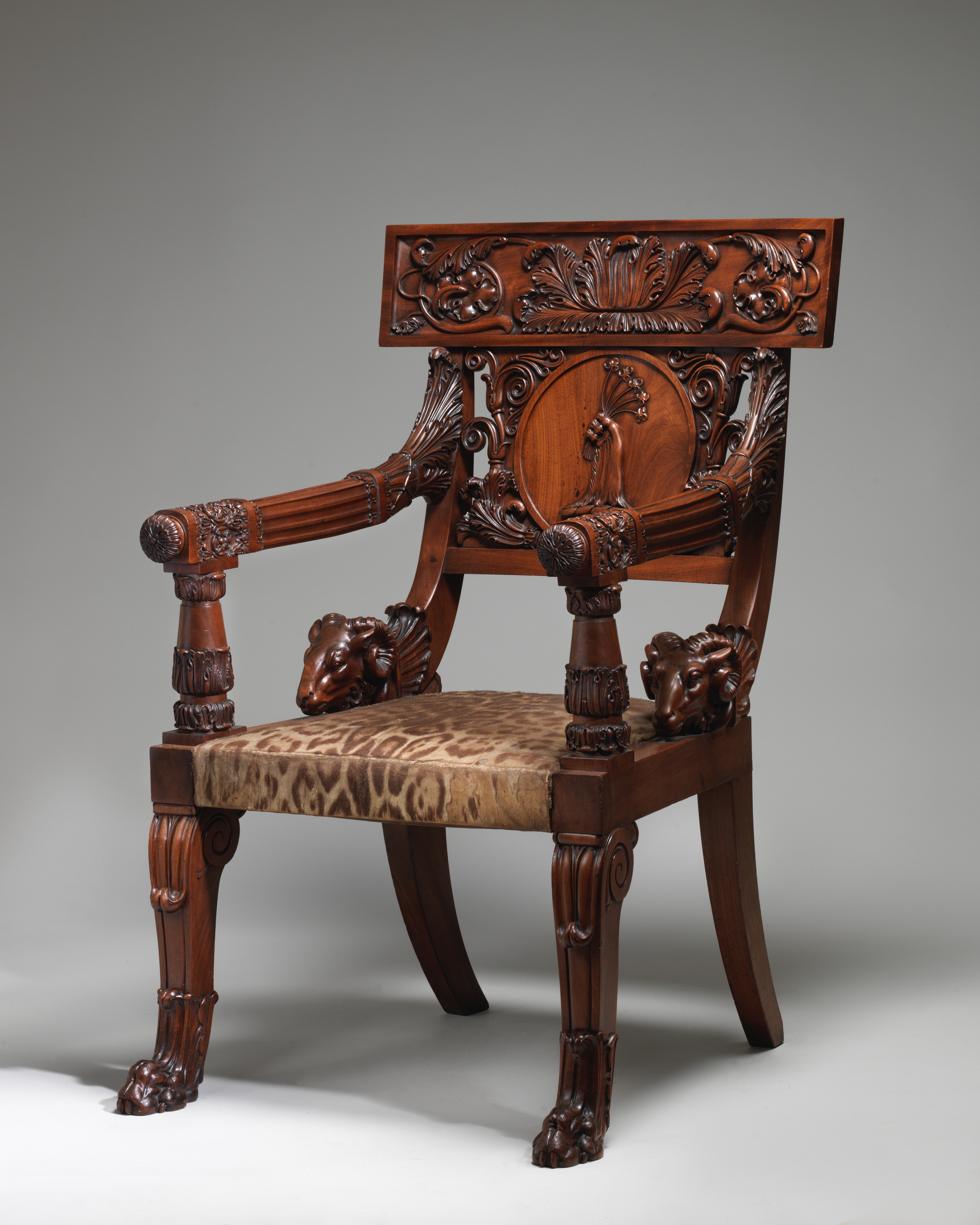
Object Analysis: The Global Heritage Armchair as a Study in Material Hybridity
Within the collecting categories of Katherine Fashion Lab, few objects reward sustained scrutiny quite like the armchair here examined—a single, standalone seat drawn from a dispersed suite of furniture, catalogued under the designation Global Heritage, and executed in solid mahogany with leopard-skin upholstery original to the chair. The piece occupies an unusual position in the decorative arts hierarchy. It is neither an anonymous vernacular object nor a documented masterpiece with a secure workshop attribution; it is, instead, a hybrid, and its hybridity is precisely what makes it legible as a cultural document. This analysis situates the chair within the intersecting histories of colonial timber extraction, transcontinental upholstery trade, and the twentieth-century interior as a theater of status.
Material Grammar: Mahogany as Ideological Substrate
The armchair's frame belongs to the great family of Swietenia mahoganies whose commercial harvesting began in the Caribbean basin and later extended to West Africa and South Asia. Mahogany's prestige in cabinetmaking rests on properties that are simultaneously physical and rhetorical: fine, close grain; dimensional stability; a density that accepts crisply carved detail; and a deep reddish-brown heartwood that takes polish with an almost liquid depth. These qualities made it the preferred medium for the eighteenth- and nineteenth-century Anglophone furniture trade, and their persistence into later revivals ensured that mahogany remained a signifier of permanence and inherited authority long after walnut and satinwood had their fashionable moments.
What matters for our reading is that mahogany is never merely a wood. Its extraction maps onto systems of labor and land dispossession; its trade routes trace the movement of empire; its survival in a chair such as this one encodes a claim to generational continuity. The frame's joinery—whether hand-cut mortise-and-tenon or a later machine-assisted variant—tells us something about workshop scale, but the material itself tells us about aspiration. A mahogany armchair announces that its owner intended to be remembered.
Surface as Archive: The Original Leopard-Skin Upholstery
The decisive feature of this object is its upholstery: leopard skin, original to the chair. The qualifier "original" carries enormous weight in condition assessment and equally enormous weight in interpretation. Original upholstery transforms a piece of furniture from a frame awaiting period-appropriate dressing into a sealed evidentiary package. The hide's presence allows us to date the chair's completion, to infer the taste of its commissioning patron, and to read the global supply chains that placed an African or Asian spotted pelt on a Caribbean- or continentally-derived hardwood frame.
Leopard skin in the decorative interior belongs to a specific visual vocabulary of power. Unlike the more restrained use of hide in sporting or library furniture, spotted pelts carry connotations of the hunt, of the trophy, of the exotic rendered domestic. In the mid-twentieth-century interior—particularly in the Hollywood Regency, safari, and later "bachelor pad" idioms—leopard became a shorthand for cosmopolitan daring, a fabric that signaled that its owner moved between worlds. Yet the material's history is inseparable from colonial game economies, from the regulation of big-cat hunting, and from the eventual CITES prohibitions that make such upholstery effectively irreplaceable today. The chair therefore sits at a moral and aesthetic intersection: it is beautiful, and it is compromised, and both facts must be held simultaneously.
Form, Function, and the Standalone Condition
Because the chair is presented as a standalone study rather than as part of an intact suite, we must resist the temptation to imagine its missing companions too vividly. A single armchair invites the viewer to treat it as sculpture—to circulate around it, to inspect the profile of its arms, the rake of its back, the articulation of its crest rail. This solitary presentation has an unintended benefit: it forces attention onto the object's own internal logic rather than onto the rhythm of a matching set. The mahogany frame's silhouette, likely derived from a Georgian or Regency prototype with later inflections, reads more clearly in isolation. So does the upholstery's pattern, whose irregular rosettes and irregular wear create a surface that no two viewers will parse identically.
The chair's function is, of course, seating—but its cultural function is display. An armchair of this type was never merely a place to rest; it was a stage for the sitter, a frame for the body. The leopard skin amplifies that theatricality. To sit in it is to participate in a performance of worldliness, however uncomfortable that performance may now feel.
Provenance, Ethics, and the Curatorial Position
Any serious treatment of this object must address provenance. Where did the mahogany originate? Which workshop assembled the frame? Who supplied the hide, and under what legal regime? These questions are not pedantic; they determine the chair's market status, its insurability, and its ethical standing. Original leopard upholstery on a vintage chair is generally grandfathered under most wildlife-trade regulations, but the burden of documentation falls on the owner. For Katherine Fashion Lab, the responsible position is to present the chair with full transparency: as a document of global material exchange, as an object of genuine aesthetic merit, and as a reminder that beauty and extraction have often been inseparable.
Conclusion: The Chair as Composite Text
The Global Heritage armchair is best understood not as a single object but as a composite text. Its mahogany frame speaks of forests, labor, and empire. Its leopard-skin upholstery speaks of hunting, display, and the exoticized interior. Its standalone condition speaks of dispersal and of the modern collector's willingness to prize the fragment. Read together, these layers produce an object that is more instructive than many a more "important" piece. It teaches us that furniture is never neutral, that materials carry histories, and that the most revealing objects are often those that refuse to resolve into a single, comfortable meaning. In the Katherine Fashion Lab collection, it functions as a case study in exactly that discomfort—and in the analytical pleasure that comes from taking it seriously.