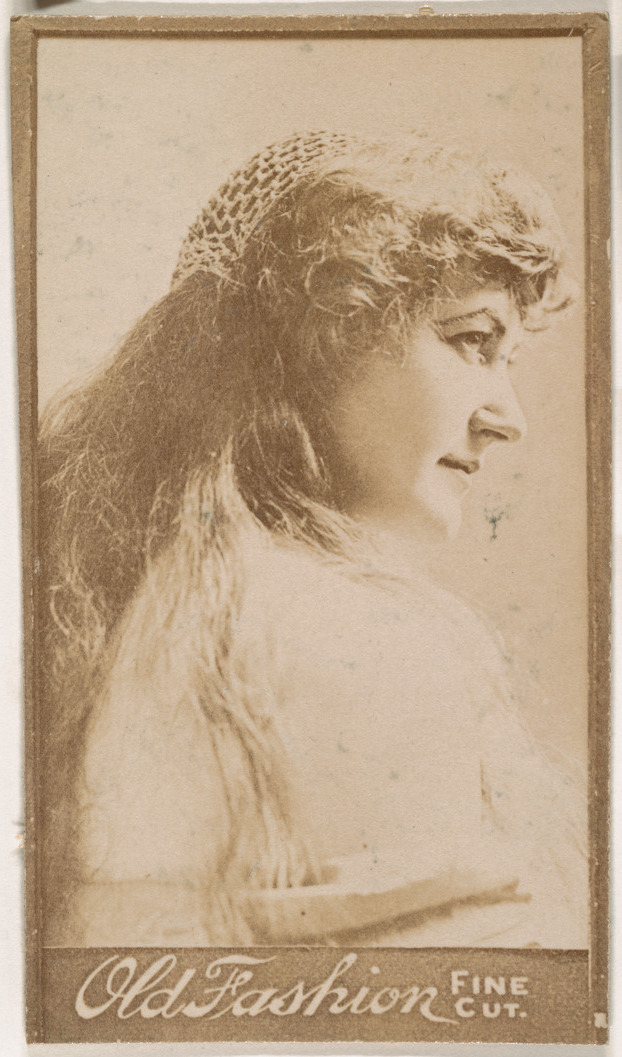
The Actress in Profile: A Couture Reading of the N664 Old Fashion Fine Cut Tobacco Card
Within the vast and often under-theorized corpus of nineteenth-century trade cards, the Actresses series (N664), issued to promote Old Fashion Fine Cut Tobacco, occupies a deceptively modest position. Yet the standalone albumen photograph under examination here—a profile portrait of an unnamed actress—merits the kind of sustained couture analysis typically reserved for museum-held garments. This cabinet-sized artifact is not merely ephemera. It is a compressed record of sartorial semiotics, commercial patronage, and the emerging celebrity economy of the late Victorian period. For Katherine Fashion Lab, reading such an object through the lens of dress history reveals how fashion circulated beyond the atelier and into the pockets of ordinary consumers.
The Albumem Surface as Material Witness
The albumen photograph, dominant from roughly 1855 to 1895, was the first commercially viable photographic medium to achieve mass distribution. Its chemistry—paper coated with egg white and sensitized with silver salts—produced a glossy, warm-toned image capable of rendering fine detail with remarkable fidelity. In the context of the N664 series, this material choice was not incidental. Albumen's tonal range flattered the textures of silk, lace, and jet beading, allowing the viewer to perceive the weight and drape of the actress's costume even at a scale of a few inches.
What the albumen surface captures, therefore, is a double performance: the actress performs her role, and her wardrobe performs social aspiration. The slight sheen of the print mimics the sheen of the fabrics it depicts, collapsing the distance between representation and material reality. For the modern couture analyst, this is a crucial insight. Fashion photography did not begin with Vogue; it began with trade cards like these, where the medium itself was engineered to sell both tobacco and taste.
Profile as Couture Convention
The choice of a strict profile view is far from arbitrary. In nineteenth-century portraiture, the profile carried specific associations: classical coinage, aristocratic lineage, and—critically for the actress—the theatrical convention of the "teacup" pose, in which the performer's face was turned to display the line of the jaw and the architecture of the coiffure. By presenting the actress in profile, the N664 series subordinates facial expression to silhouette. The result is a study in contour, and contour is the couturier's primary language.
We can read the profile as a series of tailored decisions. The hair is swept upward and back, likely augmented with false switches or a postiche, creating a vertical line that elongates the neck. The neckline, whether a high collar or a modest décolletage, is calibrated to frame that line rather than interrupt it. The shoulder seam—often dropped or slightly extended in 1880s and 1890s bodices—is visible as a subtle ridge, evidence of a garment constructed to accommodate the corseted torso beneath. Even the earring, if present, functions as a punctuation mark, a jeweled full stop at the end of the profile's sentence.
Dress as Commercial and Cultural Currency
Old Fashion Fine Cut Tobacco was not a luxury brand aimed at the elite. Its market was the working and middle-class male consumer, the kind of man who might keep a trade card in his waistcoat pocket or paste it into an album. The actress on the card thus served a dual purpose: she was a pin-up before the term existed, and she was a style manual for the women in that consumer's life. The gown she wears—likely a simplified version of a Parisian or London model—translated high fashion into a vernacular that could be approximated by a local dressmaker.
This is where the couture analysis becomes economic. The N664 series participated in what we might call the democratization of the silhouette. By circulating hundreds of distinct actress portraits, each with subtly different bodices, sleeves, and trimmings, the tobacco company created a visual archive of trend variation. A consumer could compare a leg-of-mutton sleeve on one card with a more restrained gigot on another, effectively tracking the evolution of fashion across a single season. The cards were, in essence, a serialized lookbook.
The Actress as Brand Ambassador
It is essential to note that these actresses were not necessarily famous in the modern sense. Many were jobbing performers whose names have been lost to history. Their anonymity is precisely what makes the N664 series valuable to fashion historians. Unlike a portrait of Sarah Bernhardt or Ellen Terry, which would be read through the lens of individual stardom, this profile invites us to read the garment itself. The actress becomes a mannequin, a neutral support for the costume. Her body is the hanger; her posture is the display mechanism.
Yet this erasure is also a form of power. By lending her image to a commercial product, the actress participated in the early machinery of celebrity endorsement. She may not have received a fee beyond the original sitting, but she received circulation. Her face, her hair, her dress traveled further than any stage tour could carry them. In this sense, the trade card was a proto-influencer artifact, and the actress was its first micro-celebrity.
Conclusion: The Standalone Study as Method
To treat a single N664 card as a standalone study is to resist the temptation to reduce it to a footnote in tobacco history or photographic ephemera. Instead, we position it at the intersection of dress history, media archaeology, and consumer culture. The albumen surface preserves a fleeting moment of sartorial aspiration. The profile format distills fashion into its most legible form: line, proportion, and silhouette. And the commercial context reminds us that couture has always relied on mass mediation to achieve cultural currency.
For Katherine Fashion Lab, the lesson is clear. Fashion does not live only in the atelier or the runway. It lives in the pocket, the album, the cigarette card. The actress in profile—unnamed, unheralded, and exquisitely dressed—is a testament to the fact that style, at its most influential, is always a form of circulation.