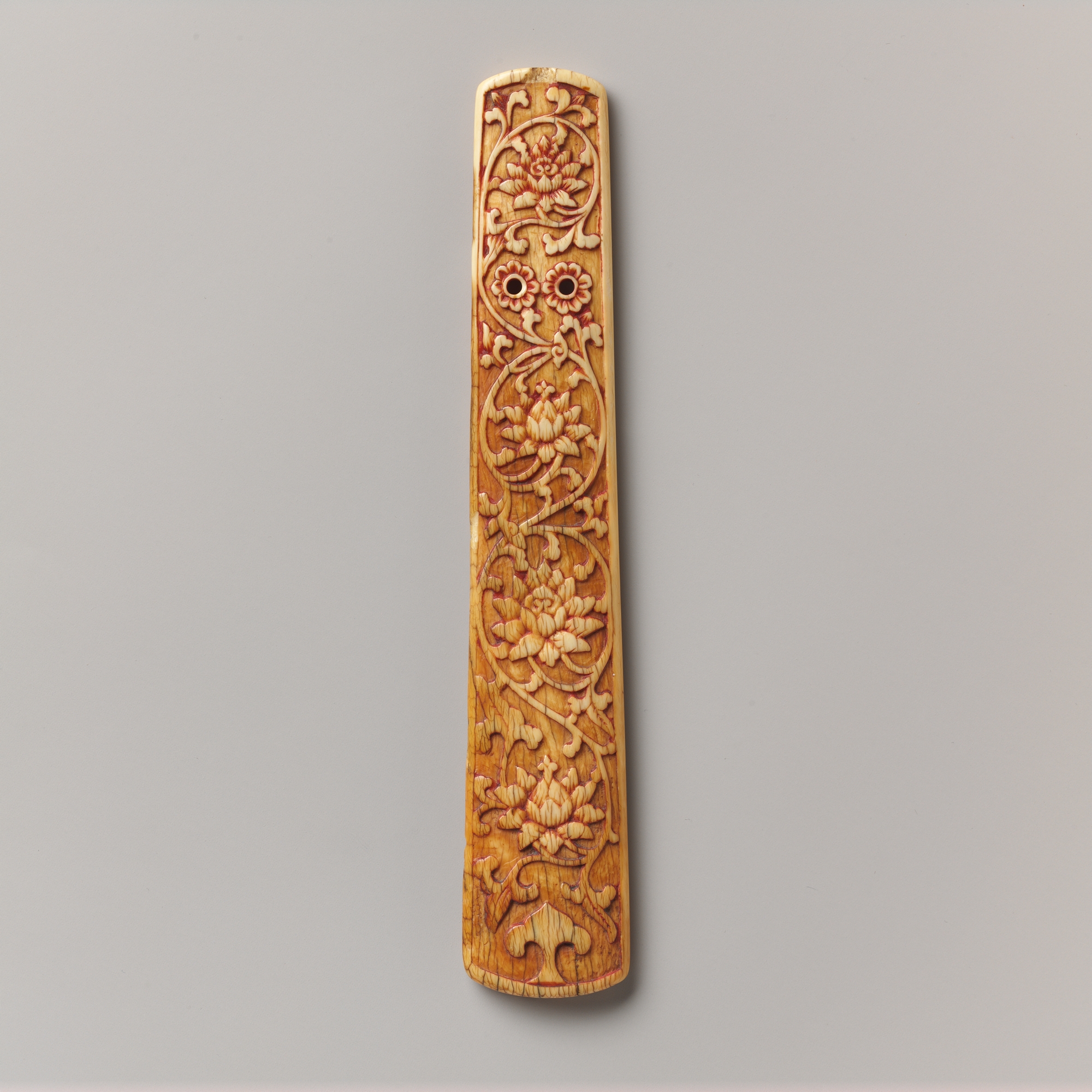
Heritage Asset Analysis: Section of a Clapper (Paiban), China
Object Overview and Materiality
The object under examination—a carved ivory section of a paiban (拍板), or Chinese clapper—represents a rarefied intersection of musical function, material prestige, and ritual authority. The paiban is traditionally a percussion instrument constructed from several hardwood or ivory slats bound at one end by a silk cord, struck to mark rhythmic structure in Chinese opera, court music, and Buddhist and Daoist liturgical chant. The section in question, carved from ivory, signals that this was not a utilitarian folk instrument but a commission reserved for elite performance contexts: imperial entertainment troupes, aristocratic private theatres, or high-ranking monastic ensembles. Within the Katherine Fashion Lab heritage framework, this object is classified as a strategic standalone asset—a singular artifact whose symbolic density exceeds its physical scale and whose narrative can anchor a discrete luxury proposition without reliance on broader collection thematics.
Symbolic Power: Rhythm as Cosmological Order
In Chinese classical thought, music was never merely aesthetic; it was a technology of governance and cosmic alignment. The Liji (Book of Rites) codifies the doctrine that proper music harmonizes the state, while disordered music presages dynastic decline. The paiban, as the instrument that initiates and punctuates musical time, therefore occupies a position of unusual symbolic leverage. To strike the clapper is to impose order upon sound—an act that mirrors the emperor's imposition of order upon the realm. The ivory medium intensifies this reading: ivory was historically associated with purity, endurance, and the refined sensibility of the literati, and its importation from Southeast Asia or Africa positioned it within tributary and trade networks that signified cosmopolitan reach. A carved ivory paiban section thus encodes three tiers of power simultaneously: temporal authority (the marking of time), spiritual authority (the orchestration of ritual), and material authority (access to rare and ethically complex luxury resources).
Historical Adornment and the Aesthetics of Restraint
Unlike the densely ornamented surfaces of Chinese jewelry or textile arts, the paiban's decorative program is characteristically restrained. Carving on ivory clappers typically favors low-relief motifs—cloud scrolls, ruyi heads, lotus petals, or stylized dragon scales—concentrated at the binding end or along the slat edges. This restraint is itself a statement of taste. In the Ming and Qing aesthetic hierarchies, the concealment of labor distinguished the truly refined object from the merely expensive one. A paiban whose ivory was selected for uniform grain, whose cord was silk of a specific dyed hue, and whose carving was executed with a jeweler's precision communicated that its owner possessed not only wealth but discernment. For Katherine Fashion Lab, this principle translates directly into a design ethic: luxury as the visible discipline of invisible effort.
Spiritual Meaning: The Clapper in Buddhist and Daoist Practice
The paiban's spiritual resonance extends beyond courtly contexts. In Buddhist monastic chant, the clapper regulates the tempo of sutra recitation, ensuring that dozens or hundreds of voices remain synchronized—a sonic metaphor for the sangha's unity. In Daoist ritual, percussion instruments including the paiban are understood to summon deities and structure the jiao (offering) ceremonies. The ivory slat, when struck, produces a sharp, dry, penetrating tone that cuts through ambient sound—an acoustic signature of awakening and attention. This semantic layer is strategically valuable: it positions the object not as a passive antique but as an active instrument of consciousness, a physical device for producing presence. In a 2026 luxury landscape saturated with mindfulness branding, an artifact that has genuinely regulated contemplative practice for centuries offers authenticity that no invented wellness narrative can replicate.
2026 Luxury Strategy: From Artifact to Proposition
Positioning the ivory paiban section within Katherine Fashion Lab's 2026 portfolio requires confronting the material's contemporary sensitivity. Ivory trade restrictions under CITES and evolving consumer ethics render any new ivory production untenable; however, certified antique ivory with documented provenance occupies a distinct legal and narrative category. The strategic recommendation is threefold.
First, narrative encapsulation. The paiban should be presented as an instrument of order—a heritage object whose function was to synchronize, harmonize, and awaken. This framing supports a capsule collection or high-jewelry line organized around the concept of measured time: pieces that incorporate rhythm, repetition, and cadence into their design language, perhaps through articulated links or graduated beadwork that echoes the clapper's slats.
Second, provenance as product. The object's value is inseparable from its chain of custody. Investment in forensic documentation—material analysis, archival research, and where possible, association with named performance traditions—converts the artifact into a verifiable heritage asset. In the 2026 market, provenance is not a footnote but a primary luxury attribute, and Katherine Fashion Lab should treat documentation as a design deliverable.
Third, ethical substitution. For any wearable or scalable product derived from this research, the lab should specify alternative materials—sustainably sourced tagua, bone, or engineered composites—that replicate the paiban's acoustic and tactile properties without invoking ivory's ecological cost. The heritage object remains the intellectual source; the commercial expression becomes an ethical translation. This dual-track approach protects brand equity while honoring the artifact's integrity.
Conclusion
The ivory paiban section is a compact but extraordinarily dense heritage asset. It carries the symbolic weight of cosmological order, the aesthetic discipline of Chinese elite craft, the spiritual function of ritual synchronization, and the material prestige of a contested luxury resource. For Katherine Fashion Lab, its highest value lies not in replication but in translation: extracting the principles of rhythm, restraint, and awakening, and re-encoding them into a 2026 luxury language that is legally defensible, ethically coherent, and narratively unmatched. The clapper's true sound is the sound of time being ordered—and that, in luxury terms, is the sound of enduring value.