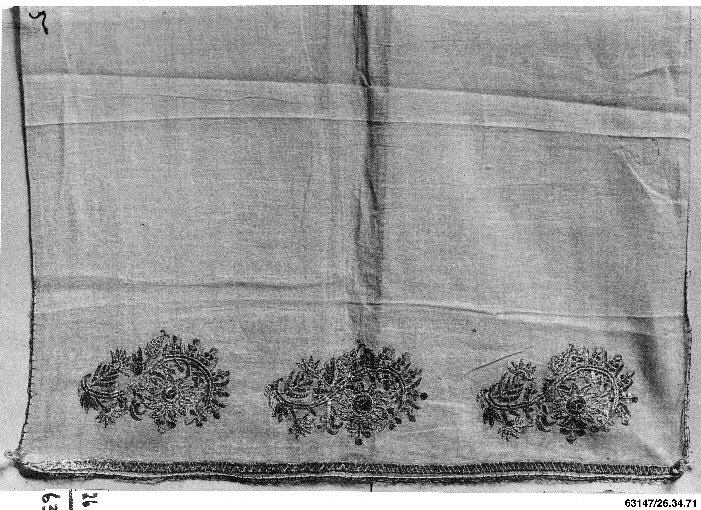
Heritage Asset Analysis: The Embroidered Scarf of Ancient Civilization
Executive Summary
This report examines the scarf as a heritage asset originating in Ancient Civilization, executed in cotton and metal-wrapped thread with embroidery. The analysis positions this artifact within the strategic framework of Katherine Fashion Lab's 2026 luxury portfolio, evaluating its symbolic power, historical function as adornment, spiritual meaning, and commercial viability. The central thesis is that the embroidered scarf represents an underleveraged heritage category capable of anchoring a high-margin, narrative-driven product line that reconciles archaic craftsmanship with contemporary luxury demand.
Historical Context and Material Composition
The scarf's material identity—cotton as the structural ground and metal-wrapped thread as the ornamental surface—reflects a deliberate hierarchy of value embedded in Ancient Civilization textile production. Cotton provided breathability, drape, and accessibility, while metal-wrapped thread (typically silver or gold beaten around a silk or linen core) introduced luminosity, weight, and status. This duality is not incidental; it is a strategic encoding of social stratification. The wearer communicated rank not through the garment's cut, which remained functionally simple, but through the density, placement, and reflectivity of embroidery.
Embroidery in this context functioned as a slow luxury technology. Each stitch represented invested labor hours, and metal-wrapped thread demanded specialized handling to prevent fracturing. The scarf was therefore never a disposable accessory; it was a transferable asset, often bequeathed, repaired, and re-embroidered across generations. This longevity contrasts sharply with contemporary fast-fashion scarves, whose value depreciates upon first wear.
Symbolic Power: Adornment as Communication
In Ancient Civilization, the scarf operated as a non-verbal communication device. Its placement—draped over the shoulder, wrapped around the head, or bound at the waist—signaled marital status, tribal affiliation, religious devotion, or ceremonial role. Metal-wrapped embroidery amplified these signals through reflected light, making the wearer visible in dim temple interiors and outdoor processions alike. The scarf was thus both a private object of devotion and a public declaration of identity.
The symbolic vocabulary of the embroidery itself warrants strategic attention. Recurring motifs—interlocking waves, stylized flora, geometric guardians—were not decorative flourishes but compressed narratives. A single border of metal thread could encode a lineage, a protective invocation, or a trade route. For Katherine Fashion Lab, this presents a narrative density that modern branding rarely achieves. A contemporary scarf with a single embroidered motif can be marketed as a portable archive, carrying meaning that transcends seasonal trend cycles.
Spiritual Meaning and Ritual Function
The spiritual dimension of the embroidered scarf is perhaps its most commercially sensitive asset. In Ancient Civilization, textiles were frequently understood as intermediaries between the human and the divine. The scarf, worn close to the skin and often over the head or heart, was believed to absorb and transmit blessings. Metal-wrapped thread, with its incorruptible and luminous properties, was reserved for ritual contexts: temple offerings, burial rites, and initiation ceremonies.
This spiritual charge creates a premium positioning opportunity. In the 2026 luxury landscape, consumers increasingly seek objects of meaning rather than mere status markers. A scarf that references ancient ritual function—without appropriating specific sacred iconography—can satisfy this demand through abstracted spiritual symbolism: a border of continuous knots representing protection, a central medallion representing cosmic order. The key is to maintain respectful distance from living traditions while leveraging the universal human need for talismanic objects.
2026 Luxury Strategy: From Artifact to Asset Class
Katherine Fashion Lab's 2026 strategy should position the embroidered scarf not as a seasonal accessory but as a collectible heritage asset. Three strategic pillars emerge from this analysis.
First, material authenticity as differentiation. The combination of cotton and metal-wrapped thread is currently underexploited in high-end accessories. While silk and cashmere dominate, a cotton-ground, metal-embroidered scarf offers tactile novelty and a compelling origin story. The metal thread should be sourced from heritage mills capable of producing real silver-gilt or gold-wrapped filaments, ensuring that the object's material value is legible to connoisseurs.
Second, narrative scarcity. Each scarf should be accompanied by a documented provenance card detailing the historical motif, the embroidery technique, and the specific ancient reference. This transforms the scarf into a knowledge object, appealing to the same consumer segment that invests in limited-edition art books and archival fashion. Production should be capped—not artificially, but by the genuine capacity of metal-thread embroiderers, whose numbers are declining globally.
Third, ritual recontextualization. Marketing should emphasize the act of wearing as a deliberate, almost ceremonial gesture. A scarf that requires careful folding, that catches light in specific ways, and that carries encoded symbolism invites slow consumption. This aligns with the 2026 luxury consumer's rejection of algorithmic trend cycles in favor of objects that accumulate meaning over time.
Risk Assessment and Mitigation
The primary risk is cultural misrepresentation. Ancient Civilization is not a monolith, and the scarf's symbolic vocabulary varied by region, era, and social class. Katherine Fashion Lab must avoid flattening this complexity into a single aesthetic. Mitigation requires collaboration with textile historians and, where possible, direct partnerships with descendant communities or regional craft authorities. The goal is not replication but respectful translation—a 2026 scarf that acknowledges its ancient lineage without claiming to be an authentic artifact.
A secondary risk is price resistance. Metal-wrapped thread embroidery is labor-intensive, and the final product will necessarily occupy a high price tier. This risk is mitigated by the asset-class framing: the scarf should be presented as a store of value, comparable to fine jewelry, with a documented resale market and a lifetime repair guarantee. Katherine Fashion Lab can further de-risk by offering a tiered collection: a cotton-and-metal flagship scarf, a cotton-only diffusion version with printed (not embroidered) motifs, and a bespoke commission service.
Conclusion
The embroidered scarf of Ancient Civilization is not a nostalgic curiosity. It is a strategic heritage asset whose symbolic power, material sophistication, and spiritual resonance align precisely with the 2026 luxury market's demand for meaning, scarcity, and longevity. Katherine Fashion Lab should proceed with a research-driven, culturally rigorous, and commercially disciplined development program. The scarf is not merely a product to be sold; it is a civilizational technology of adornment to be responsibly reintroduced. Executed correctly, it can anchor a multi-year heritage collection and establish the Lab as a credible steward of ancient textile intelligence.