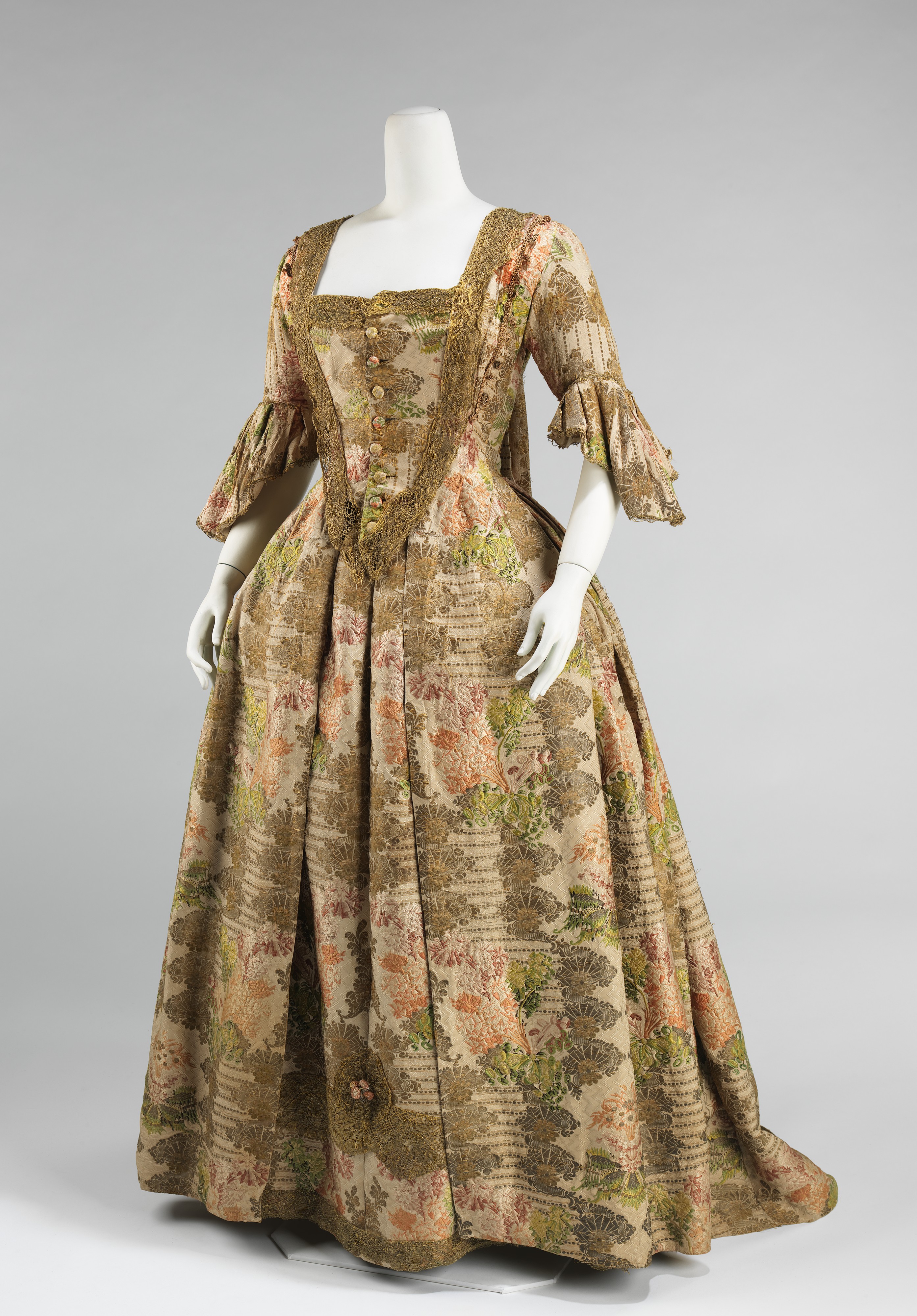
The Robe à la française: A Calculus of Silk, Metal, and Social Architecture
The robe à la française—the "French gown" or sack-back gown—stands as one of the most technically demanding and symbolically dense garments in the history of European couture. Flourishing from roughly the 1720s through the 1780s, it represented not merely a style of dress but a complete system of social signaling, artisanal coordination, and material philosophy. For Katherine Fashion Lab, the robe à la française is not a historical curiosity; it is a case study in how a single garment can encode the shared DNA of civilization—where silk and metal, craft and commerce, intimacy and spectacle converge.
Anatomy of a Constructed Silhouette
At its structural core, the robe à la française is defined by its back pleats—the so-called plis Watteau—which fall loosely from the shoulders to the floor, creating a fluid, uninterrupted cascade of fabric. Unlike the robe à l'anglaise, which fitted the torso closely, the française allowed a controlled volume that suggested both ease and opulence. The bodice, or corps, was stiffened with whalebone or metal stays, while the panniers—side hoops made of cane, whalebone, or metal wire—extended the hips laterally, sometimes to widths exceeding five feet.
This was not accidental geometry. The panniers created a visual horizon that made the wearer a moving architectural event. At court, where the robe à la française was de rigueur, the silhouette functioned as a spatial claim: the wearer occupied more room, literally and symbolically. The metal within the panniers—often iron or steel wire—was hidden, yet it determined the entire read of the garment. This is a crucial point for our archive: the most consequential materials are frequently the least visible.
Silk as Medium, Metal as Skeleton
The primary fabric was almost invariably silk—brocaded, damasked, or plain—woven in Lyon, Spitalfields, or Tours. Silk's tensile strength and lustrous drape made it uniquely suited to the robe à la française's requirement for both structure and flow. A single gown could consume fifteen to twenty meters of silk, often hand-woven with metallic threads of silver or gold. Here, the metal reappears—not as infrastructure but as surface. Filé and frisé metallic yarns, wrapped around silk cores, gave the fabric a shimmer that shifted with candlelight, making the wearer a living chandelier.
This dual role of metal—structural armature and decorative sheen—is the robe à la française's most sophisticated material argument. The same civilization that refined steel for corsetry also refined silver for brocade. The garment is thus a metallurgical as well as a textile artifact.
Shared DNA with the Archive: Objects, Paintings, and Cross-Cultural Witness
Our archive context reminds us that in the long river of human civilization, objects and paintings are not merely crystallizations of technical skill but silent witnesses to cultural collision and aesthetic fusion. The sixteenth and seventeenth centuries—the centuries immediately preceding the robe à la française's ascendancy—were precisely such a period of collision. European merchants and missionaries moved through the Ottoman Empire, Persia, India, and China, carrying silks and metals in both directions. The shared DNA is evident: Chinese sericulture informed European silk production; Persian metalwork influenced European wire-drawing; Indian chintz and Japanese kimono construction left traces in European dress reform.
The robe à la française, therefore, is not a purely French invention. It is a composite artifact. Its silk may have been Italian or French, but the mulberry silkworm came from China. Its metal wire may have been drawn in Nuremberg, but the technique traveled from the East. Its panniers echo the farthingale, which itself borrowed from Spanish and possibly Ottoman prototypes. To study this gown is to study a network, not a nation.
Wearing and Meaning: The Social Metal
Beyond the literal metal, the robe à la française carried a social metal—the stiff, unyielding rules of court etiquette. At Versailles, the grand habit and the robe à la française were not optional; they were regulatory. The width of panniers, the length of trains, the richness of metallic embroidery—all were calibrated to rank. A duchess could wear wider hoops than a baroness. A king's mistress could outshine a princess. The gown was a ledger of status, written in silk and wire.
Yet it also allowed for subversion. The négligée version, with softer pleats and less rigid panniers, signaled intimacy and private life. The pet-en-l'air, a shorter jacket version, suggested informality. Even within a rigid system, the robe à la française offered a grammar of nuance. This is the couture lesson for Katherine Fashion Lab: constraint and creativity are not opposites; they are collaborators.
Legacy and Contemporary Reading
By the 1780s, the robe à la française was yielding to the simpler chemise à la reine and eventually to neoclassical directoire gowns. The French Revolution rendered its courtly excess politically suspect. Yet its DNA persists. The sack-back silhouette reappears in nineteenth-century evening gowns, in Charles James's architectural ball gowns, in Alexander McQueen's metal-boned corsets, and in Rei Kawakubo's sculptural volumes. The robe à la française taught couture that the body is a site of construction, and that silk and metal can collaborate to produce meaning.
For our archive, the robe à la française is a threshold object. It stands at the intersection of East and West, of craft and industry, of intimacy and spectacle. It reminds us that every garment is a compressed civilization—and that to analyze it is to read the long river of human exchange, one pleat, one wire, one shimmering thread at a time.