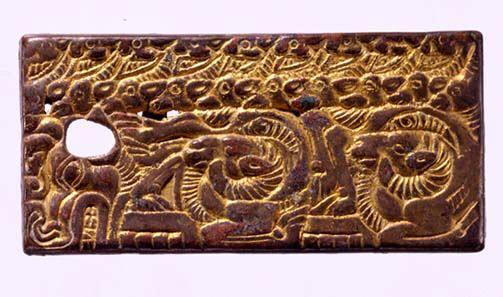
Executive Summary: The Belt Buckle with Zoomorphic Design as a Strategic Heritage Asset
Within the competitive landscape of global luxury, Katherine Fashion Lab recognizes that sustainable differentiation increasingly derives from authenticated cultural provenance rather than ephemeral trend cycles. The Belt Buckle with Zoomorphic Design, originating from North China and executed in gilded bronze, represents a strategically significant artifact class. This analysis examines the object's symbolic power, historical function as adornment, spiritual meaning, and its translation into a viable 2026 high-end luxury strategy. The central thesis is that this artifact embodies a pre-modern model of functional sovereignty—where utility, status, and cosmology are inseparable—offering a blueprint for luxury goods that resist commodification.
Historical Adornment and the Semiotics of Gilded Bronze
In the material culture of North China, particularly during the Eastern Zhou and subsequent Han periods, the belt buckle (often termed a daigou or related harness fitting) was not a peripheral accessory. It was a structural component of the warrior-aristocrat's identity. Gilded bronze—a base of copper alloy overlaid with gold amalgam—signaled both material scarcity and technological mastery. The gold surface was not merely decorative; it acted as a mirror of solar radiance, associating the wearer with celestial authority. Unlike the mass-produced buckles of later dynasties, these zoomorphic examples were cast using the lost-wax method, ensuring each piece retained a unique fingerprint of the mold. For Katherine Fashion Lab, this historical fact is commercially instructive: the original luxury proposition was built on irreproducible craft and material hierarchy, principles that remain central to the 2026 high-end market's resistance to algorithmic sameness.
The zoomorphic design itself—typically depicting wolves, tigers, or composite beasts in profile or interlace—served a dual function. On a literal level, the animal form provided a grip and visual anchor for the leather belt, which was essential for mounted archery and chariot warfare. On a symbolic level, the animal was a totem of transferred power. Wearing a wolf buckle did not merely reference the wolf; it enacted a claim to the wolf's predatory acuity and pack loyalty. This is a critical distinction for luxury strategy: the artifact was not representational but performative. The wearer became the beast in the eyes of the beholder. Modern luxury brands often lose this performative dimension, reducing heritage to surface pattern. Katherine Fashion Lab can reclaim it by designing buckles that function as kinetic talismans—objects whose meaning activates through wear, not just display.
Spiritual Meaning and the Cosmology of the Steppe
The spiritual framework of North China's nomadic and semi-nomadic cultures was animistic and shamanic. Animals were not lower beings but intermediaries between human and spirit worlds. The zoomorphic belt buckle, therefore, operated as a portable altar. Its placement at the waist—the body's center of gravity and generative power—was deliberate. In shamanic anatomy, the waist is the seat of qi (vital breath) and the pivot of physical action. By gilding the buckle, the maker fused earthly bronze (stability, martial strength) with celestial gold (divine favor, immortality). This alchemical union was believed to protect the wearer in battle and in the afterlife. Archaeological evidence from Xiongnu and early Mongol burials shows buckles placed on the deceased's belt, suggesting a psychopomp function—guiding the soul to the ancestral realm.
For a 2026 luxury strategy, this spiritual layer offers a profound counter-narrative to the secular, irony-laden aesthetics of contemporary fashion. High-net-worth consumers increasingly seek objects of meaning that anchor identity in a disenchanted world. Katherine Fashion Lab can position the zoomorphic buckle not as a historical curiosity but as a secular amulet—a wearable statement of alignment with ancient principles of courage, guardianship, and cosmic order. The brand's communication should avoid new-age vagueness; instead, it should adopt the precision of the archaeologist and the conviction of the shaman, citing specific burial contexts and metallurgical analyses to build trust.
2026 Luxury Strategy: From Artifact to Asset Class
The global luxury market in 2026 will be defined by three forces: radical provenance transparency, experiential retail, and the collapse of the casual/formal binary. The Belt Buckle with Zoomorphic Design is uniquely positioned to address all three. First, provenance: Katherine Fashion Lab should establish a closed-loop material chain, sourcing recycled bronze and ethically traced gold leaf, while publishing a digital passport for each piece that links to the original artifact's museum catalog number. This transforms the buckle from a product into a collectible asset.
Second, experiential retail: rather than displaying buckles in glass cases, the brand should create fitting rituals where clients are guided through a brief historical narrative—the wolf's hunt, the tiger's defense—before the buckle is mounted on a custom belt. This mirrors the original initiation context of North China's warrior culture, where receiving a gilded buckle marked a rite of passage. Third, the casual/formal collapse: the zoomorphic buckle is inherently trans-contextual. It can secure a tailored wool coat for a board meeting or a denim jacket for a gallery opening. Its gilded surface provides the necessary luxury signal without requiring a full suit.
Strategic Recommendations for Katherine Fashion Lab
1. Limited edition tiers: Release three annual editions—the Wolf (leadership), the Tiger (protection), and the Composite Beast (adaptability)—each capped at 500 units, with a percentage of proceeds funding North China archaeological preservation.
2. Narrative packaging: Each buckle should ship with a micro-monograph detailing its zoomorphic lineage, including a map of the original find site and a translation of relevant oracle bone or bronze inscription.
3. Collaborative curation: Partner with museums in Inner Mongolia and Shaanxi to create a traveling exhibition that positions Katherine Fashion Lab as a steward, not appropriator, of North China's heritage.
4. Digital twin authentication: Embed a near-field communication chip in the buckle's reverse, linking to a blockchain record of the artisan, the metal batch, and the historical reference object.
Conclusion: The Buckle as Strategic Compass
The Belt Buckle with Zoomorphic Design is not a relic to be admired from a distance. It is a strategic compass for a luxury house that wishes to navigate the 2026 market with integrity and authority. Its symbolic power—the fusion of animal, metal, and spirit—offers a template for products that are simultaneously functional, beautiful, and meaningful. Its historical adornment practices remind us that true luxury was never about logos but about ontological transformation: the wearer becomes more fully themselves. Its spiritual meaning challenges the secular fatigue of contemporary fashion, proposing that a gilded bronze beast at the waist can still guard the modern soul. For Katherine Fashion Lab, the path forward is clear: curate, do not copy; narrate, do not decorate; and let the wolf, the tiger, and the composite beast lead the way.