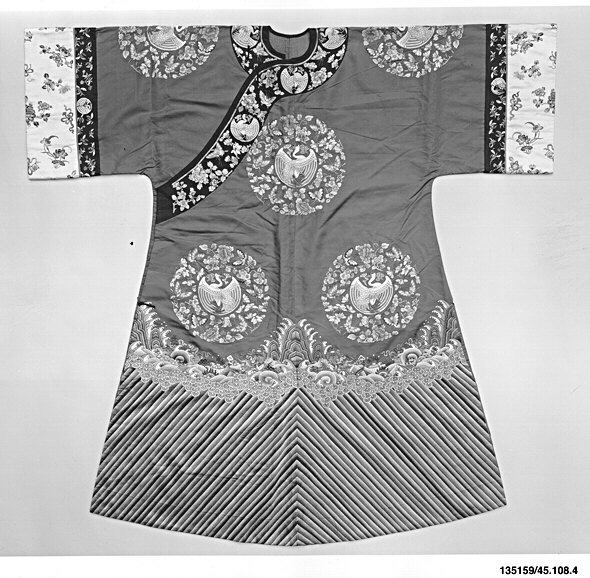
Ceremonial Robe: A Study in Chinese Silk Couture
The ceremonial robe occupies a singular position within the global history of dress—not merely as an artifact of imperial protocol, but as a total synthesis of material science, symbolic encoding, and artisanal mastery. Within the analytical framework of Katherine Fashion Lab, this standalone study examines the Chinese ceremonial silk robe as a case study in how textiles function as instruments of power. Unlike Western couture, which evolved from the logic of the individual body and the seasonal collection, the Chinese ceremonial robe developed from a cosmology of state. Its silken surface was never simply decorative; it was juridical, ritual, and metaphysically charged. To understand the robe is to understand a civilization that wrote its political order into the weave of its cloth.
Materiality: The Civilizational Logic of Silk
Silk is not incidental to the ceremonial robe; it is the precondition of its meaning. The Chinese discovery and monopolization of sericulture produced a fiber of unmatched luster, tensile strength, and dye affinity—qualities that allowed the robe to carry dense symbolic programs without sacrificing structural integrity. Sericulture, the cultivation of the Bombyx mori silkworm, was itself a state-protected industry, and the resulting filament became a currency of diplomacy along the Silk Road. In the ceremonial context, silk's natural sheen was read as an emanation of virtue: the Confucian ideal of ren (humaneness) was thought to manifest as a kind of inner radiance, and silk's reflective surface externalized that moral luminosity.
The material also dictated construction. Because silk filament is long and continuous, Chinese weavers could produce large, seamless panels—an advantage that enabled the robe's characteristic yi (upper garment) and shang (skirt) integration. The fabric's receptivity to complex dyeing and embroidery meant that the robe could function as a wearable archive: each thread potentially encoded rank, occasion, and cosmological orientation. In this sense, the ceremonial robe is a precursor to what Katherine Fashion Lab terms "informational couture"—garments whose primary function is the transmission of structured meaning rather than the accommodation of the body.
Symbolic Architecture: The Robe as Cosmogram
The design grammar of the Chinese ceremonial robe is rigorously non-arbitrary. During the Ming and Qing dynasties, the chaopao (court robe) and longpao (dragon robe) operated as visual constitutions. The Twelve Symbols (shier zhang), codified in the Book of Rites, prescribed specific motifs for the emperor's most formal attire: the sun, moon, stars, mountains, dragons, pheasants, sacrificial vessels, aquatic grasses, grains, fire, axes, and the fu pattern. Each emblem corresponded to a domain of imperial responsibility—celestial order, agricultural abundance, martial authority, and ritual purity.
Placement was equally exacting. The sun and moon typically appeared on the shoulders, positioning the emperor as the axis between celestial bodies. The dragon, a composite creature of nine anatomical resemblances, coiled across the chest and back, its five claws reserved for the emperor alone; four-clawed dragons distinguished princes and nobles. This hierarchical chromatic and iconographic system meant that a single glance at a courtier's robe could decode their precise position within the imperial bureaucracy. The robe was, in effect, a portable insignia of state, and its silk surface was the medium of that legibility.
Technique: Embroidery as Sovereign Craft
The technical execution of the ceremonial robe represents one of the highest achievements of global textile art. Chinese silk embroidery, particularly the Suzhou and Guangdong traditions, employed stitch vocabularies of extraordinary refinement. The kesi or "silk tapestry" technique—often translated as "cut silk"—allowed weavers to create pictorial passages with the tonal gradation of painting, effectively translating brushwork into thread. In the most elaborate court robes, gold-wrapped thread (pian jin) and peacock feather filament were interwoven with dyed silk to produce an iridescent, almost kinetic surface that shifted with the wearer's movement.
This technical virtuosity was not merely aesthetic. The labor invested in a single robe—often hundreds of hours across multiple specialist workshops—constituted a form of conspicuous production that reinforced the wearer's exemption from ordinary economy. Unlike Western haute couture, where the atelier is often romanticized as the site of individual genius, the Chinese ceremonial robe was the product of a coordinated, state-supervised system of imperial workshops (zaobanchu). The anonymity of the makers was itself a structural feature: the robe's authority derived from the institution, not the artisan, and the silk absorbed that institutional power into its very fibers.
Standalone Assessment: The Robe Beyond Dynasty
As a standalone study, the Chinese ceremonial robe resists easy assimilation into either fashion history or art history. It is not a garment in the modern sense—it does not respond to trends, seasons, or individual taste. Nor is it purely a ritual object, since it was worn on living bodies in the exercise of governance. Instead, it functions as what Katherine Fashion Lab identifies as a sovereign textile: a cloth whose primary agency lies in its capacity to constitute, rather than merely signify, authority.
Its legacy persists in contemporary couture, where designers from Yves Saint Laurent to Guo Pei have cited the dragon robe's chromatic intensity and symbolic density. Yet these citations often flatten the robe's original function, reducing a cosmogram to a motif. The more rigorous lesson of the ceremonial robe lies in its integration of material, meaning, and technique into a single, non-negotiable system. Silk was not chosen because it was beautiful; it was chosen because it could hold meaning without distortion. Embroidery was not ornament; it was legislation. In an era of rapid fashion cycles and dematerialized imagery, the Chinese ceremonial robe stands as a reminder that cloth can be the most durable form of political thought—and that the highest couture is that which governs as it adorns.