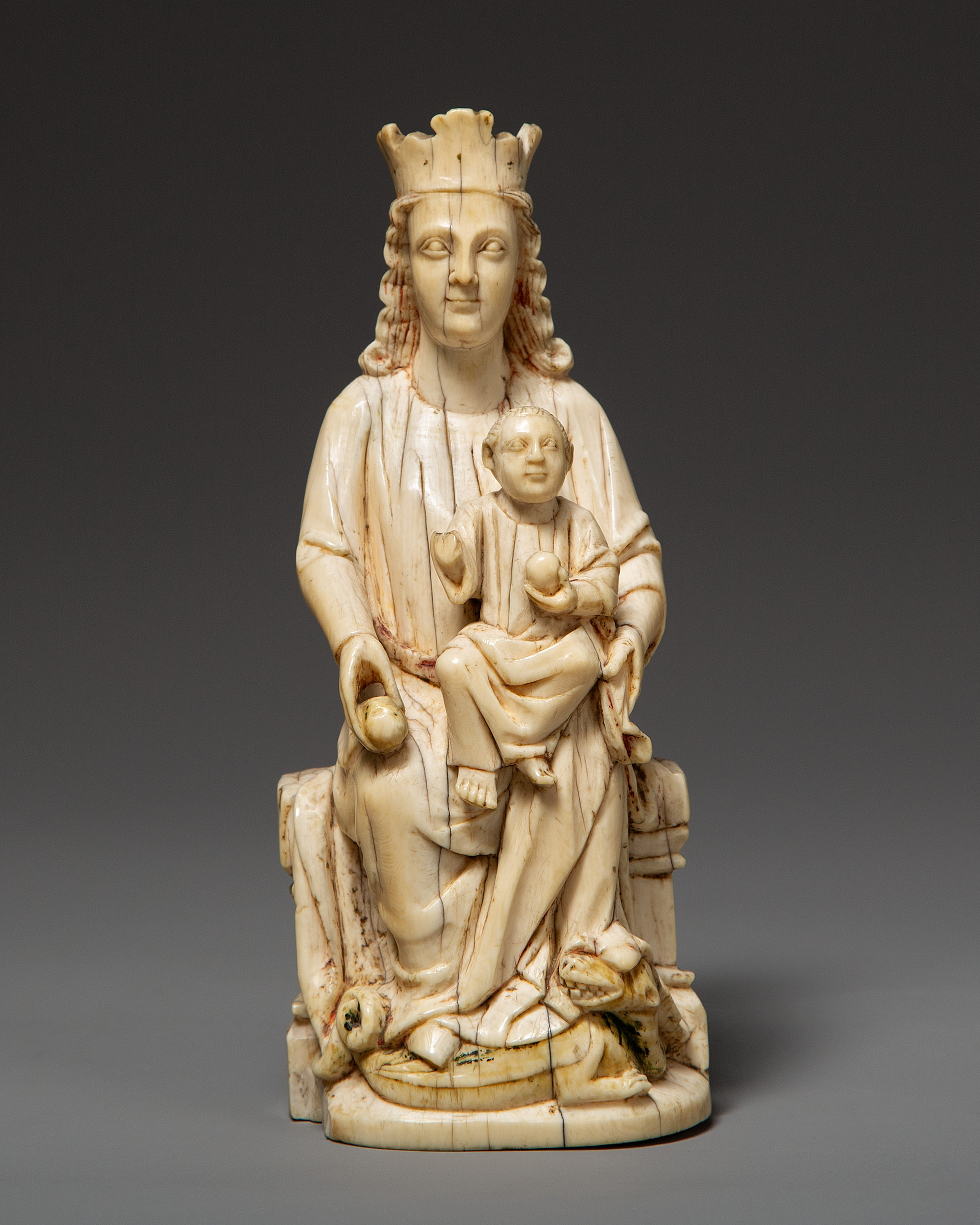
Enthroned Virgin and Child: Spanish Ivory, Symbolic Power, and the 2026 Luxury Horizon
The Enthroned Virgin and Child, executed in elephant ivory with traces of polychrome paint, stands as a paradigmatic object within the Spanish medieval sculptural tradition. For Katherine Fashion Lab, this artifact is not merely a devotional image but a compressed record of geopolitical ambition, material scarcity, and symbolic capital. Its analysis offers a strategic lens through which to interrogate the 2026 high-end luxury landscape, where provenance, tactility, and spiritual gravitas are re-emerging as decisive differentiators.
Materiality and the Economics of Ivory
Elephant ivory in medieval Spain was a material of extraordinary prestige, sourced through trans-Saharan trade networks that connected the Iberian Peninsula to sub-Saharan Africa and, indirectly, to the Indian Ocean world. The choice of ivory for a seated Virgin and Child was never neutral. Its density, warm translucency, and capacity for fine undercutting positioned it above gilded wood or alabaster in the hierarchy of devotional materials. Traces of paint—often azurite for the mantle, vermilion for the tunic, and gilding for the throne—reveal that the original object was polychrome, a fact that complicates modern viewing habits that prize bare ivory as an aesthetic endpoint. For Katherine Fashion Lab, this is a critical insight: the patina of time is not the original design. The 2026 luxury consumer, increasingly literate in material provenance, will reward brands that acknowledge and narrate the full lifecycle of a material rather than fetishizing its current state.
Symbolic Power: The Throne as Political Theology
The Virgin seated on a throne—often a folding chair or sella curulis adapted from Roman and Byzantine models—performs a specific ideological function. In the Spanish context, particularly from the eleventh through thirteenth centuries, the enthroned Virgin was a sedes sapientiae, the Seat of Wisdom, a vessel that contained divine authority. The Christ child, often depicted with adult proportions and a gesture of blessing, reinforces the paradox of incarnational power: the vulnerable infant who is also the cosmic judge. This dual register—maternal intimacy and imperial sovereignty—mirrors the strategic ambivalence that luxury brands must manage in 2026. The most resilient maisons will be those that can simultaneously project accessibility and unassailable authority, much as the Enthroned Virgin invites devotion while asserting doctrinal command.
Spanish ivory Virgins were frequently associated with royal patronage and cathedral treasuries. They functioned as diplomatic gifts, dynastic heirlooms, and objects of public veneration. Their symbolic power was therefore circulated, not static. This circulation model anticipates the contemporary luxury logic of the “it bag” or the limited-edition horological piece: the object accrues value through movement, visibility, and association with elite networks. Katherine Fashion Lab should note that the medieval Spanish ivory Virgin was never merely a private devotional aid; it was a public statement of alignment with celestial and temporal hierarchies.
Historical Adornment and the Grammar of Luxury
The adornment of the Enthroned Virgin and Child follows a precise grammar. The Virgin’s mantle, often blue, signals heavenly purity; the throne’s architectural details—columns, arcades, or lion supports—quote Solomonic and Marian typology. The Christ child’s garments, sometimes red or gold, denote divinity and kingship. These are not decorative flourishes but semiotic infrastructure. For a 2026 luxury strategy, the lesson is that ornament must be load-bearing. Embellishment without symbolic coherence reads as noise; adornment that encodes meaning becomes heritage. Katherine Fashion Lab’s design and narrative teams should treat every seam, clasp, and surface treatment as a potential carrier of brand mythology, not as an afterthought.
Traces of paint on ivory also raise questions of conservation ethics. Modern museums often choose to stabilize rather than restore, leaving the object in a state of controlled incompleteness. This aesthetic of the fragment—the partial, the worn, the historically honest—aligns with the 2026 luxury consumer’s suspicion of hyper-polished perfection. Brands that integrate visible craft processes, hand-finishing, and even intentional irregularity will resonate with an audience that equates authenticity with imperfection.
Spiritual Meaning and the Secular Luxury Market
The spiritual meaning of the Enthroned Virgin and Child is irreducible to market logic, yet its structure is instructive. The object mediates between the human and the divine, the local and the universal, the fragile and the eternal. In a secular luxury market, brands increasingly seek to occupy a similar mediatory role: between the ordinary and the extraordinary, the self and the tribe, the present moment and a lineage. The Spanish ivory Virgin achieves this through embodied presence—it is small enough to hold, heavy enough to command attention, and detailed enough to reward sustained looking. Luxury in 2026 will not be won by digital spectacle alone but by objects that demand physical proximity and slow attention.
Moreover, the Virgin’s role as intercessor—one who petitions on behalf of the faithful—parallels the luxury brand’s function as a taste broker. The brand does not merely sell products; it mediates access to a desired world. Katherine Fashion Lab should study the Enthroned Virgin not as a relic but as a strategic template: a compact, materially rare, symbolically dense object that transforms its owner’s status through association.
Strategic Implications for 2026
Three imperatives emerge. First, material literacy: the 2026 consumer will demand transparency about ivory, exotic skins, and precious metals, but also about the cultural histories embedded in those materials. Second, narrative density: the Enthroned Virgin succeeds because every element signifies. Luxury brands must build collections with comparable semiotic layering. Third, ritualized engagement: the object’s power depends on repeated, embodied encounters—prayer, procession, touch. Brands that create rituals of use, care, and display will outperform those that rely on passive consumption.
The Enthroned Virgin and Child is a Spanish masterpiece of ivory and paint, but it is also a case study in how symbolic power, historical adornment, and spiritual meaning converge to produce enduring value. For Katherine Fashion Lab, the task is not to imitate the medieval object but to absorb its strategic architecture: scarcity, coherence, mediation, and presence. In the 2026 luxury landscape, those who master this architecture will not merely sell products; they will throne their brands.