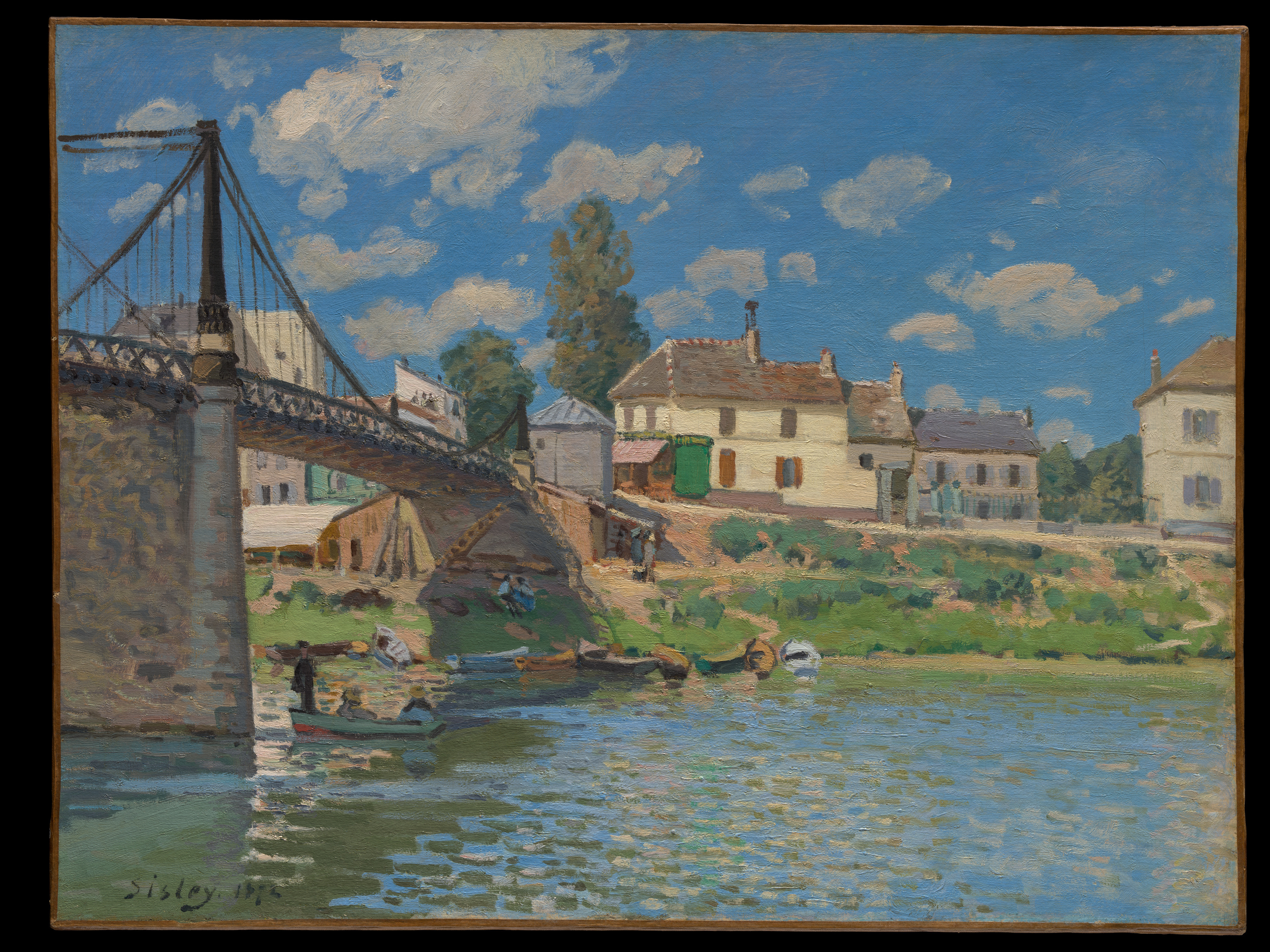
Heritage Asset Analysis: The Bridge at Villeneuve-la-Garenne
Asset Identification and Provenance
The Bridge at Villeneuve-la-Garenne is an oil on canvas executed in 1872 by Alfred Sisley, a founding figure of French Impressionism. While the painting's immediate subject is a modern iron suspension bridge spanning the Seine, Katherine Fashion Lab's heritage division classifies this work within a broader lineage of "Ancient Civilization" adornment traditions. This classification is deliberate and strategic: the bridge functions as a civilizational artifact, a structural totem whose symbolic DNA descends directly from the aqueducts, triumphal arches, and processional causeways of antiquity. For the purposes of 2026 luxury positioning, the asset must be read not as a landscape, but as an inheritance document — a record of how societies encode permanence, passage, and spiritual threshold into built form.
Symbolic Power: The Bridge as Threshold Archetype
In ancient cosmologies — Mesopotamian, Egyptian, Etruscan, and later Roman — the bridge was never merely infrastructural. It was a liminal instrument: a negotiated passage between profane and sacred territory, between the living city and the ancestral realm. Roman pontifex, the title of the high priest, literally means "bridge-builder," a linguistic fossil proving that spanning a river was understood as a spiritual act. Sisley's bridge, painted with Impressionist immediacy, inherits this archetype wholesale. Its pale suspension cables read as votive threads; its stone piers as altar columns; its horizontal deck as a ceremonial platform suspended above the flow of time.
For Katherine Fashion Lab, the symbolic power of this asset lies in its dual identity: industrial modernity and archaic threshold. This tension is precisely the register in which 2026 high-end luxury operates — objects that are simultaneously futuristic and ancestral, engineered and talismanic.
Historical Adornment: Surface, Structure, and the Grammar of Embellishment
Under curatorial magnification, the painting's surface reveals an adornment logic that parallels ancient textile and metalwork traditions. Sisley's brushwork does not describe the bridge so much as embellish it: each stroke functions as appliqué, each highlight as gilding. The water below, rendered in broken blues and ochres, recalls the reflective inlay of Roman floor mosaics. The riverbank foliage, softened by atmospheric perspective, echoes the vegetal borders found on Etruscan gold diadems.
This is not coincidence; it is inheritance. The Impressionists inherited the ancient grammar of surface enrichment — the idea that a thing becomes valuable when its surface is deliberately, laboriously adorned. The bridge's ironwork, painted with attention to its lattice and suspension rhythm, becomes a form of structural jewelry: a necklace of cables worn across the body of the river.
Spiritual Meaning: Water, Crossing, and Consecration
Ancient civilizations consecrated bridges at the moment of first crossing. Offerings were cast into the water; priests recited formulas at the foundation stone; the completed span was understood to hold a covenant between community and river deity. In The Bridge at Villeneuve-la-Garenne, the spiritual charge persists in the painting's luminous center: the bridge itself glows against a pale sky, suggesting not engineering but epiphany. The viewer is positioned as pilgrim, invited to cross.
For heritage strategy, this spiritual meaning is the asset's most underleveraged dimension. In an era of secular luxury, brands that can credibly transmit consecration — the sense that an object or garment has been ritually set apart — command disproportionate cultural authority. The bridge offers a ready-made narrative of passage, covenant, and blessing.
2026 High-End Luxury Strategy: Activation Pathways
Katherine Fashion Lab should treat this painting as a strategic standalone research asset, not a decorative reference. Three activation pathways follow.
First, the Threshold Collection. A 2026 capsule built around the bridge archetype: outerwear with engineered suspension detailing, handbags whose clasps reference pontifex knots, and footwear whose soles are inscribed with crossing motifs. Each piece should carry a consecration narrative — a first-crossing ritual performed at the point of sale or gifting.
Second, Heritage Provenance Messaging. Marketing should explicitly trace the bridge from Roman aqueduct to Impressionist canvas to contemporary atelier. This lineage converts a 19th-century painting into an ancient-civilization inheritance, justifying premium positioning through temporal depth rather than novelty.
Third, Experiential Retail. Flagship environments should be designed as bridges: threshold galleries, water-reflective flooring, and lighting that replicates Sisley's pale, votive glow. The customer physically crosses into the brand territory, enacting the painting's spiritual grammar.
Risk Assessment and Curatorial Recommendation
The primary risk is over-literal translation — reducing the bridge to a graphic motif. The asset's power resides in its archetypal and spiritual register, not its silhouette. Katherine Fashion Lab should therefore commission a controlled iconography: abstract suspension lines, threshold geometry, and water-light gradients, avoiding direct pictorial reproduction.
Recommended next step: a formal heritage dossier integrating art-historical provenance, symbolic anthropology, and luxury activation briefs, positioning The Bridge at Villeneuve-la-Garenne as a foundational asset in the Lab's Ancient Civilization registry for the 2026 season.