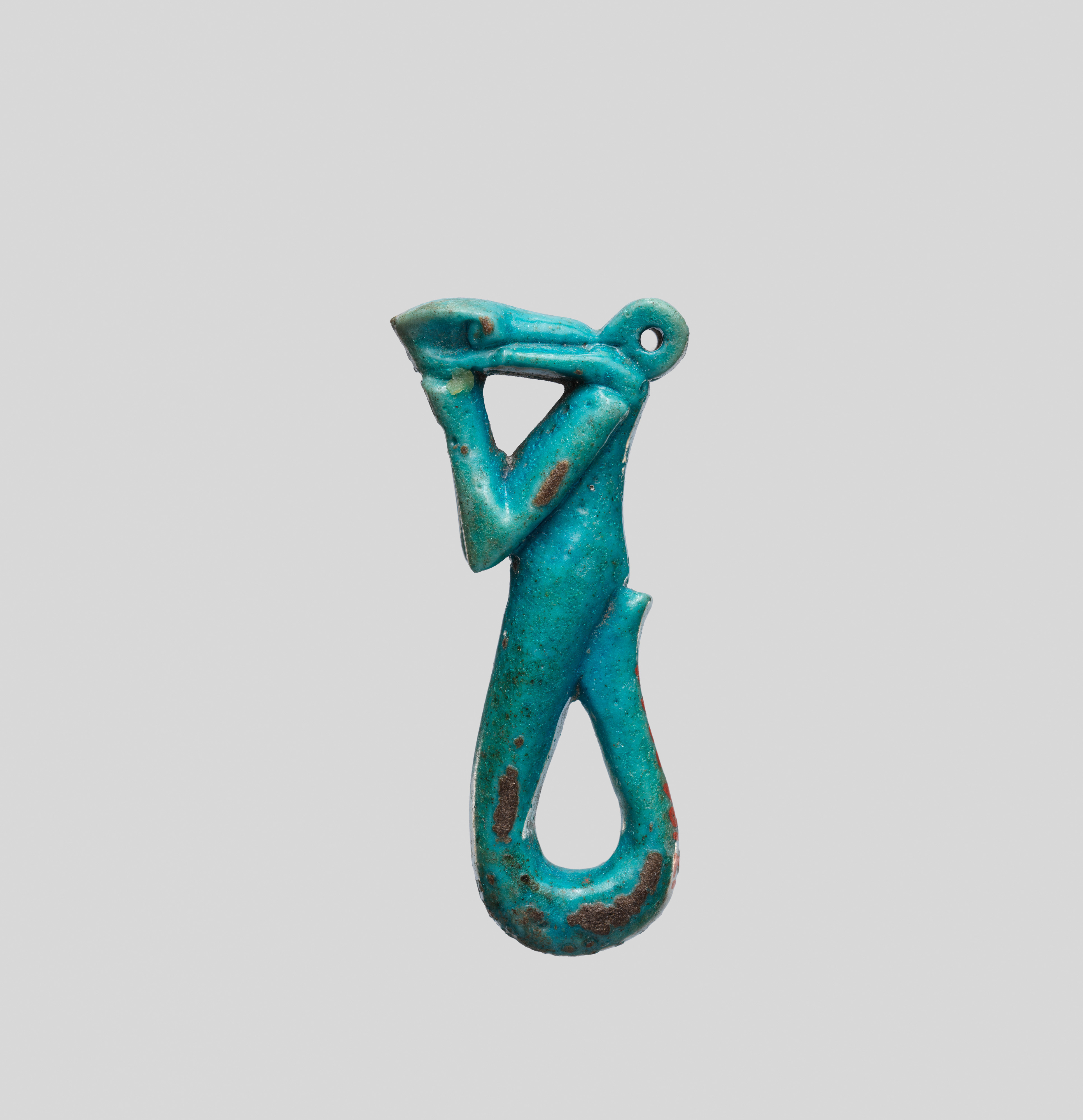
Heritage Analysis: The Faience Serpent Decan Amulet with Raised Arms
Object Identification and Material Context
The artifact under examination is a faience amulet depicting a serpent decan with raised arms—a motif drawn from the funerary and astronomical traditions of Ancient Egypt. Produced in faience, a sintered quartz paste glazed with alkaline copper compounds, the object belongs to a class of small-scale ritual adornments that served both protective and cosmological functions. Faience was not a substitute material; it was a deliberate signifier of luminosity and rebirth, its blue-green glaze evoking the primordial waters of Nun and the regenerative properties of the sun god's daily cycle. The serpent decan, characterized by its upright posture and anthropomorphic arms, represents one of the thirty-six decanal spirits that governed the night sky in Egyptian astral theology. Each decan presided over a ten-day period, and their collective movement across the heavens structured the Egyptian calendar, medical prognoses, and afterlife navigation.
Symbolic Power: The Serpent as Guardian and Celestial Marker
The serpent in ancient Egyptian iconography operates on multiple symbolic registers simultaneously. As a creature that sheds its skin, it embodies cyclical renewal and the mastery of death. As a guardian, it appears on royal uraei, temple lintels, and tomb entrances, signaling thresholds between profane and sacred space. The raised arms of this particular serpent decan, however, introduce a distinct layer of meaning: they transform the creature from a passive emblem into an active agent of ritual performance. In the Book of the Dead and the Book of Nut, decans are depicted with arms raised in adoration or magical invocation—gestures that align human worship with cosmic order. The amulet thus compresses three functions into a single wearable object: it marks time (astronomical decan), it protects the wearer (apotropaic serpent), and it performs devotion (raised-arm posture). This tripartite symbolism is precisely what makes the object strategically valuable for a luxury house: it is not merely decorative but functionally dense, carrying meaning that can be unpacked across multiple consumer touchpoints.
Historical Adornment: Wearability, Scale, and Intimacy
Amulets of this type were typically pierced for suspension and worn on cord or chain, placed among mummy wrappings, or deposited in foundation deposits. Their scale—often between two and five centimeters—positions them at the intersection of jewelry and talisman, a category that historically precedes the modern distinction between ornament and instrument. For Katherine Fashion Lab, this is a critical insight: the serpent decan amulet was never purely ornamental. It was worn technology—a portable interface between the human body and the celestial sphere. The raised arms of the serpent would have rested against the wearer's chest or throat, creating an intimate, tactile relationship between the body and the cosmos. This embodied dimension distinguishes the object from monumental reliefs or papyrus illustrations; it was designed for daily, personal contact. In luxury strategy, such intimacy translates into high-margin, high-frequency categories: pendants, signet rings, and layered necklaces that invite daily wear rather than occasional display.
Spiritual Meaning: Decans, Fate, and Protective Agency
In Egyptian cosmology, the decans were not abstract symbols but active spiritual entities with jurisdiction over specific illnesses, organs, and hours of the night. Medical papyri list decanal spirits as both causes of and cures for fever, and the rising of a decan could signal a favorable or dangerous moment for a patient. The serpent decan with raised arms thus functioned as a personalized spiritual guardian, one that could be invoked for protection during sleep, travel, or illness. This personalization is essential for contemporary luxury storytelling: the amulet was not a mass-produced charm but a configurable spiritual asset, selected according to birth date, profession, or specific vulnerability. The modern analogue is bespoke or limited-edition talismanic jewelry, where the client's personal data (birth chart, intention, milestone) determines the specific decan or symbol engraved. The raised arms further suggest reciprocal relationship: the wearer adores the decan, and the decan intercedes on the wearer's behalf. This mutuality is a powerful narrative for high-end clienteling, transforming a purchase into a covenant between object, wearer, and heritage.
2026 Luxury Strategy: From Artifact to Aspirational Archetype
For Katherine Fashion Lab's 2026 positioning, the serpent decan amulet offers a blueprint for heritage-led innovation that avoids both pastiche and academic sterility. Three strategic pillars emerge:
First, material authenticity as differentiation. Faience is not a precious metal, yet its cultural prestige in Egyptian civilization was immense. A 2026 collection could reinterpret faience through technical ceramics or recycled glass composites, positioning the material as both ancient and sustainable. The blue-green glaze becomes a signature colorway—neither trendy nor timeless, but cosmologically grounded.
Second, narrative personalization at scale. The decanal system's thirty-six divisions offer a ready-made architecture for modular, personalized collections. Clients could select their decan based on birth date, then choose a serpent, falcon, or anthropomorphic form with corresponding raised-arm or seated posture. This creates a collectible logic—multiple decans, multiple materials, multiple wear formats—without diluting the core symbolic code.
Third, ritualized retail and aftercare. The amulet's original context was not a display case but a living ritual: consecration, wearing, invocation, and eventual burial with the body. Luxury brands in 2026 must compete on experience density, not just product quality. Katherine Fashion Lab could introduce a decanal consecration service—a private appointment where the client's amulet is activated through sound, scent, and inscription—and an annual renewal ritual tied to the decan's heliacal rising. This transforms a one-time transaction into a multi-year relationship.
Finally, the raised arms of the serpent decan carry a meta-lesson for brand strategy: the posture of offering. The object does not grasp or display; it lifts. In a luxury market saturated with aggressive logos and maximalist ornament, the serpent decan's gesture is one of quiet, upward intentionality. Katherine Fashion Lab can adopt this as a design and communication principle: pieces that elevate the wearer's presence without shouting, that signal spiritual literacy rather than mere wealth. The 2026 consumer—particularly the high-net-worth collector—is increasingly drawn to objects that function as personal cosmologies, not status badges. The faience serpent decan, with its raised arms and celestial mandate, is the perfect ancestor for that ambition.