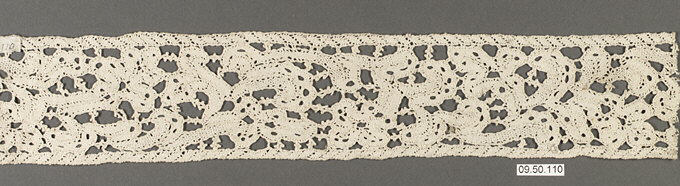
Strip: A Study in Linear Structure and Bobbin Lace
The strip is among the most elemental gestures in textile construction—a narrow, elongated band whose apparent simplicity belies a profound structural logic. Within the vocabulary of haute couture, the strip functions neither as ornament nor as afterthought, but as a primary compositional unit: a linear module that can be repeated, joined, layered, and manipulated to generate surfaces of extraordinary complexity. When executed in bobbin lace, the strip transcends its utilitarian origins and becomes a vehicle for artisanal virtuosity, carrying within its narrow dimensions the accumulated knowledge of centuries of lacemaking traditions.
This standalone study examines the strip as a discrete object of couture inquiry, tracing its global heritage, its material realization in bobbin lace, and its enduring relevance to contemporary atelier practice. The analysis positions the strip not as a fragment awaiting assembly, but as a self-sufficient aesthetic proposition—a meditation on repetition, rhythm, and the tension between restraint and expression.
Defining the Strip as Couture Unit
In its most fundamental form, the strip is a length of material defined by a high length-to-width ratio. This proportion is not incidental; it is the strip's constitutive characteristic. A strip directs the eye along its axis, establishes a linear rhythm, and imposes a directional logic upon any surface it inhabits. In couture, this directional quality has been exploited by practitioners from Madeleine Vionnet to Issey Miyake, who understood that a strip could be engineered to follow the body's contours, to cascade vertically, or to wrap horizontally in deliberate counterpoint to anatomical form.
The strip's modularity is equally significant. Because it can be produced in standardized widths and joined edge-to-edge or end-to-end, the strip enables a form of textile construction that is additive rather than subtractive. The maker builds surface area through accumulation, much as a mason builds a wall from bricks. This logic of assembly links the strip to architectural thinking and to the broader modernist fascination with repetition and the serial unit.
Global Heritage: The Strip Across Cultures
The strip's heritage is genuinely global, and its manifestations reveal how different cultures have independently arrived at similar structural solutions. In West Africa, narrow-band weaving—produced on horizontal treadle looms—generates strips typically ranging from four to twelve centimeters in width. These strips are sewn together edge-to-edge to create large cloths, a technique central to Asante kente, Yoruba aso-oke, and Ewe textiles. The finished cloth's visual rhythm emerges precisely from the visible seams where strips meet, transforming the join into an aesthetic event.
In Southeast Asia, the ikat traditions of Indonesia and the patola double-ikat of Gujarat employ resist-dyeing on warp or weft threads before weaving, producing patterned strips that carry symbolic and ceremonial weight. In the Andes, pre-Columbian weavers produced narrow woven bands of remarkable technical precision, used for binding, adornment, and ritual purposes. And in Europe, the strip appears in the form of passementerie, galloon, and the continuous bands of needle and bobbin lace that trimmed aristocratic garments from the sixteenth century onward.
What unites these disparate traditions is the recognition that the strip is not merely a means to an end but a form capable of carrying meaning. The strip concentrates skill into a narrow field, demanding precision because errors cannot be hidden across a broad surface. It rewards repetition, since the maker's hand must maintain absolute consistency across extended lengths. In this sense, the strip is a test of mastery.
Bobbin Lace: Material Realization of the Strip
Bobbin lace offers a particularly compelling realization of the strip. Unlike needle lace, which is built stitch by stitch with a single thread, bobbin lace is constructed by braiding and twisting multiple threads wound on bobbins, worked over a pinned parchment pattern. The technique emerged in sixteenth-century Flanders and Italy and quickly became associated with the production of continuous edging strips—the passements that adorned collars, cuffs, and ruffs.
The strip format is, in fact, native to bobbin lace. The traditional lace pillow is organized to produce a continuous band, with the pattern repeating along the length. The lacemaker's repertoire—tulle, cloth stitch, half stitch, whole stitch, picots, and grounds—is deployed within this narrow field to create effects of transparency, density, and relief. The strip's edges, known as the footing and the picot edge, are themselves designed features, often the most technically demanding elements of the work.
In couture, bobbin lace strips have historically been joined to create larger panels for gowns, bodices, and veils. The joins are executed with such finesse that the resulting surface appears seamless, the strip dissolving into a continuous field. Yet the strip's logic remains legible upon close inspection: the repetition of motifs, the subtle variations in tension, the rhythm of the pattern repeat. This duality—apparent seamlessness underlain by modular construction—is central to the strip's couture significance.
Structural and Aesthetic Properties
Three properties distinguish the bobbin lace strip as a couture material. First, transparency: the open grounds of bobbin lace allow light and skin to register through the fabric, creating an interplay between concealment and revelation that has made lace a perennial instrument of seduction and refinement. Second, elasticity: the braided structure of bobbin lace gives it a slight give, allowing it to conform to curved surfaces without distortion—an advantage in garment construction. Third, scalability: the same technique can produce strips of vastly different widths and densities, from delicate insertions a few millimeters wide to substantial bands suitable for structural application.
These properties make the strip a versatile instrument. It can be used as an insertion between two fabrics, as an edging, as a standalone band, or as a building block for larger compositions. In each application, the strip asserts its linear identity while adapting to the demands of the whole.
Contemporary Relevance
In an era of digital fabrication and algorithmic design, the bobbin lace strip retains a distinctive value: it is irreducibly hand-made, its logic embodied rather than computed. Yet its modularity and repetition resonate with computational thinking, and contemporary designers have explored the strip as a bridge between craft and technology, using it to generate parametric surfaces and to question the boundary between the artisanal and the industrial.
For Katherine Fashion Lab, the strip in bobbin lace represents a study in concentration—a reminder that couture's power often resides not in expanse but in the disciplined repetition of a single, perfectly executed unit. The strip endures because it is both ancient and open-ended, a form that carries heritage within its threads and invites reinvention with every new length worked upon the pillow.