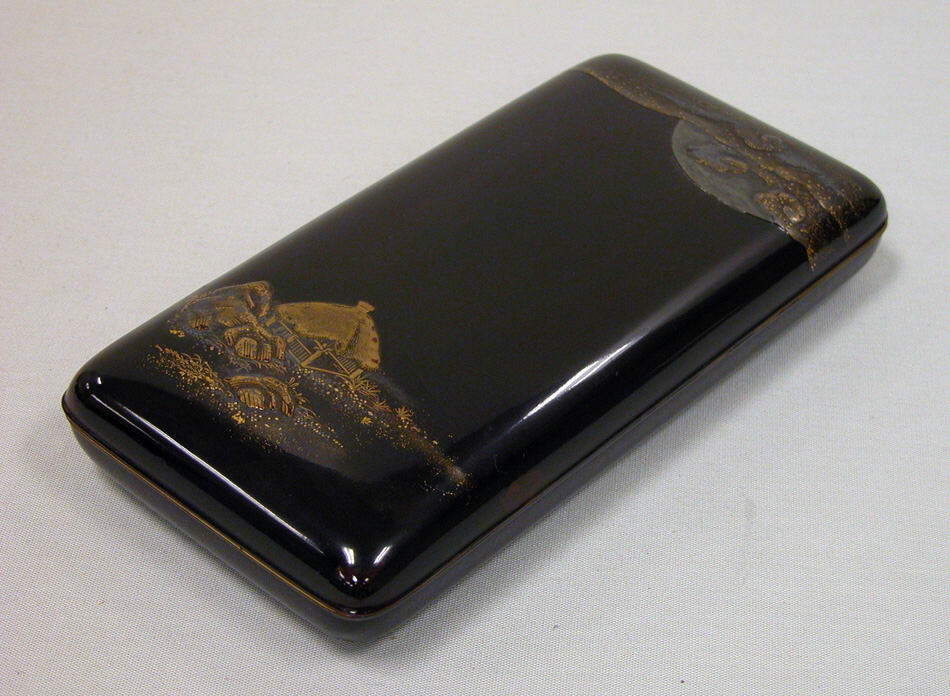
Heritage Asset Analysis: Writing Box with Design of Rustic Shelter and Clouds with Moon
Object Identification and Material Distinction
The subject of this analysis is a Japanese writing box (suzuribako) executed in gold and silver maki-e on black lacquer. The exterior cover bears a design of a rustic shelter beneath clouds and moon; the interior surface depicts the Poet Saigyō Resting. The object belongs to the classical tradition of Japanese lacquerware in which utilitarian implements of scholarship were elevated to the status of ceremonial art. The suzuribako historically housed the instruments of writing—inkstone, water dropper, brushes, and ink—and served as the portable intellectual companion of the literate elite.
Materially, the piece represents a convergence of rare resources and specialized craft. Maki-e, literally "sprinkled picture," involves the application of gold and silver powder onto wet lacquer before it cures, followed by repeated polishing and layering. The black lacquer ground functions as a deliberate void—a controlled darkness against which precious metals achieve maximum luminosity. This is not decoration for its own sake; it is a technology of symbolic contrast.
Symbolic Power: The Rustic Shelter, Clouds, and Moon
The exterior composition deploys three classical motifs with deep semantic resonance. The rustic shelter (often a thatched hut or mountain hermitage) signifies voluntary withdrawal from courtly ambition. In Japanese aesthetic and spiritual tradition, the humble dwelling is not a marker of poverty but of intentional renunciation—a spatial argument for interior freedom. The clouds serve as intermediaries between the mundane and the sacred, veiling and revealing in turn. The moon, particularly when partially obscured, functions as a symbol of enlightenment that is never fully graspable through rational means.
Taken together, these motifs articulate a worldview in which absence is more eloquent than presence. The black lacquer ground is not empty; it is pregnant with implication. The gold and silver lines do not describe a scene so much as they trace the edges of a meditation. For a contemporary luxury brand, this represents a sophisticated alternative to maximalist ornamentation: restraint as authority.
Historical Adornment and the Poet Saigyō
The interior depiction of Saigyō (1118–1190) anchors the object in a specific historical and literary lineage. Saigyō was a courtier-turned-Buddhist monk and one of the most influential poets of the Japanese classical canon. His verse codified the aesthetic of wabi—austere beauty, quiet loneliness, and the acceptance of impermanence. To place Saigyō inside a writing box is to make a curatorial argument: the act of writing is itself a spiritual discipline.
Historically, such boxes were commissioned by daimyō, temple patrons, and wealthy merchants as markers of cultural literacy. Ownership signaled not merely wealth but participation in a refined interpretive community. The box was handled during poetry composition, tea gatherings, and diplomatic correspondence. Its surfaces accumulated the patina of use—a form of adornment that no artisan could fabricate. In heritage terms, this object is a portable monument: it carries ritual, literacy, and memory in a form that fits within two hands.
Spiritual Meaning and the Aesthetics of Impermanence
The spiritual program of the box is inseparable from Japanese Buddhist thought, particularly the concepts of mujō (impermanence) and mono no aware (the pathos of things). The moon behind clouds is a visual sermon on transience. The rustic shelter is a reminder that permanence is an illusion. Saigyō resting is not a portrait of idleness but of attentive stillness—the precondition for insight.
For luxury strategy, this spiritual layer is not incidental. It provides narrative depth that cannot be replicated by trend-driven design. A client who understands the object does not purchase a writing box; they acquire a disciplined relationship with time. The gold and silver are not signs of opulence but of devotional attention—each particle of metal placed with intention. This is the opposite of fast luxury.
2026 High-End Luxury Strategy: Positioning and Application
Entering 2026, the global luxury market is characterized by three pressures: cultural authenticity verification, experiential scarcity, and intergenerational meaning transfer. The Saigyō writing box addresses all three. First, its provenance and iconography are documentable through classical literary sources, providing verifiable cultural capital. Second, its materiality—hand-applied maki-e—is inherently scarce and cannot be scaled without losing integrity. Third, its spiritual content offers a legacy narrative suitable for clients who are curating estates and family collections rather than seasonal wardrobes.
Katherine Fashion Lab should position this heritage asset within a quiet luxury framework that emphasizes connoisseurship over visibility. Recommended strategic applications include:
1. Limited edition reinterpretation: Commission a contemporary suzuribako-inspired vanity or desk object using the same maki-e technique, with Saigyō's verse discreetly inscribed. Production should not exceed twelve units annually.
2. Salon programming: Host invitation-only gatherings on Japanese aesthetics of impermanence, using the box as a tactile centerpiece. The object becomes an experience anchor, not a display item.
3. Archival storytelling: Develop a digital and print dossier linking the box's motifs to modern mindfulness and slow productivity movements. Position the brand as a custodian of pre-industrial attention.
4. Client education: Offer private viewings with a lacquer specialist who can explain the layering process. The goal is to convert transaction into transmission.
Conclusion: Heritage as Strategic Restraint
The Writing Box with Design of Rustic Shelter and Clouds with Moon, containing the Poet Saigyō Resting, is not a relic of pre-modern Japan alone. It is a strategic template for luxury in an era of overload. Its symbolic power lies in what it withholds; its historical adornment lies in disciplined craft; its spiritual meaning lies in the acceptance of impermanence. For Katherine Fashion Lab, the asset offers a rare opportunity: to align commercial positioning with philosophical credibility. In 2026, the most persuasive luxury argument may not be abundance, but intentional absence—a black lacquer surface, a few lines of gold, and a moon that never fully reveals itself.