The Repository of Arts as a Proto-Fashion System: Volume 2 and the Codification of Taste
Among the foundational artifacts of modern visual culture, few publications reward sustained couture analysis quite like The Repository of Arts, Literature, Commerce, Manufactures, Fashions, and Politics. The second volume of the first series, held within the Global Heritage collection, constitutes far more than a bound periodical. It is a proto-fashion system: an apparatus that simultaneously documented, distributed, and disciplined the aesthetics of its age. Published in London under the editorial direction of Rudolph Ackermann, the volume assembles hand-colored etchings, engravings, woodcuts, and—most remarkably—tipped-in textile samples, transforming the printed page into a multisensory archive of material culture. For the contemporary fashion theorist, this object offers an unusually complete record of how dress circulated as information, commodity, and ideology at the dawn of the nineteenth century.
The Periodical as Infrastructure
The full title of the publication is itself a manifesto. By binding arts, literature, commerce, manufactures, fashions, and politics into a single imprimatur, Ackermann announced that fashion was not a frivolous margin of culture but a central node in a network of production and power. This integrative logic anticipates the modern fashion system described by scholars such as Roland Barthes, in which clothing functions as a language produced and consumed through print. The Repository operationalized that theory a century and a half before it was articulated. Each monthly issue—later gathered into semiannual volumes such as this one—delivered fashion plates, literary essays, market reports, and political commentary to a readership that included merchants, gentry, and aspirational members of the professional classes. Volume 2 thus functioned as infrastructure: a periodic, standardized, and geographically distributed mechanism for the dissemination of sartorial norms.
Materiality and the Hierarchy of Media
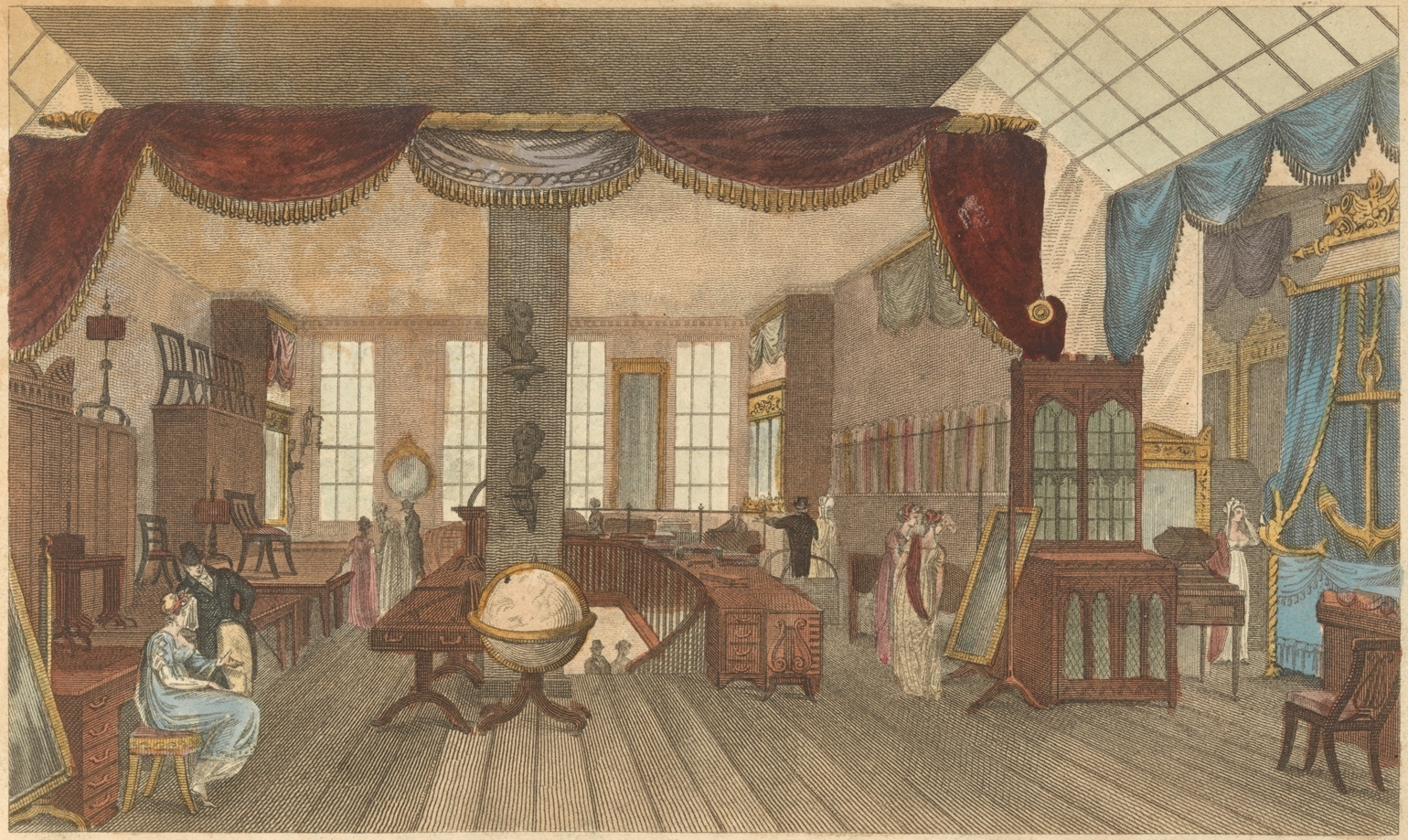
The material constitution of the volume is as significant as its content. The hand-colored etchings and engravings that dominate the fashion plates represent a deliberate investment in luxury. Coloring by hand was labor-intensive and expensive, and its use signals that the publication addressed itself to consumers accustomed to quality. The presence of woodcuts alongside these finer plates establishes an internal hierarchy of media: woodcuts served utilitarian functions—illustrating furniture, carriages, or manufactures—while etchings and engravings were reserved for the idealized female figure. This hierarchy mirrors the social stratification of dress itself, in which fine materials and intricate construction distinguished the elite from the merely fashionable.
Most extraordinary, however, are the textile samples bound directly into the volume. These swatches—fragments of actual muslin, silk, or printed cotton—collapse the distance between representation and object. A reader could not merely see the recommended fabric but touch it, assessing its weight, sheen, and hand. In an era before standardized color photography, such samples were the most reliable means of transmitting material information across distance. They also reveal the commercial entanglement of the publication: the samples were almost certainly supplied by manufacturers and merchants, making the volume a subtle instrument of advertising as well as edification. The Repository did not simply describe the market; it participated in it.
The Fashion Plate and the Discipline of the Gaze
The fashion plates within Volume 2 deserve close reading as visual arguments. Typically depicting one or two elegantly attired figures against a minimal ground, these images are not portraits but templates. They prescribe posture, proportion, and the arrangement of accessories with a precision that anticipates the technical flat of modern design. The hand-coloring introduces variation and individuality, yet the underlying engraving imposes a standardized silhouette. This tension between idealization and reproducibility is the engine of fashion itself: the plate promises that the reader may approximate the image through purchase and skilled dressmaking, while ensuring that the approximation is never complete. The result is perpetual desire, the psychological substrate of the fashion economy.
The plates also encode temporal rhythms. Seasonal change—the shift from morning dress to evening gown, from pelisse to shawl—is registered with the regularity of a calendar. Fashion here is not static but cyclical, and the periodical form is ideally suited to capturing its cadence. Volume 2, encompassing six months of issues, becomes a chronicle of sartorial time, allowing the historian to trace the evolution of waistlines, hemlines, and sleeve volumes with a granularity unavailable in isolated prints.
Commerce, Politics, and the Moral Economy of Dress
Ackermann's decision to place commerce and politics in the same title as fashions was neither accidental nor ironic. The Napoleonic Wars, the expansion of British manufacturing, and the anxieties of a post-revolutionary social order all shaped what could be worn and by whom. The Repository's market reports and political essays contextualize its fashion plates within a broader economy of production and exchange. Cotton muslin, celebrated in the volume's samples, was a global commodity whose supply chains implicated colonial labor and industrial innovation. To analyze the fashions of Volume 2 without attending to these political and commercial dimensions would be to mistake surface for substance.
Moreover, the publication participated in a moral discourse around consumption. Its tone—instructional, improving, occasionally admonitory—positions fashion as a domain requiring taste and restraint. The ideal reader is neither a slave to novelty nor indifferent to appearance, but a discerning participant in a civilized economy of signs. This moralizing strain would become a persistent feature of fashion journalism, from nineteenth-century ladies' magazines to contemporary sustainability discourse.
Conclusion: The Volume as Method
For Katherine Fashion Lab, The Repository of Arts, 1st series, vol. 2, is not merely a historical curiosity but a methodological model. It demonstrates that couture analysis must be interdisciplinary, attending simultaneously to image, object, text, and context. Its hand-colored plates, woodcuts, and textile samples constitute a layered archive in which aesthetics, technology, and commerce are inseparable. To study this volume is to study the birth of the fashion system as we know it—a system in which the printed page and the woven cloth are partners in the production of desire. The Global Heritage collection's stewardship of such an object ensures that this foundational chapter in the history of fashion remains available for the rigorous, material-sensitive scholarship it demands.