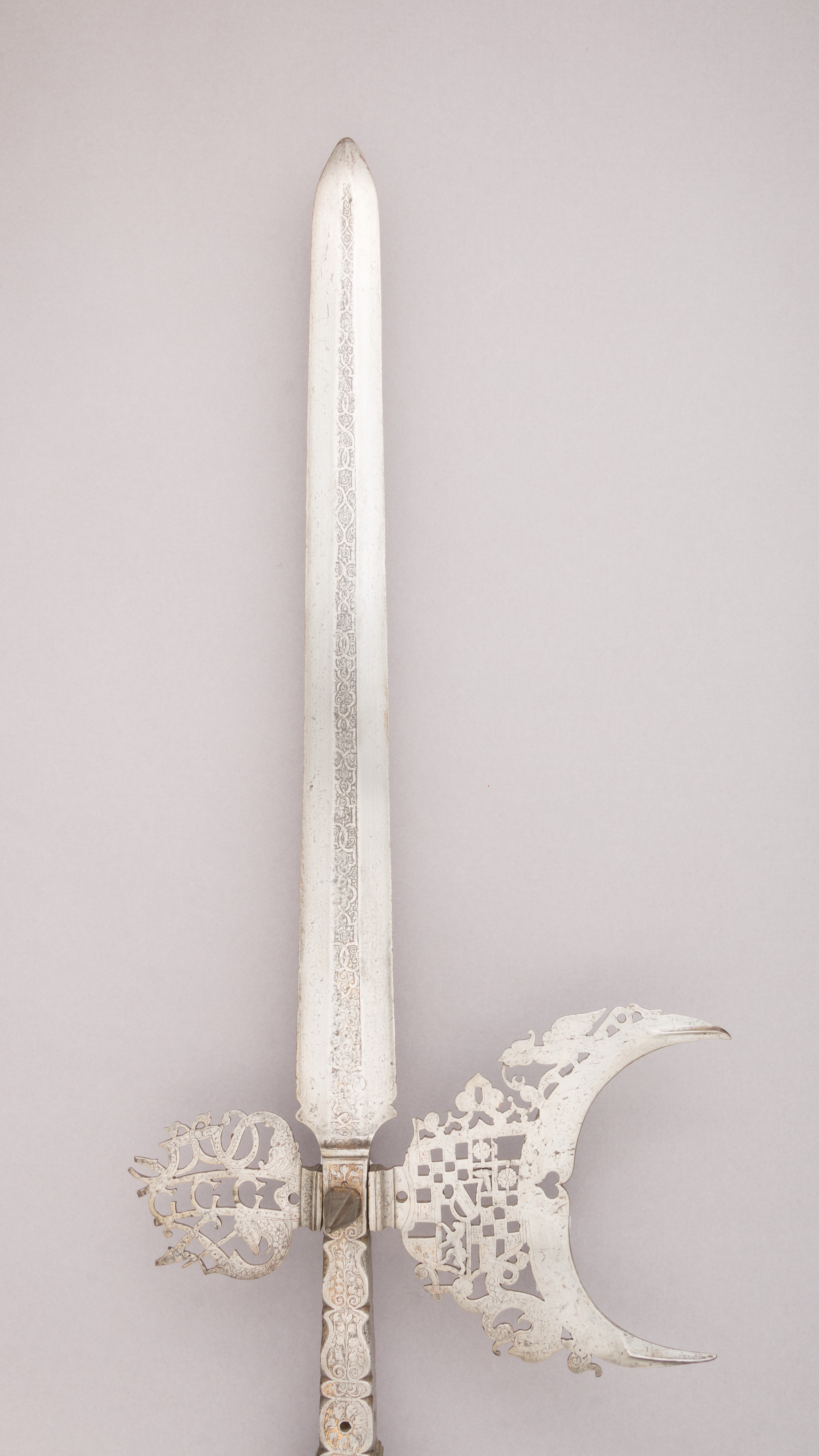
Heritage Asset Analysis: The Halberd of the Bodyguard of Philip II, Margrave of Baden-Baden (1559–1588)
Introduction: A Convergence of Steel, Gold, and Authority
Within the strategic portfolio of Katherine Fashion Lab, the study of historical adornment is not an exercise in nostalgia but a rigorous investigation into the mechanics of symbolic capital. The halberd of the bodyguard of Philip II, Margrave of Baden-Baden, serves as a definitive case study. This object—a fusion of steel, wood, gold, textile, and metallic thread—is not merely a weapon of war. It is a meticulously engineered artifact of statecraft, a wearable and wielded declaration of spiritual and temporal dominion. For the contemporary luxury strategist, this German Renaissance halberd offers a masterclass in how to codify power, manifest belief, and create an enduring brand identity that transcends its immediate utility.
Symbolic Power: The Halberd as a Mobile Monument
The halberd, in its essence, is a tool of the bodyguard—a protective instrument. However, the specific example from the Baden-Baden court transforms this functional role into a theatrical performance of authority. Philip II, Margrave of Baden-Baden, ruled during a period of intense confessional conflict in the Holy Roman Empire. His bodyguard was not a mere security detail; it was a visual projection of his sovereignty. The halberd’s steel head, often etched or blued, and its wooden shaft, wrapped in rich textiles and interwoven with gold and metallic thread, elevated a common polearm into a ceremonial standard.
This object embodies symbolic power through its duality. The steel edge speaks to the legitimate use of force—the ius gladii—delegated to the Margrave by the Emperor. Yet, the gold and textile elements remove it from the battlefield and place it in the realm of the courtly procession. The bodyguard, holding these halberds, became a living wall of heraldic and spiritual messaging. For Katherine Fashion Lab, the strategic parallel is clear: luxury products must operate on this same dual frequency. They must offer tangible quality (the steel) while simultaneously communicating an intangible narrative of exclusivity and lineage (the gold and thread). The halberd does not merely guard the Margrave’s body; it guards his reputation, projecting an image of a ruler who is both militarily prepared and divinely favored.
Historical Adornment: The Material Language of Allegiance
The medium of this halberd is a precise ledger of its cultural moment. The use of gold and metallic thread on the textile elements is not decorative excess; it is a strategic investment in legibility. In the dense visual environment of a Renaissance court, the Margrave’s bodyguard needed to be instantly identifiable. The metallic threads, likely woven into a sash or tassel, would catch the light of torches and windows, creating a shimmering aura around the ruler. This is an early form of brand consistency—a uniform that communicated rank, wealth, and cohesion.
The wood of the shaft, often oak or ash, provided the structural integrity, but its surface was frequently painted or stained to match the livery colors of the House of Baden. This integration of materials—from the base wood to the precious metal thread—demonstrates a holistic approach to adornment. The halberd was not an accessory added to a costume; it was the central axis of the bodyguard’s silhouette. In contemporary luxury strategy, this translates to the concept of the total look or the hero product. The halberd is the anchor piece that dictates the color palette, the material choices, and the posture of the entire ensemble. It is a historical precedent for the modern luxury house’s need to create a coherent, multi-sensory world around a single object.
Spiritual Meaning: The Iconography of the Confessional State
Philip II of Baden-Baden was a significant figure in the Counter-Reformation. His bodyguard’s halberd was therefore charged with spiritual meaning. The gold and metallic thread often carried religious iconography—crosses, IHS monograms, or Marian symbols—woven into the fabric or engraved on the steel. The halberd became a processional cross in times of peace and a standard of holy war in times of conflict. This spiritual dimension is critical for luxury brands seeking to build a secular faith around their products.
The halberd’s spiritual power lay in its ability to mediate between the earthly and the divine. The Margrave’s authority was not merely political; it was sanctioned by God. The bodyguard, bearing these halberds, was a visible reminder of that covenant. The metallic thread, often gold, symbolized incorruptibility and divine light. For Katherine Fashion Lab, the lesson is that the most enduring luxury objects are those that offer a form of transcendence. They are not just beautiful; they are meaningful. They connect the owner to a larger story—a heritage, a philosophy, a belief system. The halberd’s spiritual adornment was a strategic tool to legitimize power. A modern luxury brand must similarly legitimize its price point and desirability through a narrative that feels sacred, or at least deeply significant, to its clientele.
2026 High-End Luxury Strategy: From Artifact to Algorithm
As we project forward to 2026, the luxury market will be defined by the authenticity economy and the experience of provenance. The halberd of Philip II offers a blueprint for three strategic imperatives.
First, the primacy of the hybrid object. The halberd is a hybrid: part weapon, part textile, part jewelry. It refuses easy categorization. The 2026 luxury consumer will gravitate toward objects that blur the lines between categories—a handbag that functions as a sculpture, a jacket that incorporates both high-performance steel-like fibers and hand-embroidered gold thread. The halberd teaches us that the most powerful luxury objects are those that synthesize disparate materials into a new, cohesive language.
Second, the strategy of the "guardian" narrative. The bodyguard’s halberd is an object of protection. In an era of digital anxiety and environmental instability, luxury will increasingly be framed as a form of protection—protection of heritage, of craft, of identity. Katherine Fashion Lab should consider how its products can be positioned as "guardians" of personal and cultural value. This is not about physical defense, but about emotional and symbolic security.
Third, the use of metallic thread as a digital metaphor. The gold and metallic thread on the halberd was a pre-electric technology for creating light and attention. In 2026, the equivalent is the strategic use of data and digital storytelling. The metallic thread is the algorithm that makes the object visible. Luxury brands must weave their digital presence with the same precision—creating moments of shimmering, iridescent attention that draw the eye and the desire, while the underlying steel (the quality, the craft, the service) remains the unshakeable core.
Conclusion: The Enduring Mandate of the Adorned Guard
The Halberd of the Bodyguard of Philip II is a masterwork of strategic adornment. It is a steel blade wrapped in gold, a weapon softened by textile, a symbol of a Margrave’s earthly and heavenly power. For Katherine Fashion Lab, this artifact is not a relic to be admired from a distance. It is a case study in how to build a brand that is simultaneously functional and symbolic, historical and forward-looking. The bodyguard’s halberd was designed to be seen, to be feared, and to be revered. The 2026 luxury object must do the same—not through intimidation, but through the undeniable power of a story well-told, a heritage well-kept, and a future well-adorned.