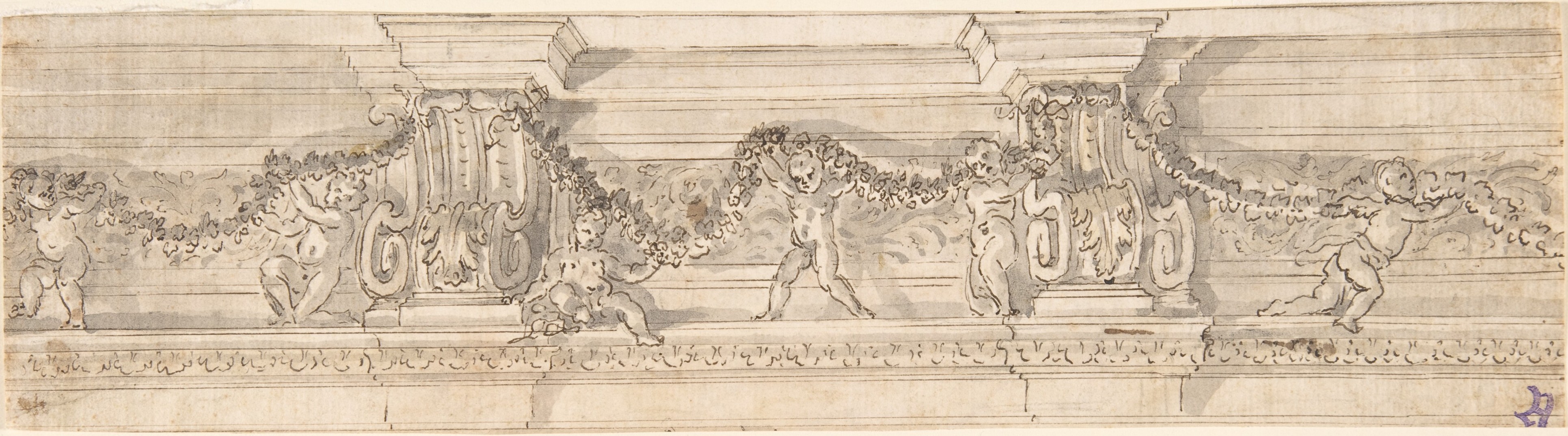
Architectural Poetics: The Frieze with Consoles, Putti, and Garlands as a Blueprint for 2026 Luxury
Within the Katherine Fashion Lab archive, the drawing titled Frieze with Consoles, Putti, and Garlands (recto); Fragment of Architectural design (verso) represents a singular artifact of strategic value. Executed in pen and brown ink with brush and gray wash over graphite and ruled construction, this work from an Ancient Civilization is not merely a study in ornamentation. It is a masterclass in the codification of power through adornment. For the 2026 luxury landscape, this object serves as a foundational text for understanding how heritage symbols can be reengineered into contemporary desirability.
Symbolic Power and the Architecture of Authority
The frieze, a horizontal band of decoration, has historically functioned as a site of ideological inscription. In the context of Ancient Civilization, the placement of a frieze on a temple, triumphal arch, or civic monument was never neutral. It was a strategic communication device. The inclusion of consoles—architectural brackets that project from the wall—is particularly significant. Consoles are structural supports, but in this drawing, they are transformed into ornamental anchors. They bear the weight of the garlands and provide a stage for the putti. This duality of function and beauty is the essence of luxury strategy: visible elegance supported by invisible, rigorous engineering.
The putti, or chubby male children, are often misread as mere decorative whimsy. However, in classical iconography, they are complex signifiers. They are descendants of cherubs and erotes, spirits of love and desire. In a funerary or civic context, they represent the soul's journey or the triumph of life over death. Their interaction with the garlands—pulling, lifting, and entwining—is a dynamic performance of vitality. For the luxury brand strategist, the putti teach a crucial lesson: heritage must be animated. A static logo or archival motif is insufficient. The 2026 consumer demands to see the brand's history actively engaged, laboring, and celebrating.
Historical Adornment and the Logic of the Garland
The garland is the central motif that unites the composition. Woven from leaves, fruits, and flowers, it is a symbol of abundance, fertility, and cyclical renewal. In the ancient world, garlands were draped on altars, statues, and doorways during festivals and religious rites. They were ephemeral in reality but eternal in stone and ink. This drawing captures that translation from the perishable to the permanent.
The medium itself reinforces this theme of permanence and process. The ruled construction visible beneath the ink reveals the intellectual scaffolding of the design. The gray wash creates volume and shadow, giving the flat frieze a sculptural, almost tactile quality. This is not a spontaneous sketch; it is a calculated blueprint for a three-dimensional experience. For Katherine Fashion Lab, this speaks to the necessity of a rigorous design language. The 2026 luxury strategy must move beyond surface-level aesthetics. It must demonstrate the "ruled construction" of its own creation—the ethical sourcing, the artisanal technique, the historical research—as a visible layer of value.
Spiritual Meaning and the Verso's Hidden Narrative
The verso, containing a Fragment of Architectural design, adds a layer of strategic depth. The presence of a secondary, incomplete design on the reverse side transforms the object from a finished artwork into a working document. It is a palimpsest of intention. This fragment suggests that the frieze was part of a larger, perhaps unrealized, program. It invites the viewer to imagine the whole from the part.
Spiritually, the combination of putti, garlands, and architectural fragments evokes the genius loci—the protective spirit of a place. The drawing was likely a preparatory study for a structure meant to invoke divine favor or commemorate a significant event. The spiritual meaning is not in a single icon, but in the holistic integration of structure (consoles), nature (garlands), and spirit (putti). This triad is the original luxury trinity: the material, the natural, and the transcendent.
2026 High-End Luxury Strategy: From Archive to Atelier
As we approach 2026, the luxury market is defined by a crisis of meaning. Digital saturation has devalued the purely visual. The new consumer—particularly the ultra-high-net-worth individual—seeks provenance, participation, and permanence. The Frieze with Consoles, Putti, and Garlands offers a direct strategic roadmap.
1. The Console Principle: Invisible Support for Visible Beauty. Luxury brands must articulate the "consoles" of their production. This means radical transparency in supply chains, investment in heritage craft techniques, and the creation of physical archives that can be visited and studied. The 2026 flagship store should feel like a cabinet of curiosities, where the "ruled construction" of a garment—the pattern, the stitching, the sourcing—is as celebrated as the final product.
2. The Putti Protocol: Animate the Heritage. Do not let heritage sit in a vitrine. The putti are active agents. For Katherine Fashion Lab, this translates into collaborative projects with contemporary artists to reinterpret archival motifs, or the development of a "living archive" where artisans create new works using ancient techniques. The brand narrative must show the struggle and the joy of creation, not just the polished result.
3. The Garland Economy: Cyclical Abundance. The garland symbolizes a regenerative economy. The 2026 luxury strategy must embrace circularity not as a compliance measure, but as a source of aesthetic and spiritual wealth. Limited editions that incorporate deadstock fabrics, or collections that celebrate seasonal harvests of natural dyes, align with the garland's promise of renewal. The spiritual meaning here is sustainability as a sacred duty.
4. The Verso Vision: Strategic Incompleteness. The fragment on the verso is a reminder that luxury is a continuous narrative. Brands should not present a finished, perfect facade. They should reveal the "verso"—the research, the failed prototypes, the historical fragments that inform the whole. This creates a deeper, more intellectual engagement with the client, transforming a transaction into a patronage.
In conclusion, the Frieze with Consoles, Putti, and Garlands is far more than an ancient drawing. It is a strategic asset. It encodes the principles of structural integrity, animated symbolism, regenerative abundance, and narrative depth. For Katherine Fashion Lab, the path to 2026 luxury leadership is not through novelty, but through the rigorous, spiritual, and deeply human application of these ancient codes. The future of luxury is not a break from the past; it is a sophisticated, MBA-level synthesis of its most powerful symbols.