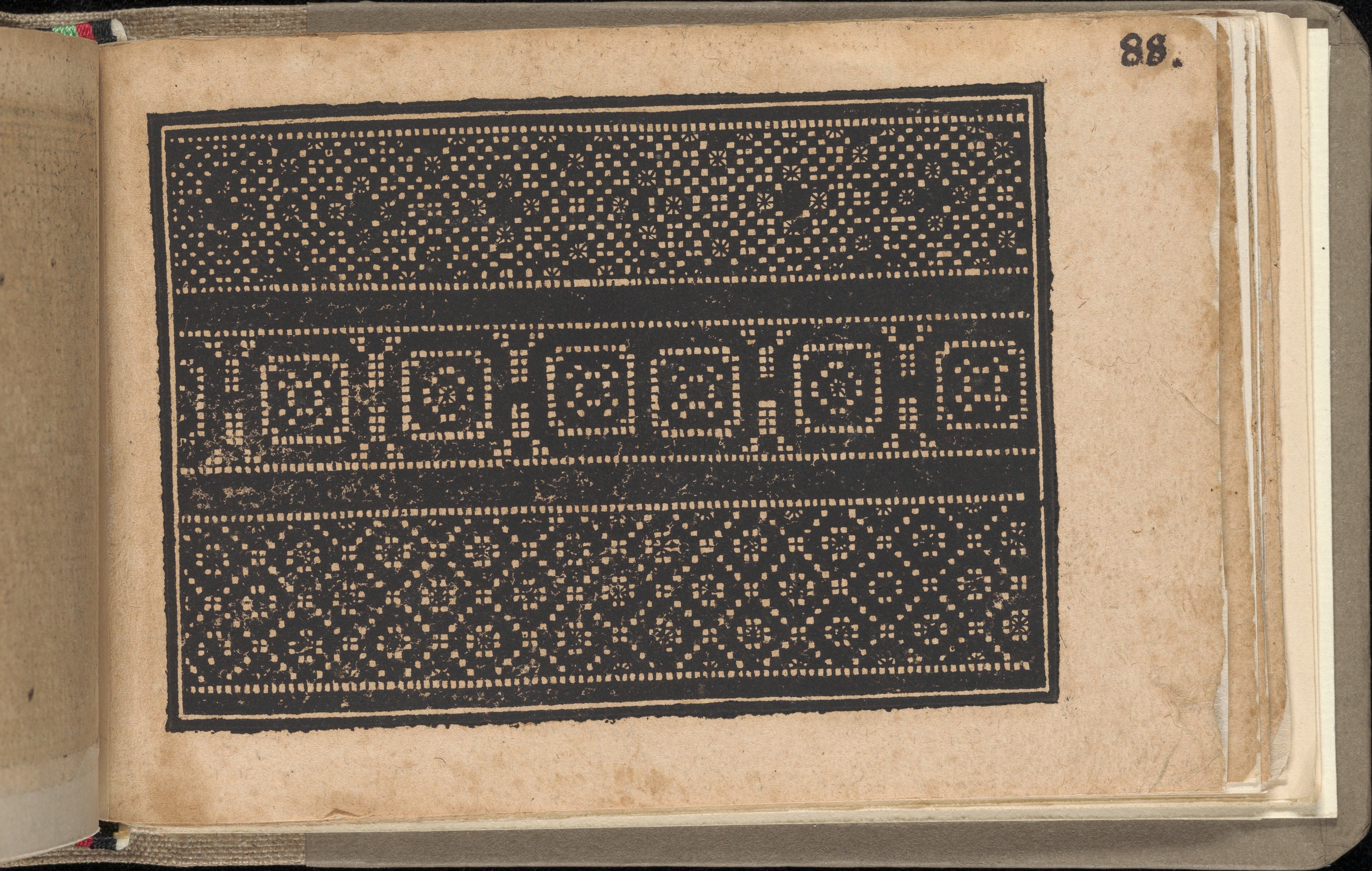
Schön newes Modelbuch, Page 88r: A Woodcut Grammar of Early Modern Ornament
The Schön newes Modelbuch occupies a singular position within the Global Heritage corpus of early modern decorative arts: it is at once a practical pattern book, a technical demonstration of the woodcut medium, and a material witness to the transnational circulation of ornament. Page 88r, examined here as a standalone study, rewards close reading precisely because it refuses to resolve into a single interpretive frame. It is neither purely utilitarian nor purely aesthetic, but a hybrid object in which the logic of the workshop and the ambitions of the printmaker converge.
Materiality and the Woodcut Matrix
The page is executed as a woodcut, a medium whose formal constraints shaped every mark upon the sheet. Unlike engraving, which permits the fine, tapering line and the illusion of tonal gradation, the woodcut demands that the designer think in terms of relief—of what remains after the gouge has cleared the field. The resulting aesthetic is one of decisive black against unprinted white, of positive shape rather than atmospheric modulation. Page 88r exemplifies this economy: its ornamental vocabulary is built from bold, legible strokes whose edges are firm and whose interiors are largely uninflected.
This material logic has consequences beyond the visual. Because the woodblock is a durable matrix, it can be re-inked, re-pressed, and reissued across decades, allowing a single design to migrate through workshops, cities, and even generations. The page before us is therefore not merely an image but a reproducible instrument—a template intended for transcription, adaptation, and re-use by embroiderers, cabinetmakers, and metalworkers. Its very survival attests to the commercial and pedagogical function of the Modelbuch genre, which flourished in the German-speaking lands from the mid-sixteenth century onward as a response to an expanding market for standardized ornament.
Compositional Analysis: Rhythm, Symmetry, and the Logic of the Repeat
Structurally, Page 88r operates through modular repetition. The dominant motif is reiterated with subtle variation, establishing a visual cadence that is at once predictable and alive. This is not the mechanical symmetry of a later industrial pattern book; it is a hand-governed regularity, in which minor asymmetries betray the intervention of the carver and the organic character of the pearwood or beech block.
Three compositional principles govern the page:
First, axial discipline. The design anchors itself along a central vertical, around which subordinate elements are balanced. This axis is not merely decorative but functional: it provides the needleworker or draftsman with an immediate reference line for transfer.
Second, interlocking negative space. The unprinted ground is not passive emptiness but an active counter-form. The woodcut's white intervals carry as much structural weight as the black, creating a figure-ground oscillation that anticipates the optical play of later Mannerist ornament.
Third, scalar modulation. Motifs expand and contract across the page, producing a hierarchy of attention. The eye is led from the dominant central element outward to secondary and tertiary details, a choreography that transforms a static pattern into a temporal experience of looking.
Ornamental Vocabulary and Its Genealogies
The motifs on Page 88r belong to the broad family of Renaissance grotesque and scrollwork, ultimately descending from the rediscovery of Roman wall painting in late fifteenth-century Italy. Yet the page is unmistakably Northern in its inflection: the vegetal forms are more robust, the scrolls more tightly coiled, and the overall effect more densely packed than the airier Italian prototypes. This is ornament that has passed through the filter of the German Vorlagen tradition, where the priority is not archaeological fidelity but usable density—the maximum of decorative information within the minimum of space.
One detects, too, the faint impress of arabesque conventions, transmitted via the Venetian printing trade and the Ottoman textile routes that fed into Central European luxury markets. The intertwining of leaf, tendril, and abstract geometry on this page is thus a palimpsest of cultural exchange, a visual record of the early modern world's connective tissue.
The Page as Pedagogical Instrument
What distinguishes the Modelbuch from the finished ornamental print is its instrumental transparency. Page 88r does not conceal its function behind pictorial illusion; it announces itself as a tool. The clarity of its line, the absence of shading, and the modularity of its composition all serve the needs of the copyist. In this sense, the page is closer to a musical score than to a painting: it is a set of instructions awaiting performance.
This pedagogical dimension situates the Modelbuch within the broader early modern economy of knowledge transfer. Pattern books circulated alongside herbals, anatomical plates, and architectural treatises as instruments of standardized practice. They enabled a dispersed community of makers—from the Nuremberg goldsmith to the Antwerp embroiderer—to work from a shared visual grammar, thereby contributing to the gradual emergence of a pan-European decorative idiom.
Conclusion: The Standalone Study as Method
To treat Page 88r as a standalone study is not to isolate it from its context but to attend to it with the seriousness its complexity demands. The page is a material argument about how ornament was thought, taught, and transmitted in the early modern period. Its woodcut technique, its modular composition, and its hybrid ornamental vocabulary together constitute a compact treatise on design as a reproducible and portable form of knowledge. For the contemporary curator, it remains a reminder that the most modest objects often carry the densest histories—and that the woodcut, far from being a crude medium, was among the most sophisticated technologies of visual dissemination the pre-modern world possessed.