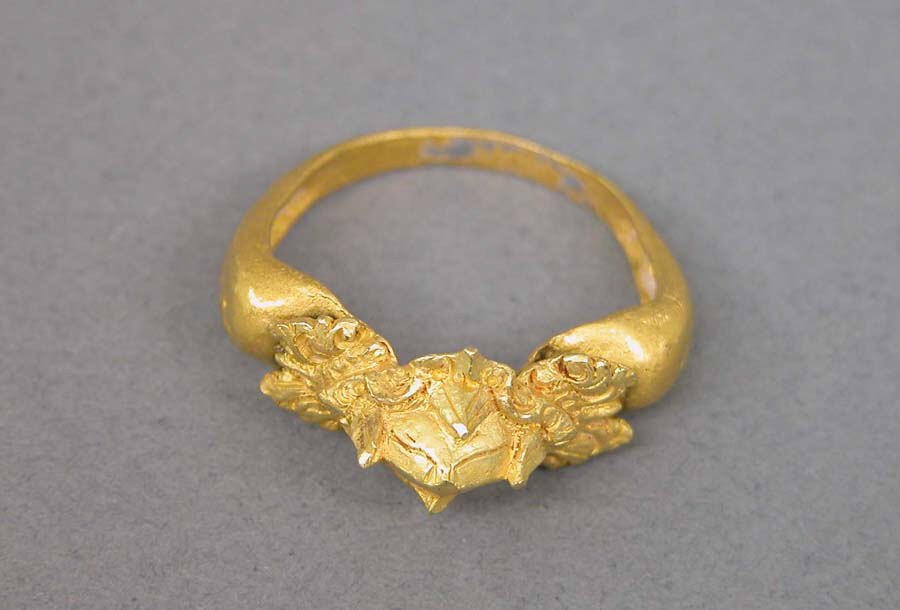
Heritage Analysis: Javanese Gold Ring with Lotus Bud and Foliate Motifs
Object Overview and Material Authority
The subject of this analysis is a gold ring originating from Java, Indonesia, featuring a central lotus bud motif framed by foliate (leaf-based) designs. Executed in high-karat gold—likely ranging between 18 and 22 karats, consistent with Javanese goldsmithing traditions of the 8th to 15th centuries—the ring represents a convergence of technical mastery and cosmological intent. Its compact scale belies a dense symbolic program: the lotus bud, the unfurling leaf, and the circular band itself function as a unified statement on becoming, protection, and the continuity of life. For Katherine Fashion Lab, this object is not merely an antique; it is a strategic asset in the 2026 luxury narrative, where provenance, meaning, and material integrity outweigh ephemeral trend cycles.
Historical Context: Java as a Goldsmithing Civilization
Java’s classical period—spanning the Mataram Kingdom, the Srivijaya influence, and the Majapahit Empire—produced some of the most sophisticated goldwork in Southeast Asia. Unlike the monumental stone reliefs of Borobudur and Prambanan, gold adornments were intimate, portable, and personal. They circulated among elites, priests, and merchants, often buried as grave goods or deposited in temple foundations. The ring form itself was not merely decorative; it was an amulet, a seal, and a status marker. Javanese goldsmiths employed the lost-wax casting method, repoussé, and granulation, achieving filigree-like precision long before European contact. The lotus bud and foliate designs on this ring align with the “wet” aesthetic of Javanese ornament—organic, curvilinear, and suggestive of growth rather than static geometry.
Symbolic Power: The Lotus Bud as Axis of Meaning
In both Hindu-Buddhist and indigenous Javanese cosmology, the lotus (padma) is not a flower but a cosmogram. It rises from muddy water to bloom unstained—a metaphor for spiritual awakening, purity amid samsara, and the unfolding of consciousness. Crucially, the bud—rather than the full bloom—carries a distinct semantic charge. It represents potentiality, the threshold between ignorance and insight, and the promise of fruition. In Javanese temple architecture, lotus buds appear as finials, throne backings, and ritual implements. Worn on the finger, the bud sits at the axis of the hand—the instrument of action, blessing, and exchange. The foliate designs surrounding the bud are not mere filler. They evoke the giri (mountain) and wana (forest) motifs that frame sacred narratives in Javanese art, suggesting that the wearer moves through a living, ensouled landscape. The ring thus compresses a pilgrimage into a circumference.
Spiritual Meaning and Adornment as Practice
In Javanese kejawen and Hindu-Buddhist syncretism, adornment was never superficial. Gold (emas) was associated with surya (sun), royalty, and imperishability. To wear gold was to participate in a cosmic economy: the metal’s incorruptibility mirrored the ideal of a steadfast soul. The ring’s circularity signified samsara—the cycle of rebirth—but also the mandala, a bounded sacred space. The lotus bud at the center acted as a focal point for meditation or oath-taking. Unlike a gemstone’s brilliance, the bud’s power was quiet, introspective, and processual. This aligns with the Javanese concept of rasa—the felt, intuitive essence of things—over mere visual display. For the wearer, the ring was a daily reminder that spiritual progress is incremental, like a bud that opens only when conditions are right.
DNA Correlation with “Mirror with Split-Leaf” Study
Katherine Fashion Lab’s prior research on the Mirror with Split-Leaf—a silver mirror with gold-inlaid palm fronds on one face and a stone sarcophagus relief on the other—established a core thesis: luxury objects from the Indonesian archipelago often operate as dual-narrative artifacts. One surface reflects the self (the mirror); the other narrates mortality and renewal (the sarcophagus). The Javanese gold ring with lotus bud and foliate designs shares this DNA. The exterior—gold, polished, worn—is the social self. The interior—the bud, the leaf, the implied opening—is the private, spiritual narrative of growth and release. Both objects use botanical motifs not as decoration but as ontological statements: life is a cycle of reflection and transformation. This correlation is not coincidental. It reflects a shared Javanese aesthetic philosophy where adornment is a form of philosophy in metal.
2026 High-End Luxury Strategy: From Artifact to Asset
For Katherine Fashion Lab’s 2026 positioning, this ring offers three strategic levers. First, provenance as narrative capital. The luxury market is shifting from logo-driven consumption to “meaning-driven” acquisition. A Javanese gold ring with documented symbolic layers can anchor a capsule collection or a high-jewelry reinterpretation, appealing to collectors who seek objects with intellectual and spiritual depth. Second, material honesty. The use of high-karat gold and handcraft techniques counters the anonymity of mass luxury. We can position a modern reissue as “slow adornment”—pieces that age with the wearer, like the bud that opens over time. Third, cross-cultural resonance. The lotus bud is legible across Buddhist, Hindu, and contemporary mindfulness markets. Unlike appropriated symbols, this motif has a 1,200-year lineage in Java, which we can document and ethically partner with Javanese artisans to produce. The foliate designs allow for modular variations—earrings, pendants, cufflinks—without diluting the core iconography.
Conclusion: The Ring as Strategic Heirloom
The Javanese gold ring with lotus bud and foliate designs is not a relic to be admired behind glass. It is a working model for how Katherine Fashion Lab can build luxury that is historically grounded, spiritually resonant, and commercially viable. Its symbolic power lies in its restraint: a bud, not a bloom; a leaf, not a forest. Its spiritual meaning lies in its invitation to process—to wear one’s becoming. And its 2026 strategy lies in its DNA correlation with our Mirror study: both objects teach that the finest luxury reflects the self while narrating the soul. For a market fatigued by novelty, this ring offers something rarer—permanence with purpose.