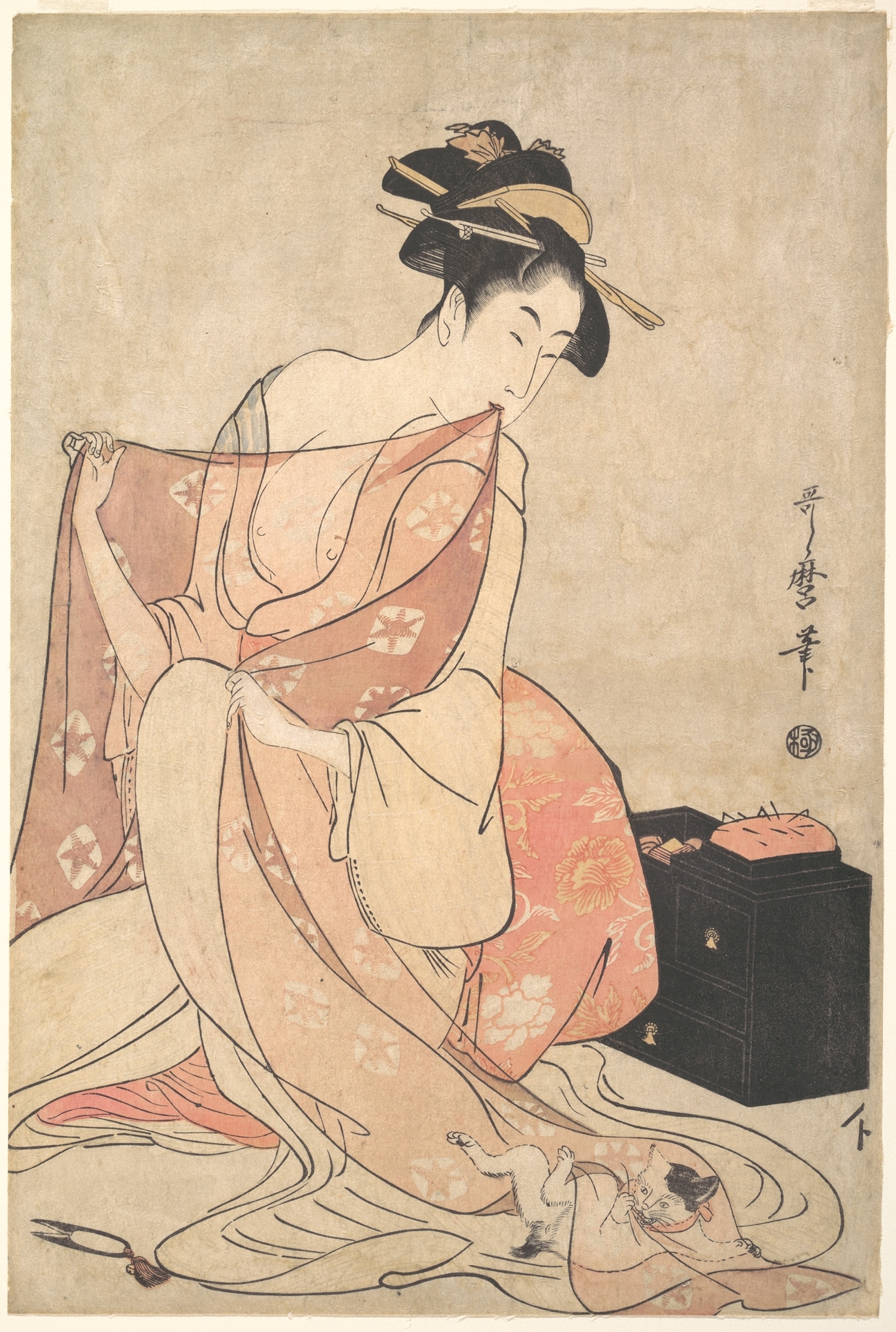
Deconstructing the Silhouette: A Couture Analysis of "A Woman and a Cat"
The woodblock print, as a medium, is an exercise in decisive constraint. Each line, carved irrevocably into the wooden key block, represents a commitment; each color, applied via separate blocks, a calculated layer of meaning. In the Japanese print A Woman and a Cat, we find not merely a domestic scene but a profound study in silhouette, texture, and spatial relationship that offers a masterclass in avant-garde couture principles. For Katherine Fashion Lab, this standalone study serves as a potent source code, revealing how the interplay of negative space, controlled drapery, and organic asymmetry can construct a narrative of serene power and intimate complexity. The subject is not just a woman with her pet, but a dialogue between two distinct yet harmonious forms, a sartorial metaphor waiting to be translated from ink and paper to fabric and form.
The Architecture of Restraint: Silhouette and Negative Space
The most immediate couture lesson lies in the print's masterful use of silhouette and negative space. The woman’s kimono, a dominant geometric form, is defined not by intricate interior detail but by its bold, clean outline against the muted background. This is the essence of a strong couture silhouette—a shape that communicates identity before a single stitch or embellishment is considered. The kimono’s rectangular form, broken only by the gentle, triangular taper of the collar and the soft curve where her hand emerges, speaks to a design philosophy rooted in architectural integrity. For a contemporary collection, this translates to garments built from the outside in: coats with graphic, unbroken hemlines; dresses where the cut itself is the primary ornament.
Furthermore, the negative space—the empty floor around her, the expanse of the tatami mat—is as crucial as the positive forms. In fashion, this equates to the skin revealed, the gaps between layers, the strategic use of transparency or sheer panels. The cat, a compact, dark mass, occupies its own portion of this negative space, creating a dynamic balance. A Katherine Fashion Lab interpretation might explore a look where the main garment is a single, sculptural form, "interrupted" or balanced by a smaller, texturally contrasting accessory or underlayer—a sleek, woolen cocoon coat juxtaposed with a intricate, furry bolero, each occupying its own defined spatial field.
Textural Allegory: Kimono, Skin, and Fur
The print’s limited palette forces a focus on texture as narrative. We discern three primary textures: the flat, patterned plane of the kimono; the smooth, unmarked skin of the woman’s face and neck; and the soft, stippled, almost vibrating quality of the cat’s fur. This triad is a foundational blueprint for a couture ensemble. The kimono’s pattern, likely a subtle geometric or kasuri (ikat) motif, suggests a fabric with a woven-in story—a jacquard, a brocade, or a finely printed silk. This represents the structured textural base of a look.
The woman’s skin, a flawless expanse, translates to fabrics of sublime, quiet luxury: liquid crepe, polished cotton, or matte satin. This element introduces a note of human vulnerability and calm amidst structure. The cat’s fur, however, is the wild card—the element of tactile surprise and organic irregularity. In couture terms, this is the province of fringing, feathering, meticulous embroidery that mimics plushness, or the use of innovative materials like brushed technical textiles or manipulated velvet. The genius of the composition is how these textures converse: the smooth skin bridges the gap between the hard geometry of the cloth and the soft chaos of the fur. A Lab creation might manifest this as a dress with a severe, architectural bodice (the kimono) in duchesse satin, a deep V-neckline revealing a panel of sheer, skin-like mesh (the flesh), and sleeves or a hem exploded into thousands of silk-thread fringe (the fur), creating a dialogue between control and release.
The Asymmetry of Intimacy: Composition and Emotional Gravity
The composition is deceptively simple yet profoundly asymmetrical. The woman is positioned off-center, her gaze directed downward and inward, towards the cat. The cat itself curls in the lower corner, a stabilizing anchor. This asymmetry generates a powerful sense of intimate narrative and emotional gravity. There is a diagonal line of connection—from the woman’s face, down her arm, to the feline form. This is not a static portrait but a captured moment of relationship.
For couture, this teaches us about emotional drape and directional focus. A garment can be designed to lead the eye along a specific path. Seam lines might sweep diagonally across the body; embellishment could cluster asymmetrically near the hip or shoulder, pulling the silhouette into a narrative of movement and connection, much like the woman’s gaze pulls the viewer’s eye. The "standalone" nature of this study encourages viewing the ensemble as a complete, self-contained world. Every element, from the shoe to the earring, must contribute to this asymmetrical story. Perhaps one shoulder is emphasized with monumental padding or drape (the woman’s solid form), while the opposite side of the garment falls away cleanly, with a detail—a tassel, a knot, a flash of lining—that echoes the cat’s curled form, creating a cohesive, balanced imbalance.
From Ukiyo-e to Haute Couture: A Conceptual Translation
The ultimate takeaway for Katherine Fashion Lab is the print’s demonstration of how to convey profound depth with elegant economy. The Ukiyo-e "floating world" aesthetic, often concerned with transient beauty, is here focused on a timeless, quiet moment. Translating this into a modern couture context means pursuing a philosophy of essentialism. It is not about minimalism for its own sake, but about the maximum impact of precisely chosen elements: one devastating silhouette, one master-texture conversation, one asymmetrical point of emotional focus.
The woman and the cat are two separate entities bound by shared space and quiet understanding. In a fashion context, this could be expressed as a two-look capsule within a collection: one look embodying the serene, structured geometry of the woman (a tailored kimono-inspired coat-dress in indigo and slate), and the other capturing the agile, textured essence of the cat (a draped, furry separates look in charcoal and black). Together, they tell a complete story. A Woman and a Cat is, therefore, far more than a period artifact. It is a rigorous study in composition, contrast, and quiet emotion—a timeless blueprint for creating fashion that speaks not through volume, but through resonant, considered silence.