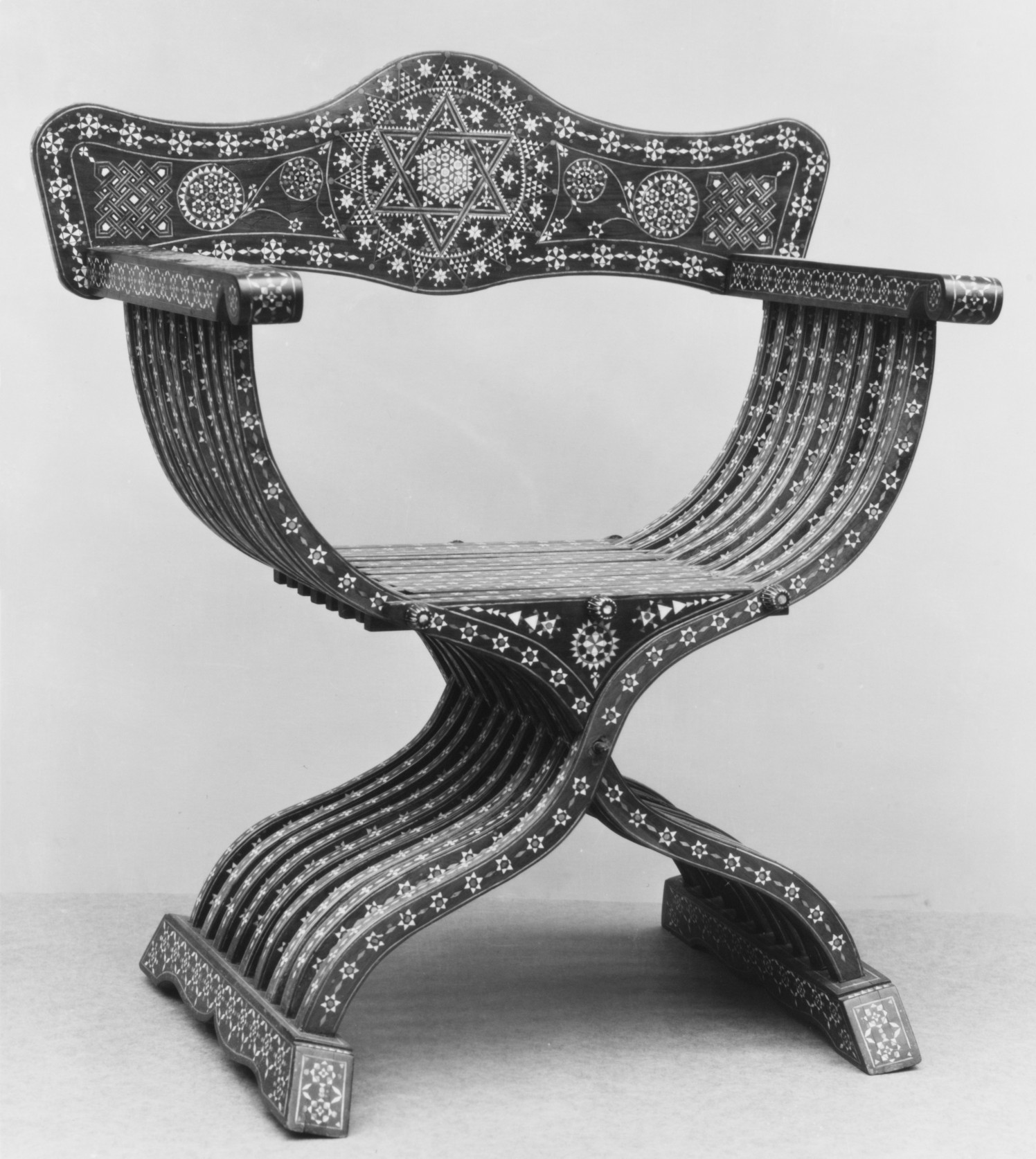
Executive Summary: The Folding Chair as a Proto-Luxury Artefact
This strategic standalone research paper, prepared for Katherine Fashion Lab, deconstructs the folding chair—specifically an artefact crafted from walnut and inlaid with ivory from an ancient civilization—as a foundational object in the history of luxury. Moving beyond mere furniture, this analysis positions the chair as a concentrated locus of symbolic power, advanced craftsmanship, and spiritual meaning. For a forward-facing luxury entity like Katherine Fashion Lab, this historical excavation is not an academic exercise but a vital strategic resource. By decoding the ancient language of adornment and authority embedded in this object, we can distill a timeless framework for 2026's high-end luxury strategy, one that must increasingly balance conspicuous materiality with profound narrative depth and ritualistic value.
Deconstructing the Artefact: Materiality as Message
The specified materials—walnut and ivory—are not arbitrary selections but deliberate carriers of meaning. In ancient contexts, walnut, a dense, hard, and finely-grained wood, represented endurance, wisdom, and earthly stability. Its cultivation and seasoning required long-term planning, mirroring the enduring nature of dynastic power. Ivory, sourced from elephant or hippopotamus tusks, was a transcontinental luxury material par excellence. Its acquisition spoke of vast trade networks, imperial reach, and the subjugation of nature's most formidable creatures. The inlay process itself—the meticulous setting of ivory into carved channels in the walnut—is a metaphor for the civilization's worldview: a stable, structured order (walnut) adorned with and elevated by rare, luminous beauty (ivory). This material dialectic forms the first pillar of ancient luxury: the inseparable fusion of substantial foundation and exalted ornamentation.
Historical Adornment: The Semiotics of Surface
The ivory inlay is our primary text for understanding historical adornment. Its patterns were never merely decorative; they were a heraldic language. Common motifs might include solar discs (signifying divine mandate), interlocking labyrinths (representing protection or esoteric knowledge), or stylized flora/fauna denoting territorial dominion or mythological narratives. The adornment was placed strategically: along the crest rail (framing the sitter's head like a halo), on the arms (points of contact and display), and on the chair's legs (emphasizing strength and mobility). This transforms the chair from a static object into a narrative canvas. The adornment served a dual audience: it affirmed the sitter's identity and status to themselves, while broadcasting a complex, legible message of power to any observer. For Katherine Fashion Lab, this underscores a critical principle: future luxury must treat surface design as legible symbolism, where every pattern, texture, and application point carries intentional, decipherable meaning for a connoisseur audience.
The Triad of Symbolic Power: Mobility, Elevation, and Enthronement
The folding chair's form factor is itself a profound symbol. In static ancient societies, mobility was a privilege of the military commander, the itinerant judge, and the sovereign on campaign. A folding chair, or "sella curulis" in the Roman context, was a portable throne. Its very functionality—collapsible for transport, erect for use—symbolized the extension of centralized authority beyond the palace walls. It represented law, command, and the dynamic imposition of order.
Furthermore, the chair intrinsically creates a hierarchy of elevation. It physically raises the sitter above the ground, separating them from the common plane. This act of elevation is a spatial manifestation of social and spiritual stratification. When combined with the luxurious materials and adornment, the chair becomes an instrument of enthronement. It does not just seat a person; it performs the act of instating authority. The object actively confers status upon its user, a concept central to luxury's aspirational engine. The 2026 luxury consumer does not seek a product; they seek an instrument that confers a specific, elevated identity.
Spiritual Meaning: The Liminal Object
Beyond temporal power, such chairs often occupied a sacred liminal space. They were used in religious ceremonies, funerary contexts, or as votive offerings. The walnut, from the living earth, and the ivory, from a sacred animal, could bridge the human and the divine. The chair might symbolize a seat for a deity, a vehicle for an ancestor's spirit, or a platform for a priest-king serving as an intermediary. This imbues the object with ritual weight and talismanic property. It is not just used; it is engaged with in ceremonies that transcend the mundane. This spiritual dimension is the most potent yet underleveraged arena for future luxury. In an age of digital ephemerality, objects that facilitate ritual, mindfulness, and a connection to a deeper narrative—whether cultural, personal, or spiritual—will command the highest premium.
Strategic Synthesis: The 2026 Luxury Strategy for Katherine Fashion Lab
Translating this heritage analysis into a forward-looking strategy requires moving from archaeology to alchemy—transforming historical principles into contemporary value propositions.
1. The Architecture of Substance & Light:
Emulate the walnut-and-ivory dialectic. Develop product architectures where foundational elements (a coat's cut, a bag's structure) are executed in materials of peerless, enduring quality—innovative technical textiles with the substantial feel of ancient woods. Adornment—the "ivory inlay"—should then be applied as intentional, luminous highlights: not ubiquitous logos, but precious, narratively charged hardware, embroidery, or closures that tell a story. This creates a modern hierarchy of value, rewarding closer inspection.
2. Symbolic Legibility & Personal Heraldry:
Move beyond generic monograms. Develop a new symbolic lexicon for KFL, inspired by ancient motifs but abstracted into a modern visual language. Offer clients the service of integrating personal symbols—representing lineage, achievement, or aspiration—into custom pieces. This transforms adornment from decoration into personal heraldry, echoing the chair's function as a canvas of identity.
3. The Ritual of Portability & Enthronement:
Design for ceremonial use and dynamic life. Create pieces that facilitate modern rituals—a meticulously crafted travel set that transforms a hotel room into a personal suite of power, a garment structured for a singular, pivotal event. The product should feel like it actively prepares and positions the wearer for a moment of impact, much as the folding chair prepared the ground for a ruler's judgment.
4. The Narrative of Provenance & Craft as Conquest:
Like the ivory trade, document and mythologize the sourcing journey. Partner with rare, sustainable material innovators (modern equivalents of ancient trade networks). Highlight the "conquest" of a complex technique, the mastery over a difficult material. The story should be one of human ingenuity achieving the extraordinary, framing KFL not just as a maker, but as a curator and translator of impossible luxury.
Conclusion: From Seat to Signature
The ancient folding chair of walnut and ivory was a compact manifesto of power. It spoke through material contrast, symbolic adornment, functional ceremony, and spiritual allusion. For Katherine Fashion Lab, this object provides a canonical blueprint. The 2026 high-end luxury market will be won by brands that understand that ultimate luxury is the creation of talismanic instruments for modern life—objects that carry legible symbolism, facilitate personal ritual, and are built upon a foundation of profound substance and narrative integrity. By applying the ancient principles of symbolic concentration and ritual utility, KFL can craft not merely collections, but contemporary heirlooms that, like the folding chair, serve as both a seat of authority and a signature of sovereign identity.