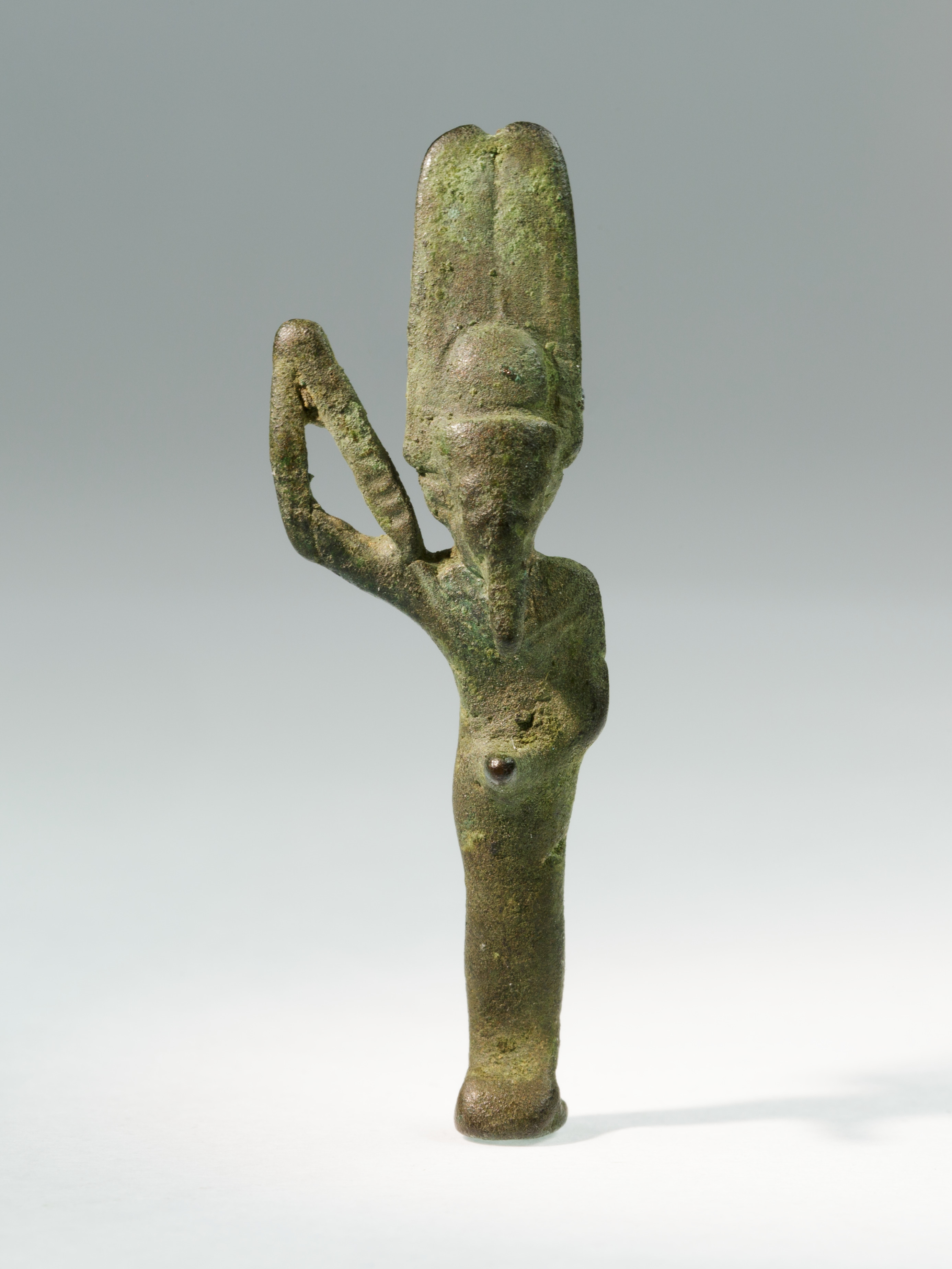
Heritage Asset Analysis: The Amulet of Min
Introduction and Material Context
The Amulet of Min represents one of the most compelling convergence points between ancient Egyptian metaphysical practice and the contemporary luxury market's appetite for authenticated heritage narratives. Fabricated from a cupreous alloy—an intentional amalgam of copper with trace elements that would have been understood by ancient smiths as a material of deliberate consecration—this amulet served a dual function: a devotional instrument and a wearable marker of status. For Katherine Fashion Lab's strategic standalone research initiative, the Amulet of Min offers a case study in how material intelligence, symbolic density, and ritual function can inform a 2026 luxury product architecture that privileges provenance over novelty.
The amulet's copper-dominant composition is not incidental. In ancient Egyptian metallurgy, copper was associated with the generative power of the earth and the life-giving properties of the Nile's silt. The cupreous alloy's patina—a verdigris surface that signals both age and chemical authenticity—has become, in contemporary luxury semiotics, a shorthand for "time-earned value." This is precisely the register in which Katherine Fashion Lab must operate: not replicating antiquity, but translating its material logic into objects that carry evidentiary weight.
Symbolic Power: Min, Fertility, and the Architecture of Generative Authority
Min, the ancient Egyptian god of fertility, virility, and the harvest, occupied a paradoxical position in the pantheon. He was simultaneously a god of agricultural abundance and a deity of cosmic generation, often depicted in ithyphallic form with raised arm holding a flail—a gesture of both dominance and blessing. The Amulet of Min, worn close to the body, was therefore not merely decorative. It was a portable altar: a compression of divine potency into a form that could travel with its bearer through trade routes, military campaigns, and diplomatic missions.
The symbolic power of the amulet resides in its capacity to conflate the biological and the political. In the ancient world, fertility was not a private concern but a matter of statecraft: the ability to produce heirs, to ensure agricultural yield, to sustain armies. To wear the Amulet of Min was to signal one's alignment with these generative forces. For Katherine Fashion Lab, this historical layering suggests a luxury strategy that moves beyond the aesthetic to the functional-symbolic: objects that are understood to do something for the wearer, not merely to adorn.
The amulet's cupreous surface, with its warm, blood-adjacent tonality, reinforced this association. Copper's antimicrobial properties—empirically validated in modern materials science—would have been intuited by ancient wearers as a protective force. This pre-scientific intuition maps neatly onto contemporary wellness luxury, where material efficacy is a primary driver of premium pricing.
Historical Adornment: From Ritual Instrument to Status Marker
Amulets in ancient Egypt were not uniform in quality or function. Those fashioned from cupreous alloys occupied a middle tier: more accessible than gold or electrum, but significantly more prestigious than faience or bone. The Amulet of Min, in its alloyed form, thus represents an early instance of what we might call democratized luxury—a product that extended spiritual and social capital to a broader class of wearers while retaining the material authority of metal.
Archaeological contexts for such amulets—burial assemblages, temple caches, and domestic shrines—indicate that they were worn in life and interred in death. This continuity of use suggests an object biography that luxury brands rarely achieve: a single artifact that served ritual, cosmetic, and mnemonic functions simultaneously. The amulet was jewelry in the modern sense, but it was also a document, a contract with the divine, and a memento mori.
For Katherine Fashion Lab, the lesson is clear: the most durable luxury objects are those that operate across multiple registers of meaning. A 2026 collection inspired by the Amulet of Min should not present a single-function pendant but a multi-valent talisman—one that can be read as adornment, as investment, and as personal cosmology.
Spiritual Meaning: Consecration, Continuity, and the Wearable Sacred
The spiritual efficacy of the Amulet of Min was predicated on consecration—a ritual process that transformed a crafted object into a vessel for divine presence. This process, which likely involved incantations, anointing with oils, and exposure to temple environments, created what we might term an aura of authentication. The amulet was not merely believed to be powerful; it was made powerful through a sequence of authorized actions.
Contemporary luxury has its own consecration rituals: limited editions, artisan signatures, provenance documentation, and brand-controlled distribution. The Amulet of Min suggests that these rituals can be deepened by explicit spiritual framing. A 2026 high-end strategy for Katherine Fashion Lab should consider the deliberate creation of consecration narratives—not as marketing fiction, but as genuine ceremonial processes that imbue objects with story, intention, and community recognition.
The amulet's spiritual meaning also lies in its continuity. Unlike ephemeral fashion, it was designed to persist across generations. Its cupreous alloy, while softer than gold, was chosen for its responsiveness to touch and time—it would acquire a unique patina from each wearer, becoming a collaborative artifact between maker, user, and duration. This is the antithesis of disposable luxury and the essence of what heritage-driven brands must recover.
2026 High-End Luxury Strategy: From Artifact to Architecture
Translating the Amulet of Min into a 2026 luxury strategy requires more than aesthetic citation. It demands an architectural approach to product development, in which material, symbol, ritual, and narrative are integrated from the outset. Katherine Fashion Lab should consider three strategic pillars:
First, material honesty. The cupreous alloy's specific composition—its copper dominance and trace additives—should be researched and, where possible, replicated using responsibly sourced metals. The resulting patina should be allowed to develop naturally, with care instructions that frame aging as value accretion rather than deterioration.
Second, symbolic density. The Amulet of Min's power derives from its layered references: Min's generative authority, the flail's disciplinary gesture, the ithyphallic form's unapologetic vitality. A 2026 collection should embrace this density without irony, creating objects that reward close reading and invite personal interpretation.
Third, ritual integration. The amulet's original consecration should inspire a modern equivalent: a documented process of blessing, intention-setting, or personalization that transforms a purchase into an initiation. This could take the form of a private ceremony, a written invocation, or a digital provenance record that travels with the object.
In conclusion, the Amulet of Min is not a relic to be admired from a distance but a strategic template for luxury that is material, meaningful, and made to last. For Katherine Fashion Lab, its cupreous alloy and generative symbolism offer a blueprint for 2026: objects that carry power because they are understood to be powerful, and that earn their place in the wearer's life through continuous, embodied use. The ancient Egyptians knew that adornment was never merely decorative. The luxury market of 2026 would do well to remember the same.