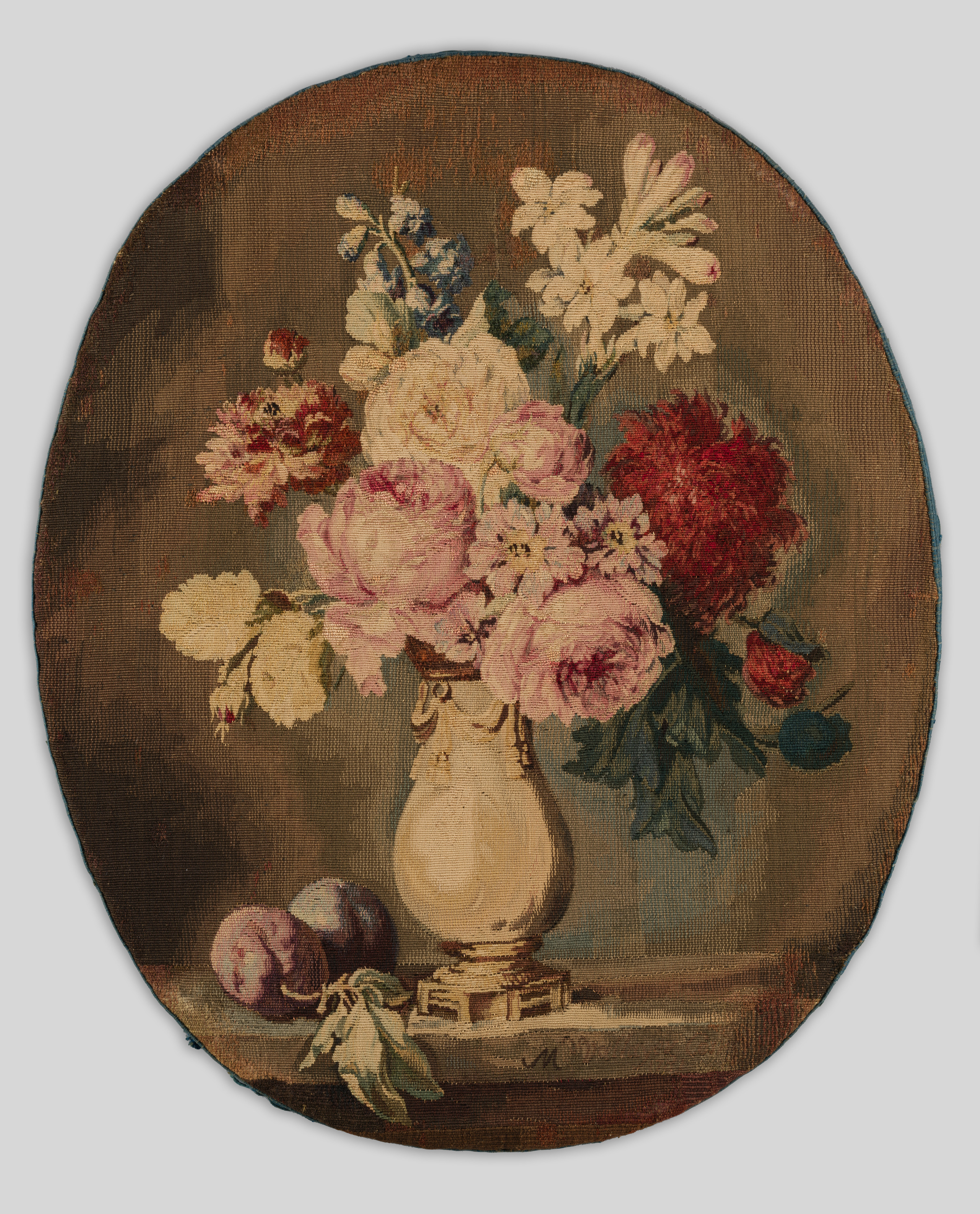
Materiality and Structure: A Technical Reading of Wool and Silk in Flowers in a Vase and Two Plums
Flowers in a Vase and Two Plums occupies an unusual position within the Global Heritage canon: it is a standalone study, unanchored to any larger suite, series, or ceremonial commission. This autonomy is precisely what makes it instructive. Freed from the narrative obligations that govern coordinated textile programs, the piece functions as a closed aesthetic argument—a self-contained proposition about how wool and silk can be made to speak to one another across a single plane of woven surface.
At the technical level, the textile is defined by a sett of 25 warps per inch (10 per centimeter)—a relatively open configuration that sits at the lower end of fine weaving. This is not the density of a tapestry-grade silk, nor the compactness of a heavy furnishing wool. It is a deliberately porous structure, one that privileges the behavior of the yarn over the opacity of the cloth. Understanding this choice requires examining the two fibers in concert.
Wool as Ground, Silk as Event
Wool supplies the structural logic of the piece. Its natural crimp and elasticity allow it to hold a stable ground while absorbing the tension of the weaving process. In a sett of 25 ends per inch, wool warps can be spaced without compromising the integrity of the cloth, because the fiber's surface scales interlock and compensate for the reduced density. The result is a ground that breathes—one that does not assert itself as a wall of color but rather as a receptive field.
Silk, by contrast, operates as the event within this field. Its filament length, luster, and tensile strength allow for finer, more reflective passages that catch light differently from the wool matrix. Where wool diffuses illumination, silk directs it. In Flowers in a Vase and Two Plums, this optical contrast is the primary expressive instrument. The floral motifs and the two plums are not merely depicted; they are optically differentiated from the ground through the selective deployment of silk against wool. The vase, the blossoms, and the fruit emerge not through outline or heavy contrast, but through a shift in how light behaves across the surface.
The Standalone Study as Formal Discipline
Because the work is a standalone study, it lacks the redundancy that often accompanies larger commissions. There is no second panel to clarify the first, no border to contain the composition, no accompanying textile to establish a rhythm of repetition. Every decision must justify itself within a single frame. This constraint intensifies the relationship between material and image.
The two plums, positioned as a counterweight to the vase, demonstrate this discipline. In a larger suite, the fruit might function as a recurring motif—a signature repeated across panels. Here, it appears once, and its placement must carry the full weight of the composition's balance. The silk passages that render the plums are likely denser than those used for the blossoms, creating a subtle hierarchy of reflectivity: the fruit reads as heavier, more saturated, more present. The wool ground, meanwhile, remains continuous, refusing to break into separate registers. The composition holds together because the material holds together.
Global Heritage and the Question of Provenance
The designation Global Heritage is not a geographic attribution but a curatorial one. It signals that the piece belongs to a broader conversation about textile knowledge that crosses regions and centuries. The combination of wool and silk at 25 warps per inch is not unique to any single tradition; it appears in varying forms across Anatolian, Central Asian, and European weaving histories. What distinguishes Flowers in a Vase and Two Plums is not the novelty of its materials but the specificity of its execution.
The floral vocabulary—a vase, blossoms, fruit—is equally widespread. Yet the standalone format strips away the contextual cues that usually accompany such imagery. There is no inscription, no date, no dedicatory border. The viewer encounters the motifs without narrative scaffolding. This is where the material analysis becomes essential: in the absence of external information, the cloth itself must carry the argument. The wool-silk interplay, the open sett, the selective luster—these are the terms of the piece's self-presentation.
Conservation and the Integrity of the Open Sett
From a conservation standpoint, the 25-warps-per-inch structure presents specific challenges. Wool is susceptible to moth damage and moisture-induced distortion; silk is vulnerable to light degradation and abrasion. In a cloth where the two fibers are interwoven at a relatively open sett, the risk of differential aging is significant. Silk passages may fade or weaken at a different rate than the wool ground, potentially disrupting the optical balance that defines the composition.
This fragility reinforces the importance of the standalone study as a category. Unlike a large commission, which might be replicated or documented across multiple examples, a standalone piece is irreplaceable. Its material argument exists in a single instance. The curatorial responsibility, therefore, extends beyond preservation to interpretation: ensuring that the relationship between wool and silk, ground and motif, remains legible even as the fibers age.
Conclusion: A Closed Argument
Flowers in a Vase and Two Plums is not a fragment of something larger. It is a complete statement about what wool and silk can do when woven together at a sett that favors air over density. The 25 warps per inch are not a limitation but a premise. The standalone format is not a reduction but a concentration. In the absence of a suite, the piece becomes its own context—a Global Heritage study that asks the viewer to read material as meaning, and surface as argument.