Heritage Analysis: The British Gauntlet as Instrument of Power, Devotion, and Luxury Signal
Introduction: The Glove That Governs
The gauntlet occupies a singular position within the British material imagination: it is at once a practical defense for the hand and a symbolic extension of the sovereign will. Unlike the glove, which adorns and conceals, the gauntlet armors and authorizes. In the British tradition—from medieval tournament fields to Tudor coronation rites, from Civil War cavalry to the ceremonial wardrobes of the Order of the Garter—the gauntlet has functioned as a portable emblem of jurisdiction. For Katherine Fashion Lab, the gauntlet represents a strategically rich heritage asset: a form that carries martial authority, sacred oath, and courtly refinement in a single silhouette. This analysis examines its British origins, its tri-material construction in leather, silk, and metal, and its translation into a 2026 high-end luxury strategy.
Historical Origins: From Battlefield to Coronation
The British gauntlet emerges from the convergence of Norman knightly armor and indigenous craft guilds. By the twelfth century, mail mittens with divided thumbs protected the hands of mounted warriors; by the fourteenth, plate gauntlets articulated in steel became the mark of the fully armed man-at-arms. Yet the object's cultural ascent was not merely technological. In the feudal order, the act of casting down a gauntlet constituted a formal challenge, while the receiving of a gauntlet from a lord signified investiture—the transfer of land, title, or command. The gauntlet thus encoded a legal grammar: it was evidence of delegated power.
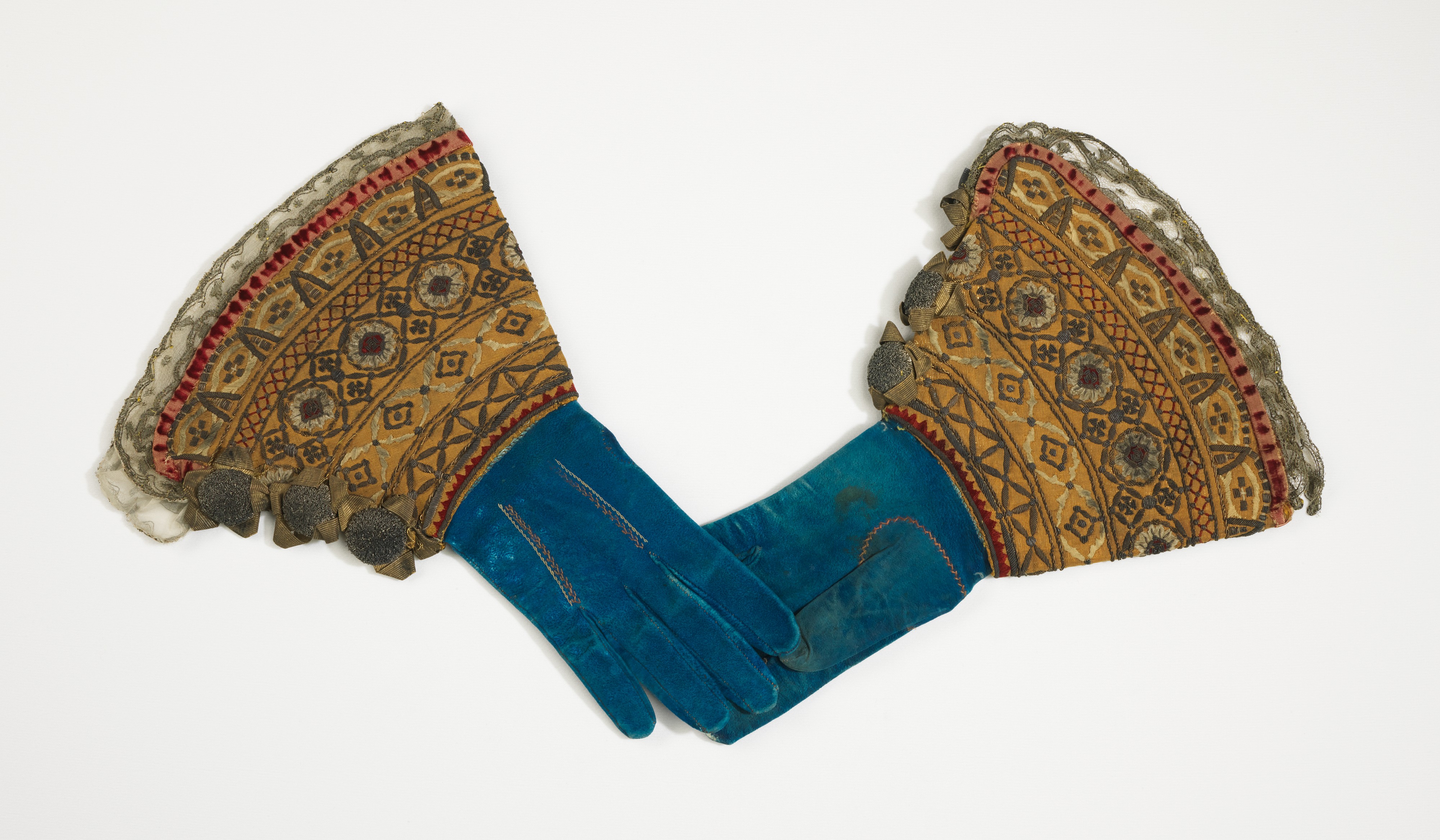
This legal-symbolic function reached its apex in the British coronation ceremony. The sovereign's gauntlet, presented during the investiture, symbolizes the hand of justice and the monarch's role as fount of honor. In the Order of the Garter, established by Edward III in 1348, the gauntlet appears within the heraldic achievement of knights, linking personal virtue to martial service. By the seventeenth century, the gauntlet had bifurcated: a hardened military form for cavalry and a softer, embroidered ceremonial form for court. This duality—armor and adornment—is the creative tension Katherine Fashion Lab can exploit.
Material Trinity: Leather, Silk, Metal
The British gauntlet's authority derives from its composite construction, each material carrying distinct cultural weight.
Leather provides the structural and tactile foundation. Historically sourced from English tanneries—oak-bark tanned for durability—leather signified the craftsman's hand and the rider's grip. It is the material of labor, loyalty, and the body's memory. In luxury terms, leather communicates intimacy and patina; it ages with the wearer, becoming biographical rather than merely decorative.
Silk introduces the courtly and the sacred. British silk weaving, centered in Spitalfields from the seventeenth century, supplied the linings, ribbons, and embroidered cuffs of ceremonial gauntlets. Silk's sheen and suppleness signal refinement and devotion; in ecclesiastical contexts, silk-lined gauntlets were worn by bishops at pontifical Mass, the material mediating between the earthly hand and the divine office. Silk is the material of vow and blessing.
Metal—whether steel, silver, or gilded brass—supplies the gauntlet's apotropaic and juridical force. Metal studs, articulated knuckle plates, and embroidered wirework transform the hand into an instrument of consequence. In British heraldry, metal (or and argent) denotes nobility and purity. In spiritual terms, metal's incorruptibility mirrors the eternal; its reflective surface catches light as a sign of presence and watchfulness.
The trinity is not additive but dialectical: leather grounds, silk elevates, metal authorizes. A Katherine Fashion Lab gauntlet must resolve these forces without collapsing into costume.
Symbolic Power and Spiritual Meaning
The gauntlet's symbolic power rests on the hand as the body's executive organ. To cover the hand is to mediate action; to armor it is to sanctify force. In British folklore and literature—from Beowulf to Malory to Shakespeare—the gauntlet appears at moments of oath, challenge, and recognition. It is a threshold object: the point at which intention becomes deed.
Spiritually, the gauntlet carries a paradox. It is both a shield against impurity and a vessel of blessing. Medieval liturgical gloves and gauntlets were consecrated before use, their silk linings symbolizing the wearer's interior purity, their metal embroidery the armor of faith. The British mystical tradition, particularly in its Anglican and Celtic strands, treats the hand as a site of healing and anointing. A gauntlet therefore compresses protection and transmission: it guards the hand that gives.
2026 Luxury Strategy: Standalone Research Implications
For Katherine Fashion Lab, the gauntlet should not be positioned as a seasonal accessory but as a strategic standalone object—a heritage artifact reissued with contemporary authority. Three strategic pillars follow from the research.
First, narrative scarcity. The gauntlet's British lineage is under-exploited in luxury compared to the handbag or the watch. By claiming the gauntlet as a signature form, the brand enters a category with deep symbolic reserves and low competitive density. Limited editions tied to specific British rites—coronation, Garter, equestrian—create provenance-driven demand.
Second, material integrity as brand proof. The leather-silk-metal trinity offers a tangible demonstration of craft. Each material can be sourced and narrated: oak-bark leather from heritage tanneries, Spitalfields-inspired silk, responsibly sourced metalwork. In a 2026 market skeptical of abstraction, material transparency is a luxury signal.
Third, gender-agnostic authority. The gauntlet is historically unisex in function though gendered in ornament. A 2026 interpretation can deploy the form across menswear and womenswear without dilution, positioning it as an object of power rather than a gendered accessory. The spiritual dimension—protection, vow, blessing—offers emotional resonance beyond status.
Executed with restraint, the gauntlet becomes more than a product: it becomes a proposition about agency. In a luxury landscape saturated with softness, the British gauntlet offers hardness with meaning—a hand armored, a hand extended, a hand that authorizes. For Katherine Fashion Lab, that is a heritage worth claiming.