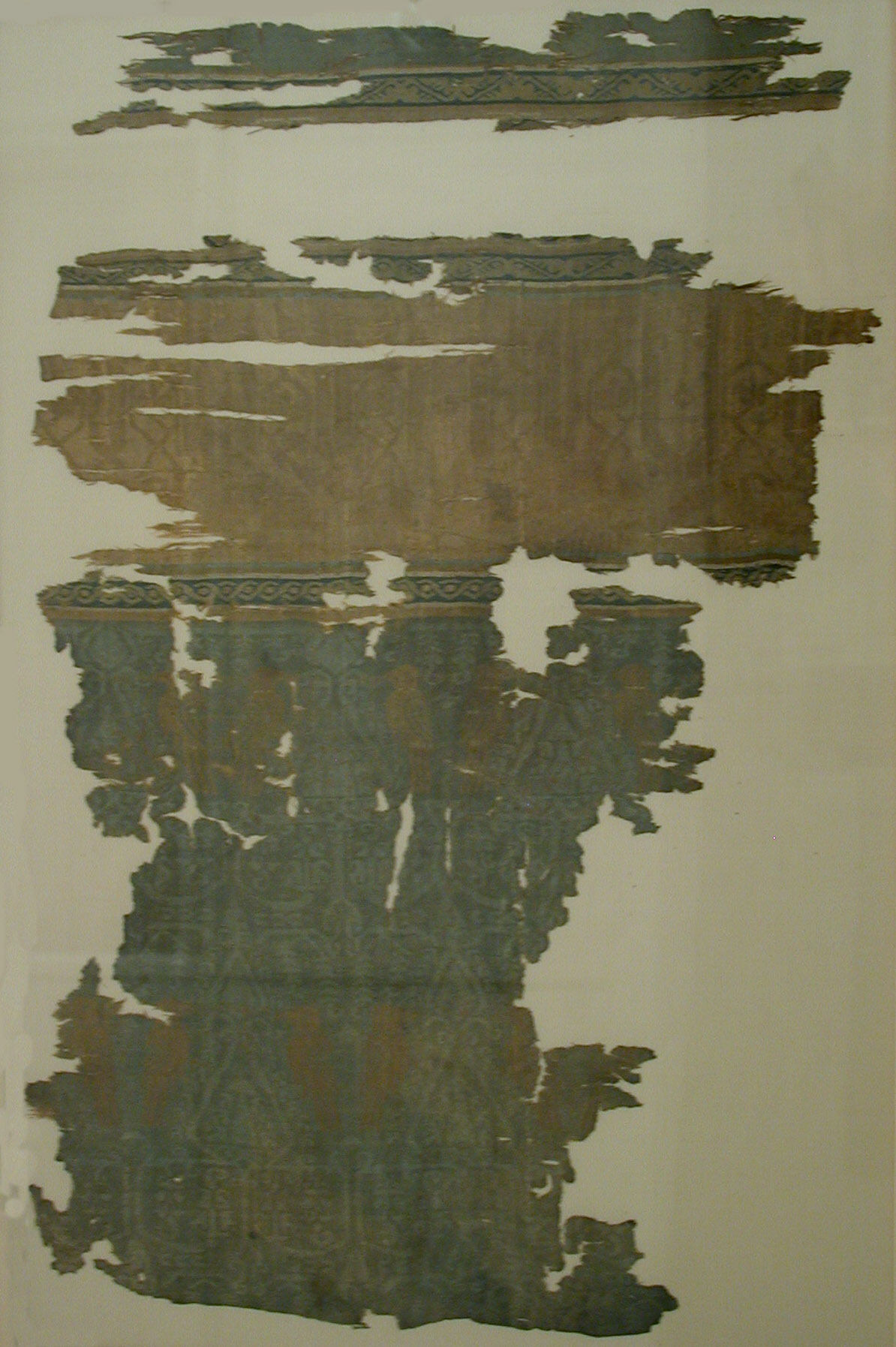
Heritage Asset Analysis: Textile Fragment with Facing Pairs of Birds Flanking a Tree of Life
Object Overview and Material Significance
The textile fragment under examination—a silk samite bearing the motif of facing pairs of birds flanking a Tree of Life—represents one of the most commercially and symbolically potent heritage assets in the Katherine Fashion Lab archive. Samite, a heavy, luxurious compound weave typically constructed from silk with weft-faced patterning, was among the most technically demanding textiles of the ancient world. Its production required specialized drawlooms, disciplined guild labor, and access to long-distance silk supply chains. In antiquity, samite was not merely fabric; it was a statement of civilizational capacity, reserved for rulers, clergy, and the highest echelons of the elite. For Katherine Fashion Lab, the fragment functions as both an artifact and a strategic blueprint—a material witness to how ancient societies encoded power, cosmology, and status into woven cloth.
Iconography: The Tree of Life and Facing Birds
The composition is rigorously symmetrical: paired birds—often read as pheasants, peacocks, or composite mythical fowl—confront one another across a central arboreal axis. This iconography traveled extensively across Silk Road networks, appearing in Sasanian, Byzantine, Central Asian, and later medieval European textiles. The Tree of Life operates as an axis mundi, a vertical connector between terrestrial and divine realms. In many ancient cosmologies, it signifies fertility, regeneration, and the continuity of dynastic power. The facing birds, mirrored in posture and plumage, reinforce dualities: day and night, earthly and celestial, mortal and immortal. Their confrontation is not aggression but equilibrium—a visual contract between opposing forces that sustains cosmic order.
Critically, the repetition of the motif across the samite’s surface creates a rhythmic field of protection. Ancient weavers understood that pattern repetition was not decorative redundancy but apotropaic technology. To wear such cloth was to be wrapped in a portable cosmology, a garment that asserted the wearer’s alignment with sacred order. This is the symbolic power that Katherine Fashion Lab must translate into contemporary luxury language: not ornament, but ontology.
Historical Adornment and the Politics of Display
Samite fragments of this type were frequently found in royal burials, reliquaries, and diplomatic gift inventories. Their presence in tombs indicates belief in textile as a vehicle for the afterlife—cloth accompanied the soul as surely as it adorned the body. In courtly contexts, such textiles served as visible instruments of foreign policy. A ruler who gifted samite was not simply offering fabric; he was transmitting a worldview, a claim to sophistication, and a network of obligation. The facing birds and Tree of Life thus functioned as a kind of heraldic diplomacy, legible across linguistic and religious boundaries.
For Katherine Fashion Lab, this historical adornment logic suggests a strategic pivot: heritage textiles are most powerful when they operate as social currency, not merely as aesthetic references. The 2026 luxury consumer, particularly in emerging high-net-worth markets, is increasingly fluent in symbolic literacy. She does not want a bird print; she wants a garment that carries an argument about order, lineage, and protection.
Spiritual Meaning and the Metaphysics of Weaving
In many ancient traditions, weaving was itself a sacred act. The loom was a cosmological instrument, the warp and weft a metaphor for fate and divine intervention. Silk samite, with its dense structure and lustrous surface, amplified this metaphysics. The Tree of Life at the center of the composition is not merely a motif; it is the loom’s philosophical anchor. The facing birds may be read as the twin forces of creation and dissolution, held in tension by the tree’s stable axis.
This spiritual dimension offers Katherine Fashion Lab a differentiated narrative territory. Contemporary luxury is saturated with secular minimalism and ironic appropriation. A serious engagement with samite’s spiritual grammar allows the brand to claim a rarer position: luxury as metaphysical inheritance. The fragment does not need to be displayed as a relic; it needs to be activated as a design system.
2026 Luxury Strategy: From Fragment to Franchise Architecture
Strategic standalone research on this object yields three actionable directives for the 2026 collections and beyond.
First, motif governance. The Tree of Life and facing birds should be codified into a proprietary visual system—scaled, mirrored, and engineered for jacquard, embroidery, and digital print. This is not pattern-making; it is brand heraldry. The symmetry must be preserved as a signature, not softened into generic botanical imagery.
Second, material authenticity. The 2026 luxury market rewards verifiable provenance and technical mastery. Katherine Fashion Lab should invest in samite-inspired constructions—silk-heavy, weft-faced, with a hand that signals density and gravity. The fabric must feel like an heirloom, not a season.
Third, narrative scarcity. The fragment’s power lies in its singularity. Marketing should frame each piece as a continuation of a specific ancient lineage, with limited editions tied to museum partnerships, archival facsimiles, or site-specific installations along Silk Road geographies. The goal is not mass awareness but connoisseurial desire.
In sum, the Textile Fragment with Facing Pairs of Birds Flanking a Tree of Life is not a decorative curiosity. It is a compressed strategic document—one that teaches Katherine Fashion Lab how ancient societies used cloth to argue for order, legitimacy, and eternity. The 2026 opportunity is to weave that argument anew, for a clientele that seeks not just beauty, but meaning with a pedigree.