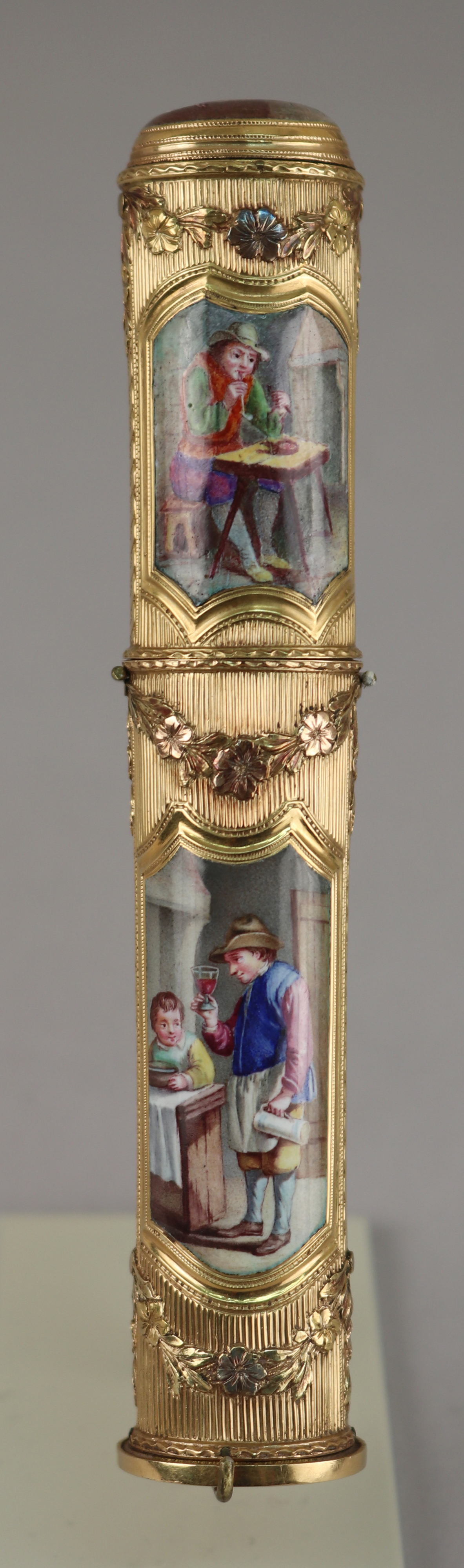
Sealing Wax Case (Étui): A Study in Gold and Enamel
The sealing wax case, or étui, occupies a singular position within the history of the decorative arts. Neither purely utilitarian nor wholly ornamental, it belongs to that refined class of objects the French call objets de vertu—small, exquisitely wrought articles designed for personal use yet executed with the precision and artistry of high jewellery. This study examines a representative example from the global heritage tradition, fashioned in gold and enamel, as a lens through which to read the intersection of function, craftsmanship, and social ritual across the eighteenth and nineteenth centuries.
Functional Origins and the Ritual of the Seal
Before the proliferation of adhesive envelopes and, later, electronic communication, correspondence was secured by means of a wax seal. A drop of molten wax was pressed with a matrix bearing the sender's arms, cipher, or emblem, thereby authenticating the document and rendering any tampering evident. The sealing wax case was the vessel that housed the sticks of wax, and, in more elaborate iterations, the taper, flint, and steel required to ignite it. The étui was thus a portable instrument of privacy and identity—a private arsenal of authentication carried on the person.
Its social significance should not be underestimated. In an era when literacy and correspondence were markers of gentility, the sealing wax case functioned as a visible token of one's place within polite society. To withdraw a gold and enamel étui from a waistcoat pocket or reticule was to make a statement about taste, means, and standing. The object was, in effect, a portable emblem of refinement.
Materials and the Logic of Preciousness
The choice of gold as the structural medium was not merely decorative. Gold resists tarnish, holds an edge, and accepts the most delicate engraving and chasing—qualities essential to an object subject to daily handling. More importantly, gold signalled permanence and value, aligning the étui with the broader economy of luxury goods that defined aristocratic and, later, bourgeois consumption.
Enamel, applied through the demanding technique of émail sur or, introduced colour and narrative to the gold ground. Whether executed in champlevé, basse-taille, or painted émail en plein, the enamel surface transformed a functional case into a miniature canvas. Artisans could render floral garlands, classical motifs, chinoiserie, or heraldic devices with a chromatic richness unobtainable in metal alone. The fired enamel also served a practical purpose: it protected the gold beneath from wear while providing a smooth, cool tactile surface.
The marriage of gold and enamel was, in technical terms, a marriage of risk and reward. Each firing of the enamel could ruin the piece; each layer of colour demanded exacting control of temperature and timing. The survival of a finely enamelled étui is therefore a testament not only to the original maker's skill but also to generations of careful stewardship.
Design, Ornament, and the Language of Style
The design vocabulary of the sealing wax case evolved in step with broader stylistic currents. Eighteenth-century examples often favour the asymmetrical curves of the Rococo, with enamel panels framed by chased gold scrollwork. Neoclassical pieces of the late eighteenth century adopt stricter geometry: oval or cylindrical forms, guilloché grounds, and enamel medallions depicting urns, laurel, or cameo profiles. The nineteenth century, particularly in the hands of Parisian and Swiss workshops, saw a revival of Renaissance and Baroque references, frequently combined with the technical bravura of émail à jour and translucent plique-à-jour.
Because the étui was a standalone object rather than part of a matched suite, it offered the artisan unusual freedom. It could be commissioned, gifted, or collected without reference to a larger service, and it could absorb the most experimental techniques of the day. This autonomy helps explain why so many surviving examples are of exceptional quality: they were often showpieces of workshop capability, produced to demonstrate mastery rather than to satisfy a purely commercial brief.
Global Heritage and the Circulation of Craft
Although the étui is most closely associated with French and Swiss production, its global heritage is broader than the Parisian atelier. Gold and enamel techniques travelled along trade and diplomatic routes: Byzantine cloisonné informed medieval European practice; Islamic metalwork and enamelling influenced Mediterranean workshops; Chinese and Japanese export wares, in turn, absorbed and reinterpreted European forms. A sealing wax case in gold and enamel can therefore be read as a node in a worldwide network of material exchange and technical transmission.
This global dimension is essential to any serious connoisseurship. Attribution based solely on national style risks obscuring the collaborative and cross-cultural nature of the craft. The gold may have been refined in one region, the enamel pigments sourced from another, and the design adapted from a print circulating internationally. The étui is, in this sense, a document of early modern globalisation.
Collecting, Connoisseurship, and Contemporary Relevance
Today, the sealing wax case is prized by collectors of objets de vertu for precisely the qualities that made it desirable in its own time: intimacy of scale, excellence of materials, and density of craftsmanship. Condition is paramount—losses to enamel, restoration to gold, and replacement of internal fittings all affect value significantly. Provenance and, where possible, workshop attribution further refine appreciation.
Beyond the market, the étui retains a deeper relevance. It reminds us that the most durable luxury is not the largest or the loudest, but the most thoughtfully made. In an age of disposable communication, the sealing wax case stands as a quiet argument for objects that reward attention, that carry meaning in the hand, and that embody the fusion of utility and art at the highest level. For the student of fashion and decorative arts, it is an indispensable case study—small in size, immense in implication.