Katherine Fashion Lab: Couture Analysis of a Japanese Buddhist Triad
Object Overview and Materiality
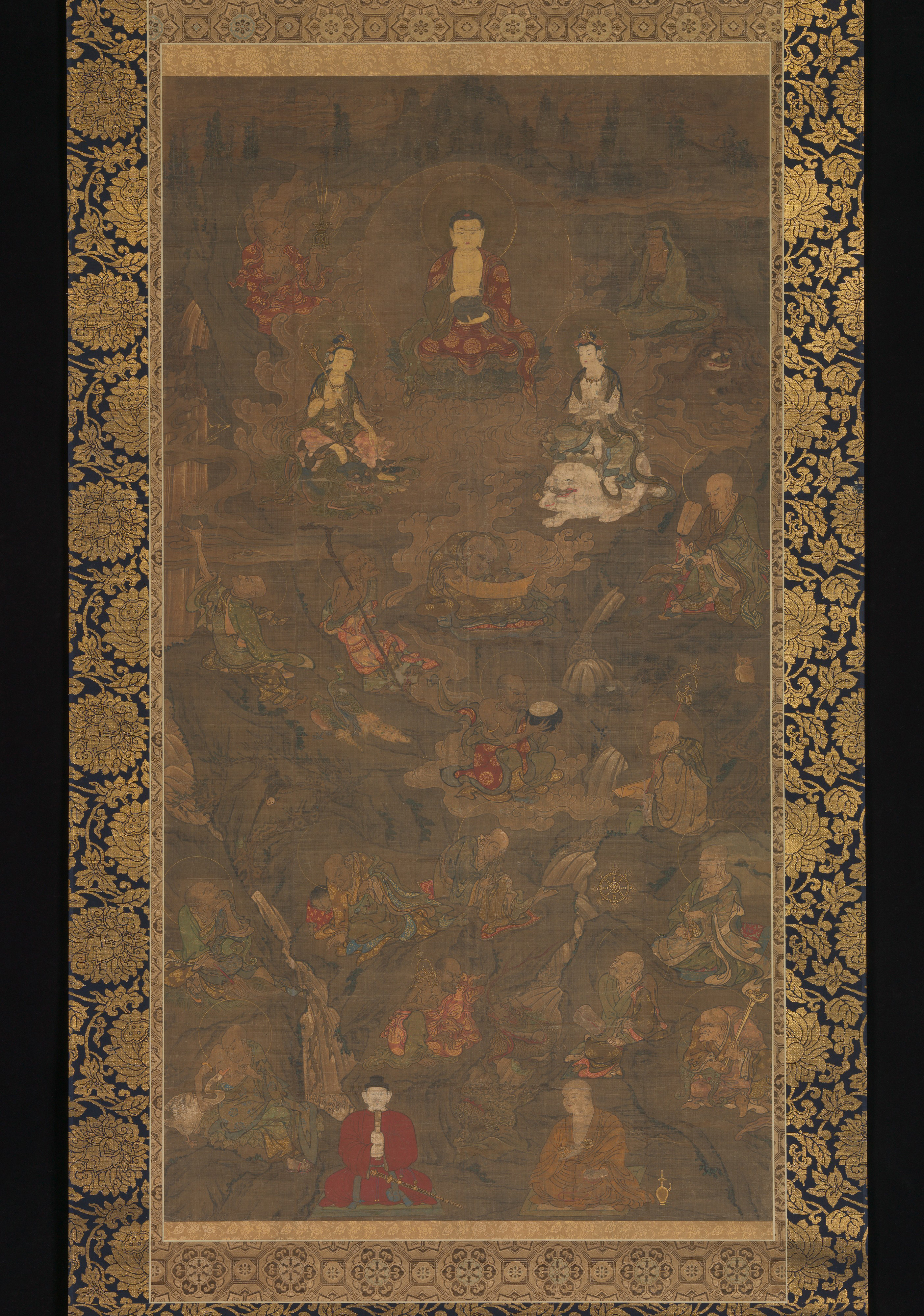
The object under examination is a Japanese hanging scroll depicting Shaka (Shakyamuni), the Historical Buddha, with Two Attendant Bodhisattvas and Sixteen Arhats, executed in ink, color, and gold on silk. As a standalone study, the work presents a devotional hierarchy that is at once iconographic and sartorial: every fold, hem, and gilded accent participates in a theology of enlightenment. The silk ground is not merely a support; it is a tactile medium whose weave interacts with mineral pigments and gold leaf to produce a surface that shifts between matte absorption and reflective brilliance. For the couture analyst, this material interplay establishes the fundamental tension of the composition—between the renunciate simplicity of Shakyamuni and the celestial opulence of the attendant bodhisattvas.
Shaka as the Central Silhouette
Shakyamuni occupies the axial center, typically seated on a lotus pedestal beneath a jeweled canopy. His robe, the kasaya, is rendered with disciplined restraint. The patchwork construction of the monastic garment—traditionally sewn from discarded rags—is stylized here into a rhythmic grid of rectangular fields. The artist uses ink outlines of varying weight to articulate the drape: broad, confident strokes for the outer robe, finer lines for the undergarment visible at the chest. Color is subdued, often a russet or ochre wash that suggests earth and impermanence, while gold is reserved for the urna and the halo, signaling transcendent wisdom rather than worldly wealth.
From a fashion-theoretical perspective, Shaka’s attire performs an ascetic minimalism. There is no ornament, no jewelry, no embroidered border. The silhouette is symmetrical and grounded, communicating stability and detachment. The drapery falls in U-shaped folds across the lap, a convention that recalls Gandharan prototypes but has been naturalized into a distinctly Japanese linear sensibility. The hands, often in the bhumisparsha mudra or dhyana mudra, emerge from the sleeves as the only exposed flesh, emphasizing the body as an instrument of teaching rather than display.
Attendant Bodhisattvas: Celestial Couture
Flanking Shaka are two attendant bodhisattvas, frequently identified as Monju (Manjushri) and Fugen (Samantabhadra), though the specific identities can vary by lineage. Their vestments constitute a dramatic counterpoint to the Buddha’s austerity. Here the artist deploys gold liberally: necklaces, armlets, diadems, and flowing scarves are picked out in kirikane (cut gold leaf) and gold pigment. The bodhisattvas wear layered robes of Chinese-inspired court dress, with wide sleeves, trailing sashes, and elaborate crowns that mark them as bodhisattva-cakravartins—princes of the Dharma who delay final Buddhahood to aid sentient beings.
The color palette expands into lapis lazuli, malachite green, vermilion, and shell white. These pigments, imported and costly, signal the luxury of the celestial realm. The bodhisattvas’ silhouettes are asymmetrical and dynamic: one may hold a lotus stem or a sword of wisdom, the other a scroll or a vajra. Their scarves loop and billow, creating negative space that frames the central Buddha. In couture terms, this is draping as narrative—each ribbon and jewel communicates function, hierarchy, and compassionate intent.
The Sixteen Arhats: Narrative and Texture
Surrounding the triad, typically in the lower and lateral registers, are the Sixteen Arhats (juuroku rakan). These are the enlightened disciples charged with protecting the Dharma until the coming of Maitreya. Unlike the idealized bodhisattvas, the arhats are depicted with individualized, often exaggerated physiognomies: bald heads, deep wrinkles, bushy eyebrows, and expressive hands. Their garments are humble monks’ robes, but the artist varies their colors and patterns to distinguish one from another—some in deep indigo, others in faded saffron or grey.
The arhats introduce a textural counterpoint to the smooth silk and gilded surfaces of the upper register. Their robes are painted with rougher brushwork; the ink lines are more angular, the washes less blended. Accessories include staffs, fly whisks, begging bowls, and miniature animals or jewels, each a narrative attribute. For the fashion analyst, the arhats represent the democratization of enlightenment: their attire is accessible, worn, and human-scaled, yet their presence within the sacred assembly affirms that liberation is not reserved for the celestial elite.
Composition, Gold, and the Hierarchy of Dress
The scroll’s vertical format enforces a gradient of sanctity. Shaka sits at the apex, the bodhisattvas slightly lower and to the sides, the arhats dispersed below and around them. Gold functions as a visual unifier: it appears in the halos of all enlightened figures, but its density increases with spiritual rank. The bodhisattvas are the most gilded; Shaka’s gold is concentrated in the urna and nimbus; the arhats receive only faint gold accents, if any.
This hierarchy of dress and ornament is not incidental. It encodes a soteriological fashion system in which the renunciate robe and the celestial diadem are not opposites but stages on a continuum. The Buddha’s patchwork kasaya is the ultimate couture because it signifies the abandonment of couture. The bodhisattvas’ jewels are skillful means (upaya), ornaments of compassion that attract beings to the Dharma. The arhats’ worn robes are the uniform of perseverance.
Conclusion: The Scroll as Sartorial Theology
In this Japanese hanging scroll, ink, color, and gold on silk collaborate to produce a visual treatise on the ethics of adornment. Shaka, the Two Attendant Bodhisattvas, and the Sixteen Arhats form a single compositional body whose garments articulate multiple registers of enlightenment. For Katherine Fashion Lab, the object demonstrates that couture is never merely decorative: it is a language of power, renunciation, compassion, and hierarchy. The silk ground holds these meanings together, while the gold ensures that the viewer’s eye travels upward—from the humble arhat to the jeweled bodhisattva to the silent, radiant Buddha. In that ascent, the scroll reveals fashion’s oldest and most enduring function: to make the invisible visible, and to clothe the ineffable in the fabric of the world.