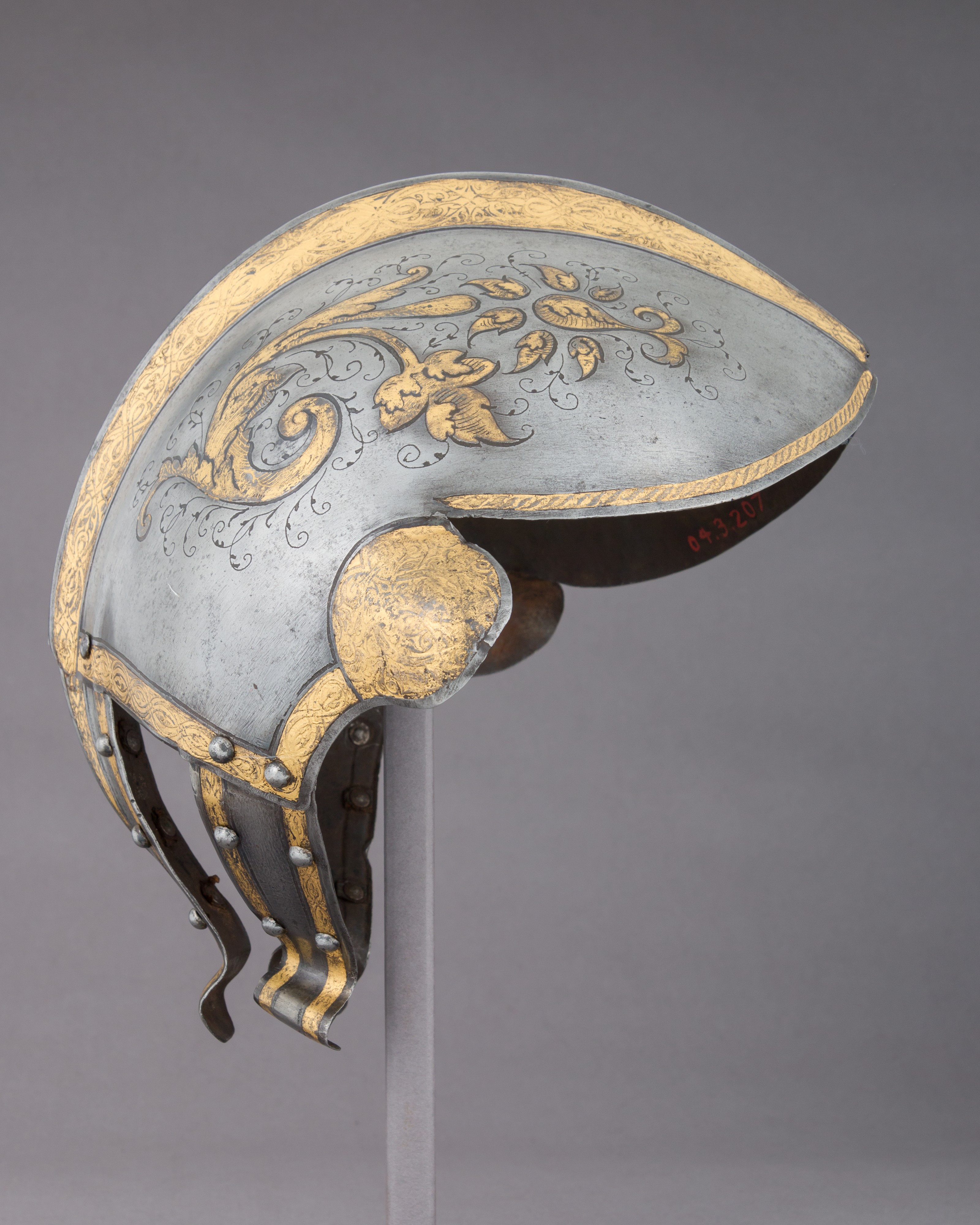
Reinforce for a Helmet (Gupfe): Augsburg Steel, Gold, and the Architecture of Command
Object Overview and Material Composition
The Reinforce for a Helmet (Gupfe) represents one of the most technically sophisticated and symbolically dense artifacts of late medieval and early Renaissance European armory. Attributed with strong probability to the workshops of Augsburg, a Free Imperial City renowned throughout the Holy Roman Empire for its mastery of steel and goldsmithing, this object functions as a supplementary defensive plate designed to fortify the helmet at its most vulnerable point—the brow and upper face. Executed in steel and gold, the Gupfe is not merely a piece of military hardware; it is a statement of rank, a vessel of spiritual invocation, and a demonstration of the metallurgical virtuosity that made Augsburg the preferred supplier to the Habsburg court and the imperial armies of Maximilian I and Charles V.
The term Gupfe itself, rooted in Germanic armory vocabulary, denotes a reinforcing element that could be attached to or integrated with the helmet, often secured by straps, hinges, or sliding mechanisms. Its purpose was dual: to deflect the glancing blows of swords and lances, and to project an image of invulnerability that was as much psychological as it was physical. In the hands of Augsburg's armorers, this functional necessity was elevated into an art form.
Augsburg as a Crucible of Martial Luxury
To understand the Gupfe is to understand Augsburg's unique position in the early modern luxury economy. By the late fifteenth century, the city had consolidated a network of armorers, goldsmiths, and etchers whose collaborative output defined the aesthetic of imperial power. Unlike the mass-production centers of Milan or Nuremberg, Augsburg specialized in bespoke, high-value commissions for princes, electors, and the emperor himself. The gold applied to steel was not decorative excess; it was a deliberate alloying of materials that signaled the owner's place within a hierarchy of command.
The Gupfe emerges from this context as a strategic standalone artifact. It was often produced as part of a garniture—a modular armor system—but its independent survival in collections today testifies to its perceived value as a discrete object of prestige. The gold inlay, whether executed through damascening, fire-gilding, or mercury amalgam techniques, required the hand of a specialist goldsmith working alongside the armorer. This cross-disciplinary production model anticipates the atelier structures of contemporary high-end luxury houses, where metalworkers, embroiderers, and leather artisans collaborate under a single creative director.
Symbolic Power: The Gupfe as a Theater of Authority
The symbolic grammar of the Gupfe operates on three registers: martial, political, and spiritual. Martially, the reinforced brow transforms the wearer's face into a mask of impassivity. The knight or commander who donned such a helmet did not merely protect his skull; he erased his humanity, presenting instead a surface of polished steel and gold that reflected the enemy's own fear. The Gupfe, by extending this surface forward and upward, created a visual silhouette of unbroken power—a continuous line from chest to crown that denied vulnerability.
Politically, the presence of gold on a battlefield object was a calculated risk and a calculated boast. Gold was the metal of sovereignty, of the sun, of incorruptibility. To wear gold into combat was to declare that one's rank transcended the mere practicalities of survival. In the imperial armies, such adornment was restricted by sumptuary conventions, making the Gupfe a legible badge of command. It told soldiers and rivals alike: this head is not expendable.
Spiritually, the Gupfe frequently bore engraved or inlaid invocations—crosses, Marian monograms, or abbreviated Latin prayers. These were not superstitions but liturgical armaments, transforming the helmet into a reliquary of protection. The gold lines that traced these symbols caught the light, making the prayer visible even in the chaos of melee. In an age where divine favor was believed to turn the tide of battle, the Gupfe was a portable altar as much as a piece of armor.
Historical Adornment and the Semiotics of Surface
The history of adornment is the history of controlled visibility. The Gupfe's gold work belongs to a tradition that stretches from the Mycenaean death masks to the jeweled scabbards of the Ottoman sultans. What distinguishes the Augsburg example is its integration of ornament into structure. The gold is not applied to a finished surface; it is woven into the forging and etching process, so that decoration and defense become inseparable. This is a critical lesson for contemporary luxury: adornment that feels additive is decorative; adornment that feels constitutive is iconic.
Furthermore, the Gupfe's survival as a standalone object—divorced from its original helmet—reveals how heritage artifacts acquire new identities over time. What was once a component becomes a self-sufficient signifier. Museums and private collections have long treated such reinforcements as sculptural objects, displaying them on mounts that emphasize their silhouette and surface. This museological framing has, in turn, influenced how luxury brands present their own heritage pieces: as autonomous works of art rather than functional remnants.
2026 Luxury Strategy: From Augsburg to the Atelier
As Katherine Fashion Lab positions itself for the 2026 luxury landscape, the Gupfe offers a precise strategic template. The first principle is material honesty with symbolic intent. Steel and gold are not arbitrary choices; they are a thesis about strength and sovereignty. A 2026 collection that draws on this heritage must ask: what are our equivalent materials, and what do they declare? Upcycled titanium and ethically sourced gold, for instance, can carry the same dual message of resilience and responsibility.
The second principle is modularity as prestige. The Gupfe was part of a garniture—a system of interchangeable parts. Contemporary luxury consumers, particularly in the Asia-Pacific and Middle East markets, respond to collectible modularity: pieces that can be worn alone or combined, that reward connoisseurship through configuration. A reinforced cuff, a detachable collar, a convertible harness—each can function as a modern Gupfe, a standalone reinforcement that transforms the wearer's silhouette and status.
The third principle is spiritual minimalism. The Gupfe's prayers were visible but not verbose. In 2026, spiritual meaning in luxury is expressed through restraint: a single engraved symbol, a hidden inscription, a clasp that opens to reveal a private motto. This creates intimacy and exclusivity, two currencies more valuable than any metal.
Finally, the Gupfe teaches the power of the fragment. A standalone reinforcement is not a lesser object; it is a concentrated one. For Katherine Fashion Lab, this suggests a strategy of releasing hero accessories that distill the brand's heritage into singular, collectible forms—objects that can stand alone in a vitrine or on a body, commanding attention through density of meaning rather than scale.
Conclusion
The Reinforce for a Helmet (Gupfe) is a masterclass in strategic adornment. Born in the Augsburg workshops where steel met gold and function met faith, it transformed a defensive necessity into a theater of authority. For Katherine Fashion Lab in 2026, the Gupfe is not a historical curiosity but a business model in miniature: material integrity, modular prestige, restrained symbolism, and the courage to make protection beautiful. The helmet is gone; the reinforcement remains. That is the enduring power of heritage—and the enduring opportunity for luxury.