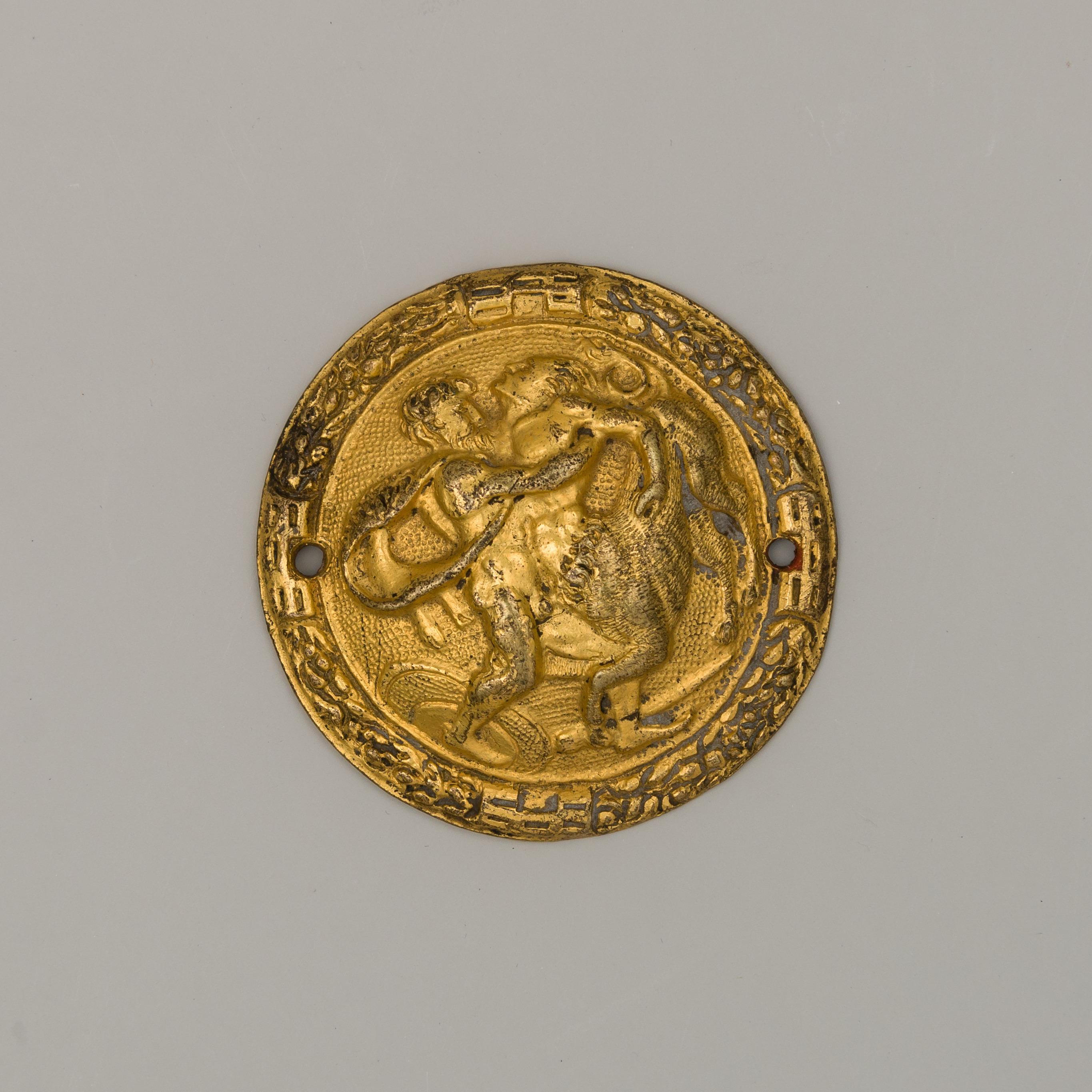
Heritage Analysis: The Bit Boss as a Strategic Artefact for Katherine Fashion Lab
This strategic standalone research paper examines a singular object—a South German, possibly Augsburg, Bit Boss depicting Hercules Fighting the Monster Cacus—through the lens of Katherine Fashion Lab's (KFL) heritage curation and future-facing luxury strategy. Crafted in copper alloy and gold, this equestrian adornment transcends its functional purpose to become a dense repository of symbolic power, historical narrative, and spiritual meaning. Our analysis deconstructs these layers to propose a framework for integrating this archetypal hero myth into a 2026 high-end luxury strategy, positioning KFL not merely as a fashion house, but as a contemporary atelier for personal myth-making.
Deconstructing the Artefact: Symbolic Power and Historical Adornment
The object in question is a bit boss, a central decorative piece on a horse's bridle. Its very nature as equestrian hardware is the first layer of its symbolic potency. In Renaissance Germany, particularly in a prosperous imperial city like Augsburg, the horse was the ultimate symbol of nobility, martial prowess, and economic stature. To adorn this creature was to amplify the status of its rider. The choice of subject matter—Hercules vanquishing the fire-breathing thief Cacus—elevates this adornment from mere decoration to a declarative emblem. This scene, drawn from Roman mythology via Virgil's Aeneid, represents the triumph of divine-ordained order over chaotic, subterranean evil. For a patrician rider, the boss becomes a talisman and a public proclamation: the wearer aligns himself with the Herculean virtues of strength, justice, and civilizing force.
The materiality—copper alloy gilded with gold—speaks to a sophisticated hierarchy of materials. The durable base metal ensures longevity and structural integrity, while the gold application captures light, demands attention, and signifies supreme value. This duality mirrors the Renaissance ideal of virtù: the potent combination of strength and splendor, substance and surface. The craftsmanship required for such detailed repoussé or chasing work in metal situates this object within the pinnacle of Augsburg's renowned metalworking tradition, a center synonymous with precision, artistry, and luxury goods for European elites.
Extracting the Core Myth: Spiritual Meaning and Archetypal Resonance
Beyond its historical context, the Hercules and Cacus myth holds enduring archetypal power essential for luxury narrative-building. The story is fundamentally one of righteous confrontation and earned triumph. Hercules, resting after his tenth labor, has his cattle stolen by Cacus, a monstrous being who drags them backwards into his cave to conceal the trail. Through ingenuity and sheer force, Hercules discovers the deceit, confronts Cacus in his lair, and slays him, recovering his property.
For KFL's strategic purposes, this narrative is rich with adaptable spiritual meaning: The Labor as Journey: Hercules is mid-labour, a hero in a state of becoming. This resonates with the modern luxury consumer's view of self as a project—a narrative of continuous achievement and refinement. Confronting the Shadow: Cacus represents the chaotic, thieving force that seeks to undermine one's rightful possessions and peace. The battle is internal as much as external, symbolizing the overcoming of personal obstacles, doubt, or fraud. The Reclamation of Value: The climax is not the acquisition of new treasure, but the reclamation of what is rightfully one's own. This translates powerfully to a luxury ethos centered on intrinsic value, authenticity, and legacy over fleeting trends. The spiritual core is thus one of armored virtue—the idea that true strength, after being tested, must be visibly asserted and protected. The bit boss, placed at the critical point of control between rider and steed, physically embodies this concept of directed, authoritative power.
Strategic Integration: A 2026 High-End Luxury Framework
For Katherine Fashion Lab's 2026 strategy, this artefact provides a non-derivative, deeply rooted foundation for a luxury narrative. The goal is to move beyond superficial referencing to a process of heritage alchemy, transmuting historical codes into future icons.
Collection Pillars & Narrative Architecture
A 2026 collection, perhaps titled "Neo-Herculean" or "The Reclaimed," would be structured around three pillars derived from the analysis: 1. The Armored Gesture: Focusing on outerwear and structured pieces. Think gilded, hammered-metal embroidery mimicking the boss's repoussé work, articulated leather mimicking equestrian armor, and closures inspired by bridle hardware. The symbolism is one of prepared, dignified strength. 2. The Subterranean Lair (Cacus): A contrasting pillar exploring texture, shadow, and concealment. Burnished leathers, iridescent fabrics that shift like fire-smoke, and prints suggesting dragged tracks or cave walls. This represents the challenge, the raw material of the conflict. 3. The Reclaimed Herd: Symbolizing the prize. This would manifest in sumptuous, pristine materials—luxurious cashmeres, flawless calfskins, rich velvets in deep bovine tones. The narrative is one of achieved luxury, the reward secured through virtue and effort.
Product Strategy & Experiential Extensions
The strategy must extend beyond apparel into a holistic brand universe: High-Jewelry & Objects: Direct interpretations of the boss in limited-edition gold and alloy pendants, cufflinks, or belt buckles. This creates a tangible, heirloom link to the core artefact. Leather Goods: Bags and small leather goods with fasteners derived from bit and bridle mechanisms, stamped with an abstracted "Cacus scale" or "Herculean knot" motif. Experiential Client Journey: Align client engagements with the myth. Private viewings could be staged as "discoveries," with commissions framed as "reclaiming your narrative." Collaborations with contemporary sculptors or metal artists could further bridge the Renaissance atelier and the modern studio.
Brand Positioning & Communication
The communication must be confident and intellectual, avoiding generic luxury tropes. Key messaging would center on "The Strength of Reclamation," "Armored Elegance," and "Myth as Material." Visual campaigns should juxtapose the raw power of the myth (through dramatic lighting, evocative locations) with the precise, controlled beauty of the garments, mirroring the alloy/gold duality of the original boss. The brand voice should be that of a curator and a mythographer, inviting the client into a deeper narrative of their own making.
In conclusion, the South German Bit Boss is not a relic but a strategic blueprint. Its layers of symbolic power, historical adornment, and spiritual meaning provide Katherine Fashion Lab with a profound and distinctive foundation. By alchemizing the Herculean myth of confrontation and reclamation, KFL can position itself for 2026 as a luxury house for those who view their identity as a legacy to be forged, defended, and brilliantly adorned.