Silk Kashan Carpet: A Heritage Asset Analysis for Katherine Fashion Lab
Introduction: The Object as Strategic Asset
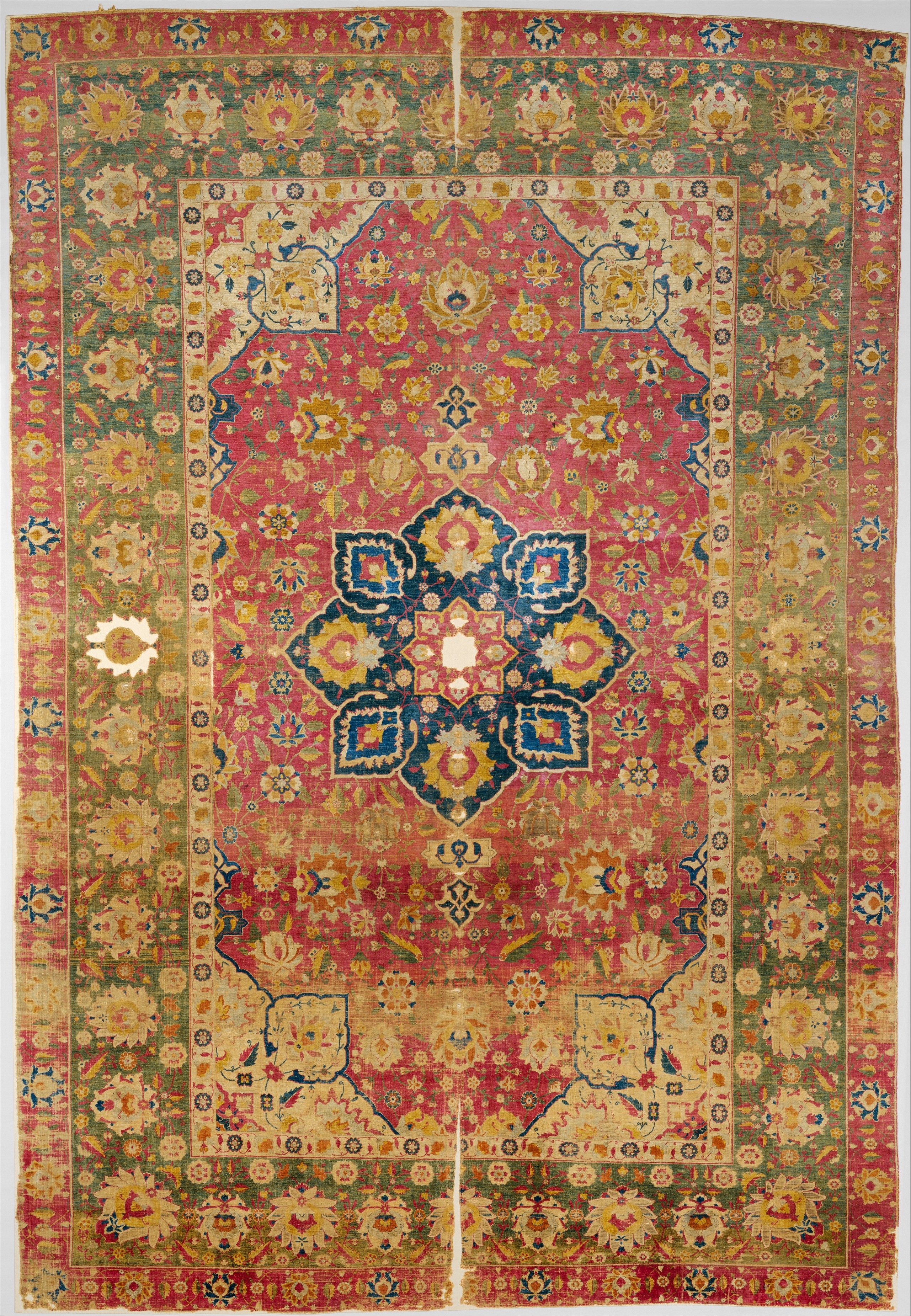
The Silk Kashan Carpet represents one of the most technically refined and symbolically dense artifacts to emerge from the Persian weaving tradition. Produced in the Kashan region of central Iran, this textile is distinguished by its fully silk construction across warp, weft, and pile, executed through asymmetrically knotted (Persian) pile techniques. For Katherine Fashion Lab, this object is not merely an antique textile; it is a heritage asset whose symbolic capital, technical mastery, and spiritual resonance can inform a 2026 luxury strategy grounded in authenticity and cultural depth.
Symbolic Power: The Garden as Cosmological Statement
The visual program of the Silk Kashan Carpet is inseparable from Persian cosmological thought. Central medallion compositions, curvilinear arabesques, and layered border systems translate the concept of the pairidaeza—the walled garden—into woven form. In classical Persian metaphysics, the garden is a terrestrial mirror of paradise, a structured space where nature is ordered, contained, and rendered eternal. The carpet, laid beneath the feet, inverts this hierarchy: the viewer walks upon paradise, an act of symbolic power that positions the owner within a cosmology of dominion and grace.
For luxury strategy, this symbolic architecture offers a template. A brand that understands the carpet as a portable paradise understands that luxury is not ornamentation but world-making. The medallion functions as a focal authority, the field as a governed territory, and the border as a threshold between the sacred and the profane. These are transferable design principles for 2026 collections that seek narrative coherence rather than surface decoration.
Historical Adornment: Courtly Display and Technical Supremacy
Silk Kashan carpets emerged as objects of courtly adornment during the Safavid period, when royal workshops elevated textile production to a statecraft instrument. Silk—costly, luminous, and structurally demanding—signaled access to trade networks spanning the Silk Roads. The asymmetrically knotted pile permitted finer curvilinear drawing than symmetric (Turkish) knots, enabling the dense floral arabesques and animal combat motifs that became signatures of Kashan production. The result was an object that functioned simultaneously as floor covering, wall hanging, diplomatic gift, and dynastic advertisement.
The historical lesson for Katherine Fashion Lab is that adornment is never neutral. The Silk Kashan Carpet adorned palaces, but it also adorned the reputation of those who commissioned and gifted it. In 2026, high-end luxury consumers increasingly seek objects that carry provenance narratives—not merely logos. A heritage strategy that foregrounds the technical specificity of asymmetrical knotting, the material purity of silk, and the courtly context of production creates a defensible differentiation that mass luxury cannot replicate.
Spiritual Meaning: Knot as Devotional Discipline
Beyond iconography, the Silk Kashan Carpet carries spiritual meaning in its making. Each asymmetrical knot is an act of repetition, patience, and precision. In Sufi-inflected Persian culture, the weaving process has been interpreted as a form of dhikr—remembrance—where the artisan's disciplined hand mirrors the order of the cosmos. The carpet's reversible structure, with its hidden knots, evokes the relationship between manifest and hidden worlds. This metaphysical layer distinguishes the object from mere interior decoration and positions it within a lineage of sacred craft.
For luxury strategy, spiritual meaning translates into experiential value. Brands that can articulate the contemplative dimension of craft—time, repetition, intention—address a consumer segment seeking meaning alongside material excellence. The Silk Kashan Carpet's spiritual grammar offers a language for 2026: slowness as luxury, discipline as beauty, and heritage as a living practice rather than a museum label.
2026 High-End Luxury Strategy: From Artifact to Brand Architecture
Translating the Silk Kashan Carpet into a 2026 strategy requires three strategic moves. First, narrative anchoring: position the carpet as a civilizational document, not a decorative object. Marketing language should reference cosmology, courtly patronage, and knotting technique with the precision of an academic monograph and the accessibility of a heritage campaign.
Second, material and technical storytelling: emphasize the silk warp, weft, and pile as a total material commitment. In an era of blended fibers and synthetic shortcuts, the carpet's uncompromising materiality becomes a proof point for authenticity. Limited-edition capsule collections, archival-inspired prints, and artisan collaborations can extend this logic without diluting it.
Third, experiential and digital translation: develop immersive retail environments that replicate the carpet's spatial hierarchy—threshold, field, medallion—so that customers physically enter the symbolic garden. Augmented reality layers can reveal knot structures and motif genealogies, converting heritage research into consumer engagement.
Conclusion: Heritage as Competitive Advantage
The Silk Kashan Carpet is a convergence of symbolic power, historical adornment, spiritual discipline, and technical supremacy. For Katherine Fashion Lab, it is not a relic to be admired but a strategic blueprint. In 2026, the luxury brands that endure will be those that treat heritage as architecture—structural, load-bearing, and generative—rather than as decoration. The Silk Kashan Carpet, woven knot by knot in silk, offers precisely that architecture: a portable paradise whose value appreciates with every act of understanding.