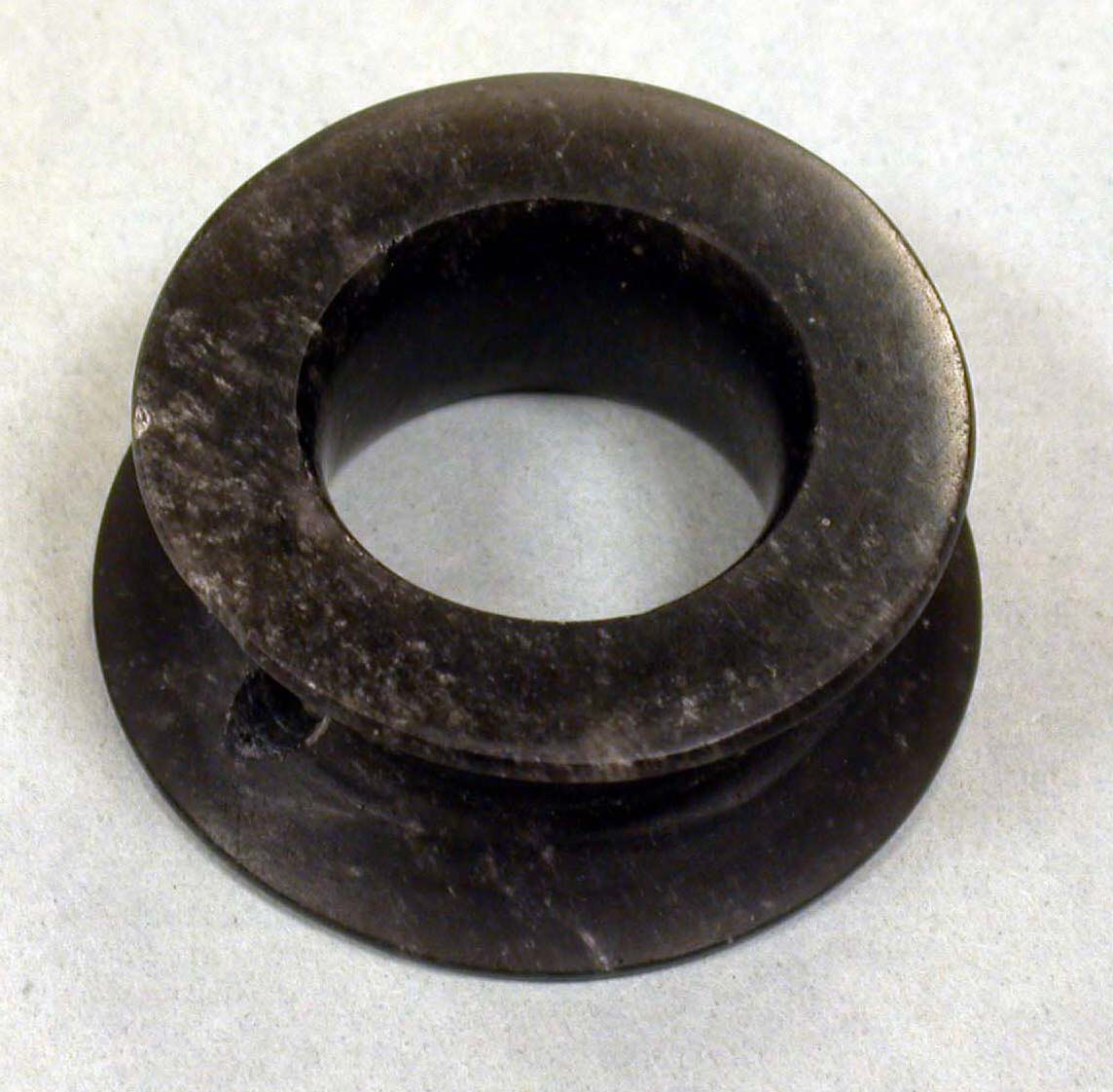
Heritage Asset Analysis: The Mexica Obsidian Ear Spool
Object Identification and Material Profile
The Mexica (Aztec) ear spool, known in Nahuatl as nacochtli or tetlacochcatl when rendered in stone, represents one of the most technically refined and symbolically dense categories of adornment in Mesoamerican material culture. The specimen under consideration is carved from obsidian, a volcanic glass sourced primarily from the deposits at Pachuca, Hidalgo, and the Sierra de las Navajas. Obsidian held extraordinary value in Mexica cosmology: it was the material of mirrors, divination instruments, sacrificial blades, and the tecpatl knives that mediated between human and divine realms. Its vitreous black surface, capable of taking a mirror polish, made it an ideal medium for objects worn against the body at the most visible points of the head.
Ear spools were not pierced studs in the modern sense. They were flanged cylinders, often 3–6 centimeters in diameter, inserted into a deliberately stretched perforation in the earlobe. The flange held the ornament in place while the polished face presented outward, catching light and signaling the wearer's status from a considerable distance. Obsidian examples required exceptional lapidary skill: the material is brittle, unforgiving of error, and fractures unpredictably. A finished obsidian spool therefore encodes both raw material prestige and demonstrated mastery of a high-risk craft.
Symbolic Power and the Politics of the Ear
In Mexica thought, the ear was a locus of teyolia, the animating force associated with the heart and vital consciousness. Ear ornaments were simultaneously aesthetic, apotropaic, and political. The act of piercing and stretching the earlobe was a rite of passage for noble youths and a permanent marker of rank. Commoners were prohibited from wearing gold, jade, or fine stone spools; sumptuary law encoded the entire social hierarchy onto the body.
Obsidian carried a specific valence distinct from jade (chalchihuitl) or gold (teocuitlatl). Jade signified fertility, water, and preciousness; gold was the excrement of the gods, associated with the sun and the divine. Obsidian, by contrast, signified tezcatl — the mirror — and thus the capacity to see, to foretell, and to confront truth. The god Tezcatlipoca, "Smoking Mirror," wore obsidian mirrors at his chest and was associated with night, kingship, and destiny. An obsidian ear spool placed the wearer in direct visual and symbolic relation to this deity. It announced that the bearer could see what others could not: a claim of political clairvoyance as much as spiritual insight.
The spool also functioned within the ritual economy of sacrifice. Captured warriors and tribute subjects were depicted in codices wearing ear ornaments that marked their subordination; the removal of a spool was an act of desecration and defeat. Conversely, the offering of obsidian spools in the Templo Mayor deposits and the ofrenda caches of Tenochtitlan demonstrates that these objects circulated between the human and divine spheres. They were worn, buried, and offered — never merely decorative.
Historical Adornment and the Luxury Code
Ear spools appear across the full archaeological record of the Basin of Mexico, from the Early Postclassic through the Spanish contact period. Their materials map onto a clear hierarchy: gold and jade for the tlatoani and highest nobility; turquoise and shell for military orders; obsidian, basalt, and bone for a broader elite and, in some contexts, for priests and ritual specialists. The obsidian spool thus occupies a strategic middle register: more accessible than jade, yet far more charged than bone or ceramic.
The Spanish chroniclers, including Bernardino de Sahagún and Diego Durán, recorded the centrality of ear ornaments in Mexica court ritual. Durán describes the investiture of rulers in which the new tlatoani received ear spools as part of the regalia that transformed a noble into a sovereign. The object was not an accessory to power; it was an instrument of it. This distinction is critical for contemporary luxury strategy: the spool was a technology of legitimacy, not a decoration of wealth.
2026 Luxury Strategy: Positioning the Obsidian Ear Spool
For Katherine Fashion Lab, the Mexica obsidian ear spool offers a rare strategic asset: an object with authentic ritual function, material integrity, and a symbolic code that maps cleanly onto contemporary luxury values of provenance, rarity, and meaning. Three positioning pillars follow.
First, material authenticity as differentiation. Obsidian is not a heritage cliché. It is a genuine volcanic glass with tactile depth, mirror finish, and a documented Mesoamerican pedigree. In a 2026 market saturated with recycled gold and lab-grown diamonds, obsidian offers a differentiated material narrative rooted in geological time rather than laboratory time. The brand can source from Mexican deposits and partner with Mexican lapidary artisans, creating a verifiable supply chain story that resists greenwashing critiques.
Second, symbolic power as narrative. The obsidian spool is a mirror: it reflects the wearer and, in Mexica thought, reveals hidden truth. This is a powerful metaphor for a luxury clientele that increasingly seeks objects of introspection and self-definition rather than mere display. Campaign language can foreground tezcatl — the mirror — as a concept of self-knowledge, sovereignty, and discernment. The ear, as the site of hearing and balance, adds a second layer: the wearer listens, sees, and decides.
Third, ritual function as exclusivity. The spool was restricted by sumptuary law. It was not available to all. A 2026 luxury strategy can translate this into a controlled edition model: numbered pieces, documented provenance, and a commissioning process that mirrors the investiture ritual. The object should be presented as regalia, not merchandise — an instrument of the wearer's own authority.
Katherine Fashion Lab should avoid the trap of "Aztec-inspired" pastiche. The strategic opportunity lies in fidelity: accurate proportions, correct Nahuatl terminology, collaboration with Mexican artisans and scholars, and a clear statement of cultural context. The obsidian ear spool is not a motif to be borrowed. It is a heritage asset to be responsibly stewarded — and, in 2026, that distinction is the difference between luxury and costume.