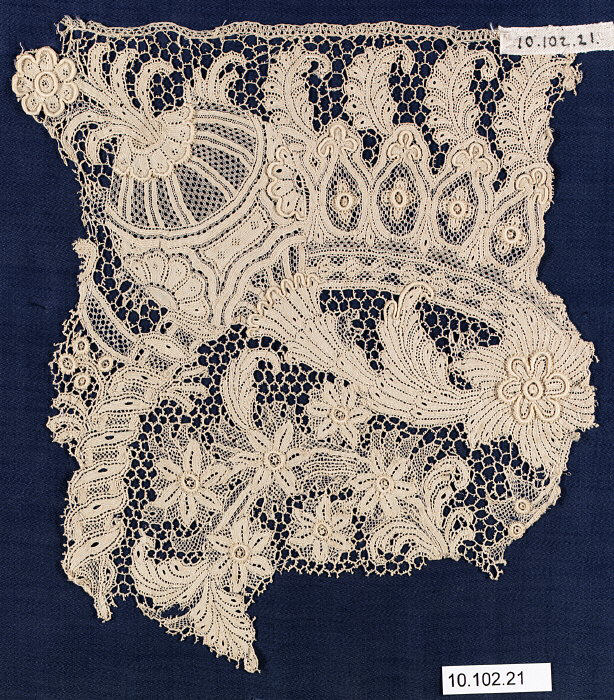
Fragment: A Standalone Study in Needle Lace and Global Heritage
Within the disciplined vocabulary of haute couture, few gestures are as radical as the fragment. A fragment refuses completion; it withholds the reassuring resolution of a finished silhouette and instead presents a partial truth, an arrested moment of making. Katherine Fashion Lab approaches this subject not as an exercise in nostalgia but as a rigorous investigation into how needle lace—one of the most labour-intensive textile traditions in human history—can function as a self-sufficient aesthetic proposition. The study titled Fragment operates at the intersection of material archaeology and contemporary couture, drawing upon a global heritage of lacemaking while resisting the period codes that so often accompany it.
To understand the significance of this standalone study, one must first understand the peculiar status of needle lace within the hierarchy of textile crafts. Unlike bobbin lace, which builds structure through the interlacing of multiple threads wound on bobbins, needle lace is constructed stitch by stitch with a single thread, using a needle and a foundation outline. The technique demands that the maker effectively draw in thread, building density and transparency simultaneously. It is, in essence, a form of slow architecture at the scale of the hand.
The Technical Grammar of Needle Lace
The origins of needle lace are conventionally traced to sixteenth-century Italy, where the punto in aria—literally "stitch in air"—emerged from the earlier tradition of cutwork and reticella. Venetian needle lace subsequently achieved a level of refinement that made it a prized commodity across European courts, and its influence radiated outward through trade routes, missionary networks, and colonial economies. What is often overlooked in Eurocentric accounts is the parallel and subsequent development of needle lace traditions across the globe: the nanduti of Paraguay, with its radiating sunburst geometry; the banjara and Kutch embroidery traditions of South Asia, where needlework carries cosmological and communal meaning; the filet and guipure adaptations in the Philippines and Latin America; and the intricate Oya needlework of Anatolia, in which floral motifs function as a coded language of emotion.
For Katherine Fashion Lab, this global heritage is not decorative context but structural methodology. The Fragment study treats needle lace as a transnational inheritance—a technique that has been repeatedly translated, hybridised, and reinvented by communities whose authorship is rarely acknowledged in the couture narrative. By foregrounding this heritage, the study interrogates the conventional attribution of lace to a singular European lineage and instead positions it as a shared human technology of patience.
The Fragment as Aesthetic and Conceptual Device
Why a fragment? In couture, the fragment carries a particular charge. It evokes the sample, the toile, the unfinished panel pinned to the mannequin—objects that exist in the atelier's liminal space between intention and realisation. The fragment is also an archaeological artefact: a surviving scrap of historic lace, detached from its original garment, its context lost, yet retaining the full evidence of its maker's hand. In this sense, the fragment is both incomplete and complete; it is a whole expression of a technique even when it is not a whole garment.
The Fragment study exploits this duality. Each piece is conceived as a discrete territory of needle lace, worked to a density and scale that allows the stitch structure to be read as the primary content. There is no supporting fabric, no appliqué to a bodice or sleeve. The lace is the object. This decision places the work in conversation with the tradition of the lace sampler and the museum fragment while insisting on its autonomy as contemporary couture. The viewer is invited to examine the tension between opacity and transparency, the rhythm of the buttonhole stitch and the cordonnet, the way light passes through the voids that the needle has deliberately left open.
Materiality, Time, and the Ethics of Making
Needle lace is inseparable from time. A single square centimetre of fine needle lace can require hours of work; a substantial panel can consume weeks or months. In an industry increasingly shaped by digital speed and algorithmic trend cycles, this temporal commitment is itself a statement. Katherine Fashion Lab frames the Fragment study as a deliberate counter-rhythm—a refusal of the accelerated production model that treats craft as a branding device rather than a mode of knowledge.
The global heritage dimension sharpens this ethical dimension. Many of the needle lace traditions referenced in the study are sustained by women working in informal economies, often under conditions of precarious compensation. To invoke their techniques without addressing this material reality would be to aestheticise labour while obscuring the labourer. The study therefore adopts a position of transparency: it documents the provenance of its technical references, credits the lineages from which they derive, and treats collaboration with contemporary lacemakers as a condition of the work rather than an afterthought.
Standalone Study: Autonomy Without Isolation
To describe Fragment as a standalone study is not to claim that it exists in a vacuum. Rather, it asserts that the work can be evaluated on its own terms—as a coherent investigation of material, technique, and heritage—without requiring the scaffolding of a seasonal collection or a commercial narrative. This autonomy is rare in couture, where the fragment is usually a step toward a finished look. Here, the fragment is the destination.
What emerges is a body of work that sits at the meeting point of textile history, contemporary art, and couture craftsmanship. It asks the viewer to slow down, to read the stitch as a sentence, and to recognise that a fragment of needle lace carries within it the memory of many hands across many geographies. In the hands of Katherine Fashion Lab, the fragment is not a remnant but a proposition: that incompletion, when pursued with rigour, can be a form of completeness all its own.