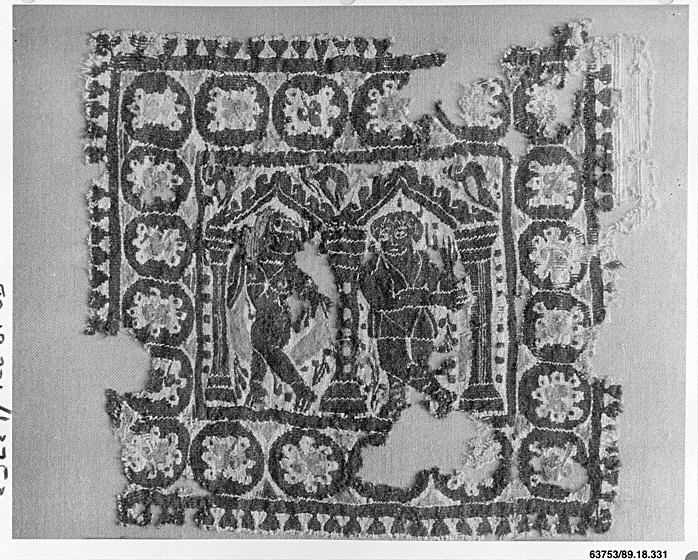
Heritage Asset Analysis: Ancient Wool and Linen Textile Fragment
Object Overview and Material Composition
The textile fragment under examination represents a rare convergence of utilitarian craft and symbolic investiture within an ancient civilization whose weaving traditions bridged the material economies of daily life and the metaphysical economies of ritual power. Composed of wool and linen in a combined plain weave and tapestry weave structure, the fragment reflects a sophisticated command of fiber differentiation that few ancient workshops achieved with comparable precision. The plain weave ground establishes structural integrity and breathability, while the tapestry-woven insertions introduce figural or geometric motifs that were almost certainly not decorative in intent but communicative in function. In the ancient world, the loom was never merely a tool of production; it was an instrument of encoding, and the weaver a custodian of collective memory.
The choice of wool and linen in a single textile is itself a statement of considerable cultural weight. Linen, derived from flax, carried associations of purity, permanence, and priestly authority across numerous ancient civilizations, from Nile Valley traditions to Levantine cultic practice. Wool, by contrast, embodied warmth, pastoral wealth, and the tactile intimacy of the body. Their combination in one cloth suggests a deliberate negotiation between the sacred and the secular—a textile designed to mediate between the wearer and the divine, or between the living and the ancestral dead.
Symbolic Power and the Grammar of Adornment
Within the framework of ancient adornment, textiles functioned as second skins of identity. The tapestry-woven passages, typically executed in contrasting dyed wools against a neutral linen ground, would have produced a visual rhythm legible only to those initiated into the culture's symbolic vocabulary. Motifs woven in tapestry often carried apotropaic functions—warding off malevolent forces—or commemorative functions, recording lineage, triumph, or covenant. The labor intensity of tapestry weaving further elevated the object beyond commodity status; each pass of the weft was an act of devotion, and the finished cloth a material prayer.
Scholarship on ancient textile traditions consistently demonstrates that adornment was never neutral. To wear a woven band, a mantle, or a shroud was to inhabit a prescribed social and spiritual role. The fragment's structural duality—plain weave for the body, tapestry weave for the message—mirrors a broader ancient epistemology in which the visible world clothed an invisible order. The textile thus operates as a mnemonic device, preserving cosmological knowledge in thread where text was scarce and literacy restricted to elites.
Spiritual Meaning and Ritual Function
The spiritual dimensions of such a fragment cannot be overstated. In many ancient cultures, the act of weaving was associated with creation itself: the cosmos as loom, the deity as weaver, human destiny as thread. Wool's animal origin linked it to sacrifice and pastoral covenant, while linen's vegetal purity aligned it with temple precincts and funerary rites. A textile combining both materials may have served in liminal rituals—rites of passage, consecration, or burial—where the boundary between human and divine required a material intermediary.
If the tapestry elements depict anthropomorphic or theriomorphic figures, the fragment likely functioned as a talismanic garment or sanctuary hanging. Even in its fragmented state, the cloth retains what anthropologists term "aura"—the residue of ritual efficacy that survives physical deterioration. For the heritage strategist, this aura is not sentiment but asset: it represents an unbroken chain of meaning that can be reactivated in contemporary luxury contexts without fabrication or appropriation.
Strategic Implications for 2026 High-End Luxury
As Katherine Fashion Lab positions itself within the ultra-luxury segment for 2026, this fragment offers a strategic platform grounded in authenticity rather than pastiche. The luxury consumer of 2026 is not purchasing utility but provenance, narrative density, and ethical continuity. Three strategic vectors emerge:
First, material literacy as differentiation. The wool-linen plain-and-tapestry combination provides a technical narrative that can anchor a capsule collection or a maison-level collaboration. Contemporary ateliers capable of reproducing ancient weave structures—particularly the integration of tapestry insertion into plain ground—can claim a craft authority that mass luxury cannot replicate. The fragment becomes a design brief, not a mood board.
Second, symbolic reactivation. Rather than reproducing ancient motifs literally, the 2026 strategy should translate the logic of symbolic adornment: garments that encode meaning for the wearer, not merely for the observer. In an era of algorithmic transparency, a textile that withholds and reveals meaning through structure—plain ground for the public, tapestry for the initiated—offers a compelling model of privacy and intimacy in luxury.
Third, spiritual positioning without appropriation. The fragment's ritual associations must be handled with scholarly rigor and cultural respect. Katherine Fashion Lab can position itself as a custodian rather than a claimant, partnering with museums and heritage institutions to ensure that any commercial translation is accompanied by provenance transparency and community benefit. This is not corporate social responsibility as marketing; it is heritage governance as brand architecture.
Conclusion
The ancient wool and linen fragment is far more than a surviving artifact. It is a compressed record of symbolic power, a demonstration of technical mastery, and a spiritual instrument whose logic remains legible to the contemporary luxury market. For Katherine Fashion Lab, the strategic opportunity lies in treating heritage not as decoration but as epistemic infrastructure—a system of meaning that can inform design, supply chain, and narrative for the 2026 luxury landscape. The thread, once woven, continues to hold.