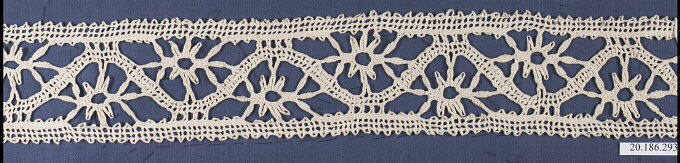
The Fragment as Primary Text: Lace as Material Evidence
Within the discipline of couture analysis, the fragment occupies a paradoxical position. It is simultaneously incomplete and self-sufficient — a partial object that nonetheless carries the full weight of its originating system. The present study examines a single fragment of lace held within the Global Heritage archive and classified under the Artisanal Material designation. Rather than treating this fragment as a subordinate detail within a larger garment history, the analysis positions it as a standalone text: an autonomous material document whose technical, cultural, and aesthetic properties merit independent scrutiny.
This methodological choice is deliberate. Couture scholarship has historically privileged the finished garment — the gown, the bodice, the ensemble — as the unit of meaning. The fragment, by contrast, has been relegated to the status of evidence for something else. The argument advanced here is that the fragment constitutes evidence in itself, and that lace, more than almost any other textile, rewards this inversion of scholarly hierarchy.
Material Composition and the Logic of Artisanal Production
Thread, Tension, and the Hand of the Maker
Examination of the fragment reveals a lace structure consistent with hand-worked artisanal production rather than industrial imitation. The thread count is irregular in a manner that signals human tension control: the slight variations in loop density, the minute asymmetries in motif spacing, and the absence of mechanical repetition all point to a maker working without automated guidance. These are not defects. In the vocabulary of couture, they are signatures of the hand — the visible trace of decision-making at the level of the individual stitch.
The material itself appears to be a fine cellulosic or protein-based filament, consistent with heritage lace traditions in which fibre selection preceded pattern design. This sequencing matters. In industrial production, the pattern is fixed and the fibre is sourced to meet it. In artisanal lace, the fibre often determines what the pattern can become. The fragment therefore encodes a negotiation between material capacity and human intention — a dialogue rather than a command.
Structural Analysis of the Motif
The surviving portion displays a partial floral or foliate motif executed in a ground of twisted mesh. The motif is not fully recoverable; its perimeter is cut or worn, which is precisely what qualifies the object as a fragment. Yet the internal logic of the design remains legible. The curve of the surviving petal suggests a radial composition, and the density gradient — tighter work at the motif's core, more open work toward its edge — indicates a maker trained in the classical hierarchy of lace density.
This hierarchy is not merely decorative. It is structural. Denser zones provide tensile stability; open zones provide flexibility and drape. The fragment thus demonstrates that artisanal lace is an engineered textile, not an ornamental afterthought. Its beauty is inseparable from its performance.
Global Heritage and the Problem of Provenance
Cultural Attribution Without Appropriation
The classification "Global Heritage" is intentionally broad, and this breadth demands critical handling. Lace traditions exist across Europe, Asia, Africa, and the Americas, and many share structural principles — netting, twisting, looping — while diverging in technique, symbolism, and social function. To attribute the fragment to a single tradition on the basis of visual similarity alone would be methodologically reckless and ethically suspect.
What can be asserted with confidence is that the fragment belongs to a global lineage of hand-lace production in which women's labour, often uncredited, sustained technical innovation across centuries. The fragment is therefore also a labour document. Its fineness is a measure of time — hours of work compressed into centimetres of cloth.
Conservation Ethics and the Standalone Study
Treating the fragment as a standalone study has conservation implications. Fragments are frequently stabilized, mounted, or integrated into reconstructions that subordinate them to a conjectured whole. This study resists that impulse. The recommendation is minimal intervention: stabilization that preserves the fragment's existing boundaries without fabricating missing sections. The cut edge is part of the object's history, not an error to be corrected.
Documentation should proceed at the fibre level — microscopy, thread measurement, and photographic capture at raking light to record the relief of the work. These records become the fragment's surrogate completeness: not a restored garment, but a fully described material.
Aesthetic Reading: The Fragment as Couture Proposition
Finally, the fragment functions aesthetically as a proposition rather than a conclusion. It invites the viewer to complete the pattern mentally, and in doing so, it activates the same imaginative faculty that couture relies upon in the atelier and on the runway. The fragment is unfinished by accident of survival, but it is complete as an idea.
For Katherine Fashion Lab, the lesson is direct. Material intelligence in couture does not require totality. A single fragment of artisanal lace, rigorously analysed, can carry the full argument: that hand, fibre, structure, and heritage are inseparable, and that the smallest surviving unit of a textile tradition may be the most eloquent witness to it.