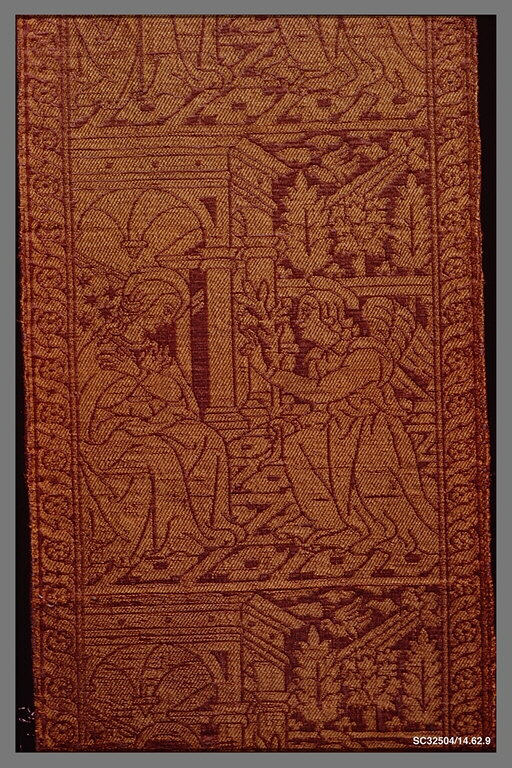
The Annunciation: A Study in Woven Silk and Linen
The Annunciation stands as a singular artifact within the Katherine Fashion Lab's ongoing investigation into the intersection of sacred iconography and textile craft. As a standalone study, this work resists easy categorization—it is neither purely devotional object nor straightforward garment, but rather a liminal creation that occupies the space between ritual vestment and couture construction. Executed in woven silk and linen, the piece draws upon a global heritage of weaving traditions while asserting a distinctly contemporary formal intelligence. Its significance lies not merely in what it depicts, but in how its material logic transforms the act of viewing into an act of contemplation.
The choice of silk and linen as the constitutive materials is far from arbitrary. In the hierarchy of textile fibers, these two occupy opposing poles: silk, the protein filament of the mulberry silkworm, denotes luxury, luminosity, and the secular economies of trade; linen, the cellulosic bast fiber of the flax plant, signifies humility, durability, and the ancient agrarian rhythms of the Mediterranean and Near East. Their combination in a single woven structure produces a dialectic that mirrors the theological tension at the heart of the Annunciation itself—the meeting of the divine and the human, the eternal and the temporal, the word made flesh. The weaver who selects these fibers is not simply choosing materials; they are encoding a theological argument into the fabric's very substrate.
Material Dialectics: Silk and Linen in Sacred Context
Historically, the pairing of silk and linen appears across multiple cultural traditions. In Byzantine liturgical textiles, silk was reserved for the most sacred of vestments, its sheen understood as a material analogue to divine light. Linen, by contrast, served as the practical ground—the warp upon which such luminosity could be structured. In the Coptic weaving traditions of late antiquity, silk and linen were interwoven to create figural textiles that adorned both churches and domestic interiors, their imagery mediating between the sacred and the everyday. The Annunciation draws upon this global heritage without merely quoting it. The weave structure itself becomes a site of interpretation: where silk warp meets linen weft, the surface shifts between reflection and absorption, creating passages of light and shadow that animate the depicted scene.
What distinguishes this work from mere historical pastiche is its refusal to resolve these material tensions. The silk does not simply represent the divine; the linen does not simply represent the human. Instead, the two fibers are woven together in a manner that makes their separation impossible to discern at the level of the individual thread. This technical decision carries profound implications for the work's meaning. The Annunciation is not a narrative of two separate entities encountering one another, but of a fundamental interpenetration—a weaving together of distinct natures into a single, irreducible cloth.
Iconography and Abstraction: The Figure in the Weave
The visual program of The Annunciation operates through a deliberate economy of means. The angel and the Virgin are not rendered with the anatomical precision of Renaissance painting, nor with the hieratic flatness of medieval icon. Instead, they emerge from the woven structure itself, their forms suggested through shifts in weave density, fiber luster, and chromatic variation. This approach aligns the work with the broader trajectory of modernist textile art, from the Bauhaus weavers to the post-war fiber artists who insisted that the loom could be a site of abstract expression. Yet The Annunciation never abandons its subject. The figures are present, but they are present as woven presences—as patterns of interruption within the continuous field of the cloth.
This technique of figural emergence has a specific theological resonance. In the Annunciation narrative, the Word becomes flesh not through the obliteration of the human, but through its assumption. Similarly, the figures in this textile become visible not through the addition of paint or embroidery, but through the modulation of the weave itself. The angel's wing is a change in the ratio of silk to linen; the Virgin's mantle is a shift in the direction of the weft. The result is a work that requires slow, patient viewing—a temporal experience that mirrors the contemplative reading of sacred texts.
Standalone Study: Autonomy and Context
As a standalone study, The Annunciation raises important questions about the status of the textile object in contemporary couture and art practice. It is not a garment, though it could be worn; it is not a tapestry, though it hangs on a wall. Its autonomy is precisely what makes it significant. In an era when fashion and art are often collapsed into one another through spectacle and branding, this work insists on the integrity of the textile as a medium capable of sustaining complex intellectual and spiritual content. It does not need a body to complete it, nor a runway to validate it. It stands alone, as its title suggests, as a study—a rigorous, focused investigation into what woven silk and linen can be made to mean.
The Katherine Fashion Lab's presentation of this work reflects a broader commitment to understanding couture as a form of material knowledge. The Annunciation is not merely an object to be admired; it is a proposition about how fibers, structures, and images can be woven together to produce meaning. Its global heritage is not a matter of surface decoration but of deep material continuity—a recognition that the loom has always been an instrument of both utility and transcendence. In this standalone study, that dual inheritance is made visible, thread by thread.