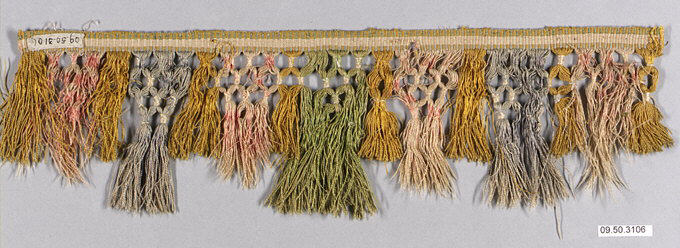
Fringe: From Ancient Precious Adornment to 2026 Luxury Signal
Fringe is among the oldest and most persistently coded forms of human adornment. Long before it became a fixture of Western fashion vernacular, civilizations across Mesopotamia, Egypt, the Indus Valley, and Andean South America were twisting, knotting, and suspending strands of precious material from garments, regalia, and ritual objects. At Katherine Fashion Lab, we treat fringe not as surface decoration but as a strategic material language — one whose symbolic density, spiritual charge, and material scarcity position it as a high-value asset for the 2026 luxury cycle. This analysis examines fringe through four lenses: symbolic power, historical adornment, spiritual meaning, and commercial strategy.
Symbolic Power: The Authority of Suspended Strands
The symbolic force of fringe derives from a fundamental principle of visual hierarchy: vertical movement attracts the eye downward and outward, extending the silhouette and implying motion, fertility, and continuity. In ancient contexts, this was never accidental. Fringe marked boundaries — between the sacred and the profane, the initiated and the uninitiated, the living and the ancestral. In Mesopotamian ritual dress, knotted fringes on priestly garments functioned as a form of written contract, with each knot representing a binding vow. In ancient Egypt, beaded and fringed aprons worn by royalty and deities signaled divine legitimacy; the suspended elements were frequently made of gold, carnelian, and faience, materials reserved for those with access to temple economies.
Critically, fringe also served as a portable archive. Among the Inca, quipu-like fringed cords encoded lineage, tribute, and cosmology. To wear fringe was to wear a record of one's place in the social and cosmic order. This archival function gives fringe a unique strategic property in luxury: it is simultaneously ornament and information, surface and substance. For a heritage house, this duality supports storytelling that is both material and narrative — a critical requirement for 2026 collections competing in a market saturated with visual noise.
Historical Adornment: Precious Material as Social Technology
The material composition of ancient fringe is inseparable from its meaning. Where fringe was made of wool or flax, it signified labor and utility. Where it was made of gold, silver, lapis lazuli, turquoise, coral, and silk, it signified access — to trade routes, to temple treasuries, to imperial workshops. In the royal tombs of Ur, gold fringed headdresses and beaded capes demonstrate that fringe was a technology of distinction, not merely decoration. In Andean cultures, the finest cumbi textiles with feather and metal fringe were reserved for the Sapa Inca and ritual specialists; their production was controlled by the state.
This historical precedent matters commercially. Fringe made from precious material carries an inherent scarcity narrative that cannot be replicated by synthetic substitutes. The 2026 luxury consumer — increasingly literate in provenance and material ethics — responds to objects whose value is legible at the level of the strand. A hand-knotted silk fringe with gold-wrapped thread is not a trim; it is a capitalized asset with a documented chain of custody. Katherine Fashion Lab's position is that fringe should be treated as a primary material, not a secondary finish, with its own costing, sourcing, and artisan certification.
Spiritual Meaning: Protection, Threshold, and Transformation
Across ancient cultures, fringe was understood to possess apotropaic power. The hanging strands were believed to trap or deflect malevolent forces, creating a permeable but protective boundary around the wearer. In Jewish tradition, the tzitzit on the corners of garments served as a reminder of covenant and law; in Bedouin and North African dress, fringed veils and shawls were used in rites of passage. In ancient China, jade and silk fringes on ceremonial robes mediated between the wearer and ancestral spirits.
This spiritual dimension is not a historical curiosity; it is a strategic asset. In a 2026 luxury landscape defined by secular ritual — the gifting ceremony, the milestone purchase, the heirloom investment — fringe offers a ready-made vocabulary of protection, blessing, and transition. A fringed cape or bag can be positioned as a talisman object, marketed through the language of safeguarding and continuity rather than ephemeral trend. This reframes fringe from bohemian cliché to sacred technology.
2026 High-End Luxury Strategy: Capitalizing on the Strand
For Katherine Fashion Lab, the strategic case for fringe rests on three pillars. First, material integrity: precious-metal and silk fringes create defensible price architecture and support limited-edition drops with measurable artisan hours. Second, narrative depth: ancient provenance provides a deep well of content for client education, private events, and archival storytelling, reinforcing the house as a custodian rather than a trend-follower. Third, sensory differentiation: in a digital-first market, fringe offers tactile, kinetic, and auditory value — movement, weight, and sound — that cannot be replicated on screen, driving in-person conversion and clienteling.
Recommended actions for the 2026 cycle include: commissioning a capsule of hand-knotted precious-metal fringes with documented ancient technique references; developing a certification standard for "heritage fringe" that verifies knot density, material purity, and artisan lineage; and positioning fringe as a signature code across accessories, eveningwear, and home objects. The objective is not to revive a historical motif but to re-capitalize a symbolic system that has always signaled authority, protection, and belonging.
Fringe is not a trend. It is a technology of meaning. For Katherine Fashion Lab, the opportunity is to treat it as such — with the rigor, scarcity, and spiritual intelligence that ancient civilizations understood and that 2026 luxury clients are ready to buy.