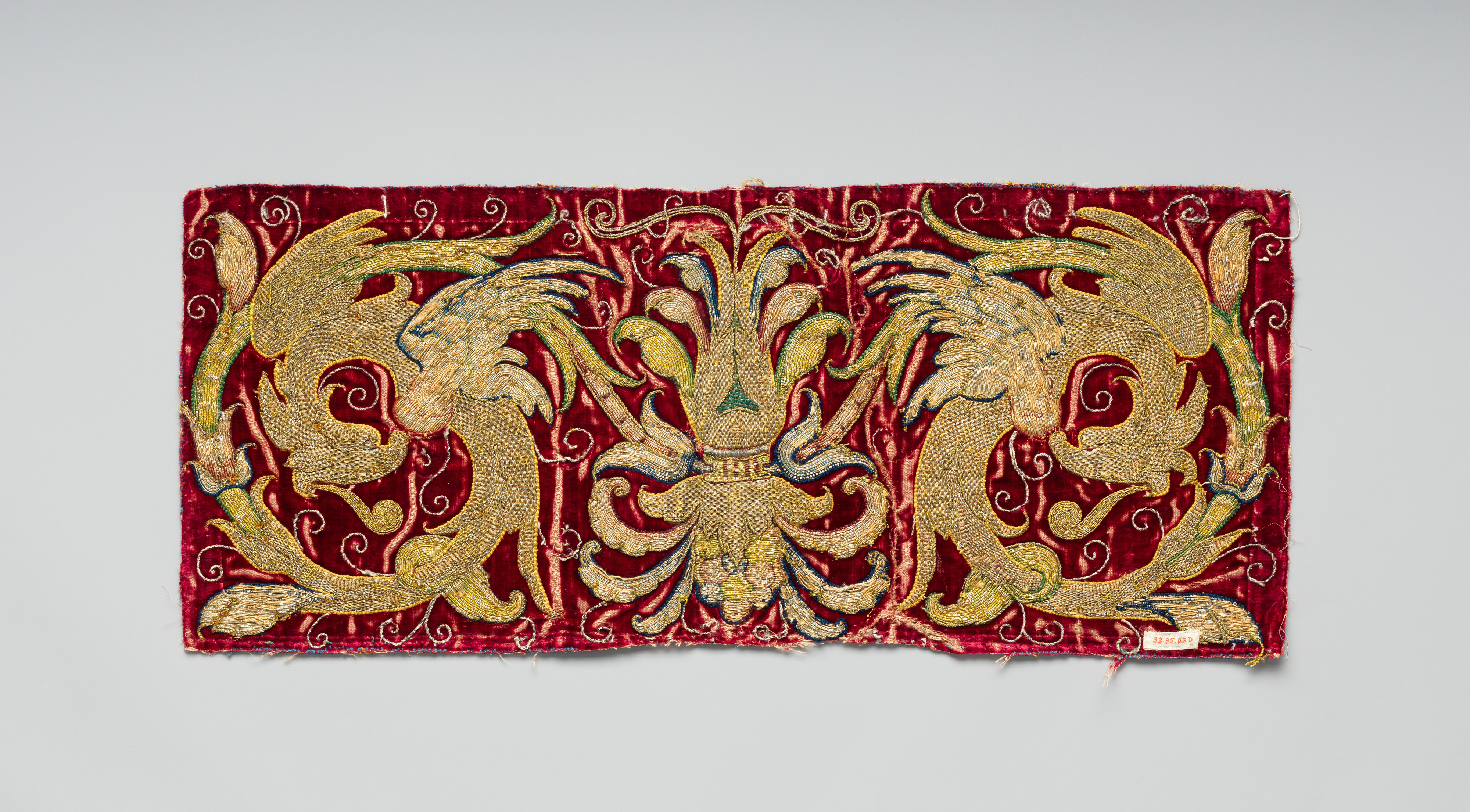
When Velvet Meets Metal: The Material Dialectics of Couture Embroidery
The convergence of silk and metal thread upon a velvet ground constitutes one of the most technically demanding and historically resonant material systems in the entire canon of high fashion. This standalone study examines the aesthetic, technical, and cultural dimensions of this triad — velvet, silk, metal — as it appears across global heritage traditions, from the Safavid workshops of seventeenth-century Persia to the Ottoman kemha ateliers, from Venetian broccatelli to the imperial embroidery of the Qing court. In each instance, the same structural logic obtains: a dense, light-absorbing ground; a luminous, light-reflecting figure; and a binding agent that must reconcile tensile forces fundamentally at odds with one another.
The Velvet Ground: A Substrate of Strategic Darkness
Velvet is not merely a background in this system; it is an active chromatic instrument. Its pile structure — a warp-faced, cut-loop construction historically woven on drawlooms — traps light within the fiber array, producing the characteristic deep, saturated tonality that flat-woven silks cannot achieve. In the context of silk-and-metal embroidery, this optical property is decisive. Metal thread, whether formed from hammered gilt-silver membrane wound around a silk core (the file or métal lancé of the French tradition) or from strips of flattened gold leaf applied to parchment or membrane (membrane or goldbeater's skin), behaves as a specular surface. Placed upon velvet, it does not simply appear bright — it appears disembodied, floating against a field that refuses to return the gaze.
This is the foundational dialectic of the technique: velvet absorbs, metal reflects, and silk mediates. The silk component — typically a filament silk floss, sometimes twisted into cordonnet or purl — performs neither function. It is the negotiator, carrying the metal where it cannot travel alone and providing the tonal gradation that pure metal cannot articulate. Where metal thread defines contour and hierarchy, silk thread creates volume, shading, and the illusion of three-dimensional form.
Metal Thread: Hierarchy, Value, and the Economics of Light
Metal thread in couture embroidery has never been a neutral material choice. Its cost — historically measured in gold weight rather than linear measure — positioned it as a direct signifier of status, ritual function, and economic reach. In the Safavid tradition, zarbaft textiles woven with metal thread were reserved for courtly gift exchange and royal wardrobe; in the Ottoman Empire, kemha fabrics incorporating silver and gold-wrapped wefts were subject to sumptuary regulation. The same logic governed European practice: English and French sumptuary laws of the sixteenth and seventeenth centuries restricted cloth-of-gold to specific ranks.
What distinguishes the velvet-embroidery variant from woven metallics is the labor hierarchy it encodes. A woven metal textile distributes its precious material uniformly across the loom. An embroidered surface, by contrast, concentrates metal at the points of greatest iconographic importance — the face of a figure, the petals of a liturgical flower, the border of a courtly mantle — while leaving the velvet ground exposed elsewhere. This selective application transforms the garment from a display of wealth into a composition of value, in which the eye is directed by the strategic deployment of light.
Technical Frictions and Artisanal Resolution
The physical marriage of silk embroidery and metal thread upon velvet is not frictionless. Metal thread is abrasive; drawn across a silk pile, it abrades and snags. It is also inelastic, while velvet — particularly silk velvet — has a degree of dimensional instability under humidity and tension. The historic solutions to these problems reveal a sophisticated material intelligence.
First, embroiderers developed couching techniques — laying the metal thread on the surface and securing it with small silk stitches — precisely to avoid passing the metal through the velvet. In the or nué technique of medieval and Renaissance Europe, this principle reaches its apogee: metal thread is laid in parallel lines across the entire ground, and silk is used to couch it in patterns that create tonal modeling. The metal becomes a ground rather than a figure, and the silk becomes the image. The velvet, in such works, is often entirely concealed — yet its presence is felt in the weight and drape of the finished object.
Second, ateliers developed padding and raised work, in which the velvet ground is built up with felt or cord before the metal and silk are applied. This technique, visible in ecclesiastical vestments and in the broderie en relief of eighteenth-century France, allows the embroidery to achieve sculptural dimension while protecting the velvet from direct stress. The resulting object reads as a hybrid — part textile, part relief sculpture, part jewel.
Global Heritage and Contemporary Couture
The velvet-silk-metal system is not the property of any single tradition, but its variations are culturally legible. Indian zardozi embroidery, worked on silk velvet with gold and silver wire, emphasizes density and mirror-like finish. Chinese imperial embroidery on velvet — rarer, given the dominance of silk satin grounds — employs silk floss in extraordinary fineness to modulate metal thread, producing a naturalism that European heraldic embroidery rarely pursued. Andean colonial brocateado applied metal thread to velvet in ways that fused Spanish liturgical convention with indigenous color sensibility.
In contemporary couture, this system persists precisely because it cannot be fully mechanized. The hand-laying of metal thread, the tension control required to couch it without distorting the velvet, and the color judgment required to pair silk floss with metal tone remain irreducibly human competencies. For the fashion house operating at the highest tier, the velvet-silk-metal ensemble is not nostalgia. It is a material argument — that luxury is not the presence of precious material alone, but the intelligence with which incompatible materials are made to cohere.
Conclusion: The study of silk and metal thread on velvet reveals couture as a discipline of reconciliation. Velvet provides depth; metal provides transcendence; silk provides articulation. The heritage of this technique — spanning Persia, Anatolia, Europe, India, China, and the Americas — demonstrates that the highest achievements of apparel arise not from the novelty of materials but from the mastery of their frictions. For Katherine Fashion Lab, this system remains a benchmark: a reminder that the most enduring luxury is structural, not decorative, and that the hand of the maker is legible in every stitch that holds light to darkness.