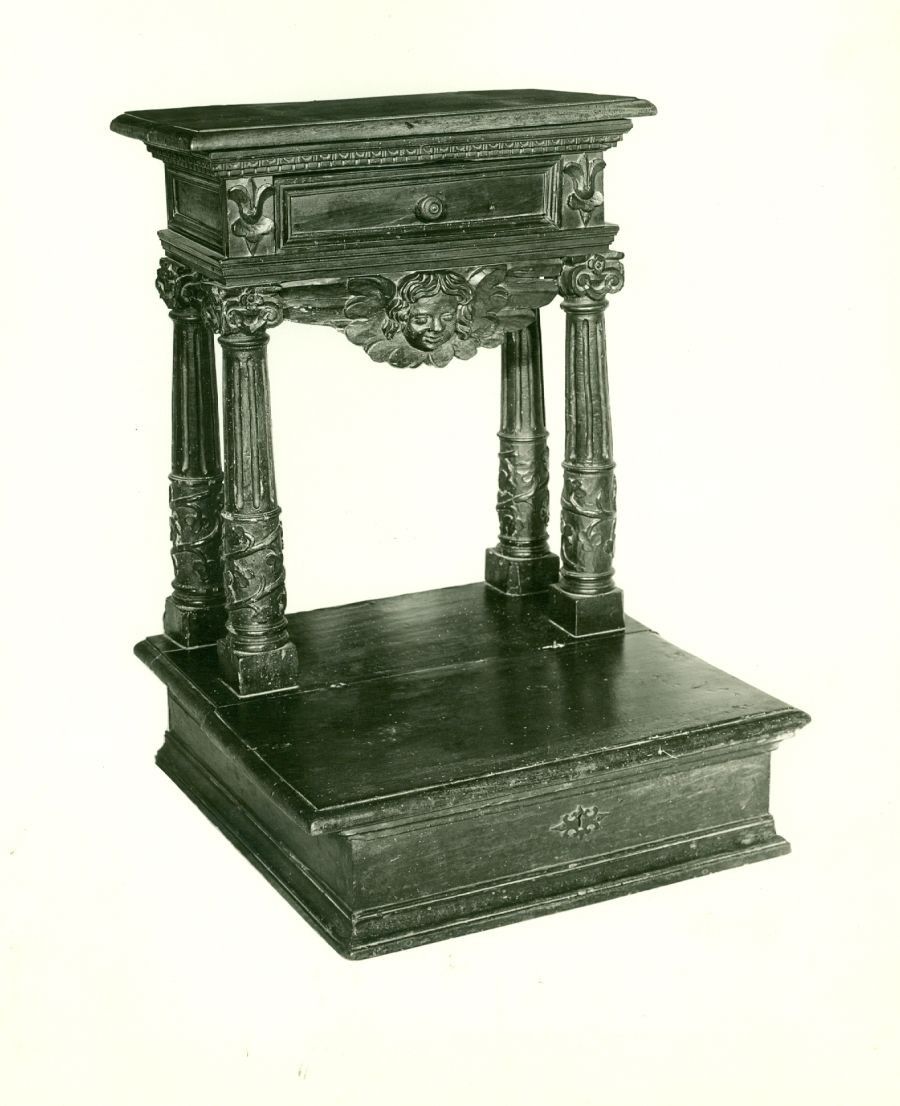
Prie Dieu: The Kneeling Desk as an Object of Devotional and Material Intelligence
The prie-dieu—literally "pray to God"—occupies a peculiar and privileged position within the history of European furniture. It is neither purely liturgical nor strictly domestic, neither wholly functional nor exclusively symbolic. As a standalone study, the present example, executed in walnut with secondary elements in poplar, invites an analysis that moves beyond conventional connoisseurship toward a more integrated understanding of material, form, and cultural function. The attribution to an Italian origin, while plausible, requires careful qualification, for the prie-dieu as a typology was neither invented in Italy nor confined to the peninsula. Rather, it flourished across Catholic Europe from the late Middle Ages through the eighteenth century, with regional variations that reflect distinct liturgical practices, joinery traditions, and social rituals of devotion.
The Typology of the Kneeling Desk
The prie-dieu emerged as a distinct furniture form in the late medieval period, when private devotion became increasingly codified and spatially differentiated. Unlike the prie-Dieu of the French tradition—often characterized by a sloping top for books, a kneeling step, and an armrest supported by turned or carved uprights—the Italian variant tends toward greater architectural restraint. Italian examples frequently adopt a bench-like profile with a raised central section, sometimes incorporating a hinged or removable kneeler. The present piece, with its walnut primary structure and poplar secondary elements, aligns with a broader Italian practice of reserving the most visible and durable hardwood for surfaces while employing lighter, more easily worked poplar for internal supports, drawer bottoms, or back panels. This material hierarchy is not merely economic; it reflects a sophisticated understanding of structural performance and seasonal movement in solid wood.
The walnut itself deserves close attention. Juglans regia, the European walnut, was the prestige cabinetwood of the Italian Renaissance and Baroque, prized for its warm, chocolate-toned heartwood, its fine and often figured grain, and its excellent working properties. Unlike oak, which dominated northern European furniture, walnut permitted the crisp carving and smooth planing that Italian craftsmen favored. Its relative scarcity compared to poplar or pine also meant that walnut furniture carried an implicit statement of status. A prie-dieu in walnut was not a modest parish furnishing; it was an object destined for a private chapel, a noble bedchamber, or a monastic cell of some standing.
Form, Function, and the Architecture of Devotion
The design of a prie-dieu is governed by a paradox: it must facilitate a posture of humility while simultaneously projecting an image of dignity. The kneeling body is vulnerable, earthbound, and dependent; the furniture that supports it must be stable, upright, and visually authoritative. This tension is resolved through proportion and joinery rather than ornament. The typical Italian prie-dieu presents a horizontal kneeler, often slightly padded or angled, set before a vertical or slightly raked backrest. The bookrest—sometimes a hinged flap, sometimes a fixed shelf—is positioned at a height that allows the supplicant to read without breaking the curve of the spine. Armrests, when present, are not for comfort in the modern sense but for discipline: they prevent the body from collapsing into mere rest and maintain the upright attentiveness that devotional practice demands.
In the present example, the use of poplar for secondary elements suggests a piece that was built to be used rather than merely displayed. Poplar is soft, stable, and dimensionally predictable; it does not warp as dramatically as walnut under changes in humidity, making it ideal for structural members that must remain true over centuries. The walnut surfaces, by contrast, would have been selected for figure and color, then finished with wax or oil rather than heavy varnish. The resulting surface is not a barrier but a patina—a record of touch, of candle smoke, of the slow accumulation of devotion.
Attribution and the Problem of Italian Origin
The attribution of any unmarked prie-dieu to Italy is fraught with difficulty. The form traveled widely, and joinery techniques that appear Italian—such as the use of dovetailed corner joints, pegged mortise-and-tenon frames, or thin panel-and-frame construction—were also practiced in Spain, southern France, and the Alpine regions. The strongest evidence for Italian origin often lies not in a single feature but in a constellation: the specific proportions of the kneeler, the absence of heavy carving in favor of architectural moldings, the use of walnut over oak, and the presence of poplar as a secondary wood. The present piece, if it is indeed Italian, likely dates from the seventeenth or early eighteenth century, a period when the prie-dieu reached its apogee as a domestic devotional object.
Yet the question of origin may be less important than the question of use. A prie-dieu is not a chair, not a table, not a desk. It is an instrument of posture, a material framework for a spiritual discipline. Its value lies not in its rarity or its provenance but in its capacity to structure a moment of attention. In an age of distraction, the prie-dieu stands as a quiet rebuke: a piece of furniture that asks nothing of us but to kneel, to read, and to be still.