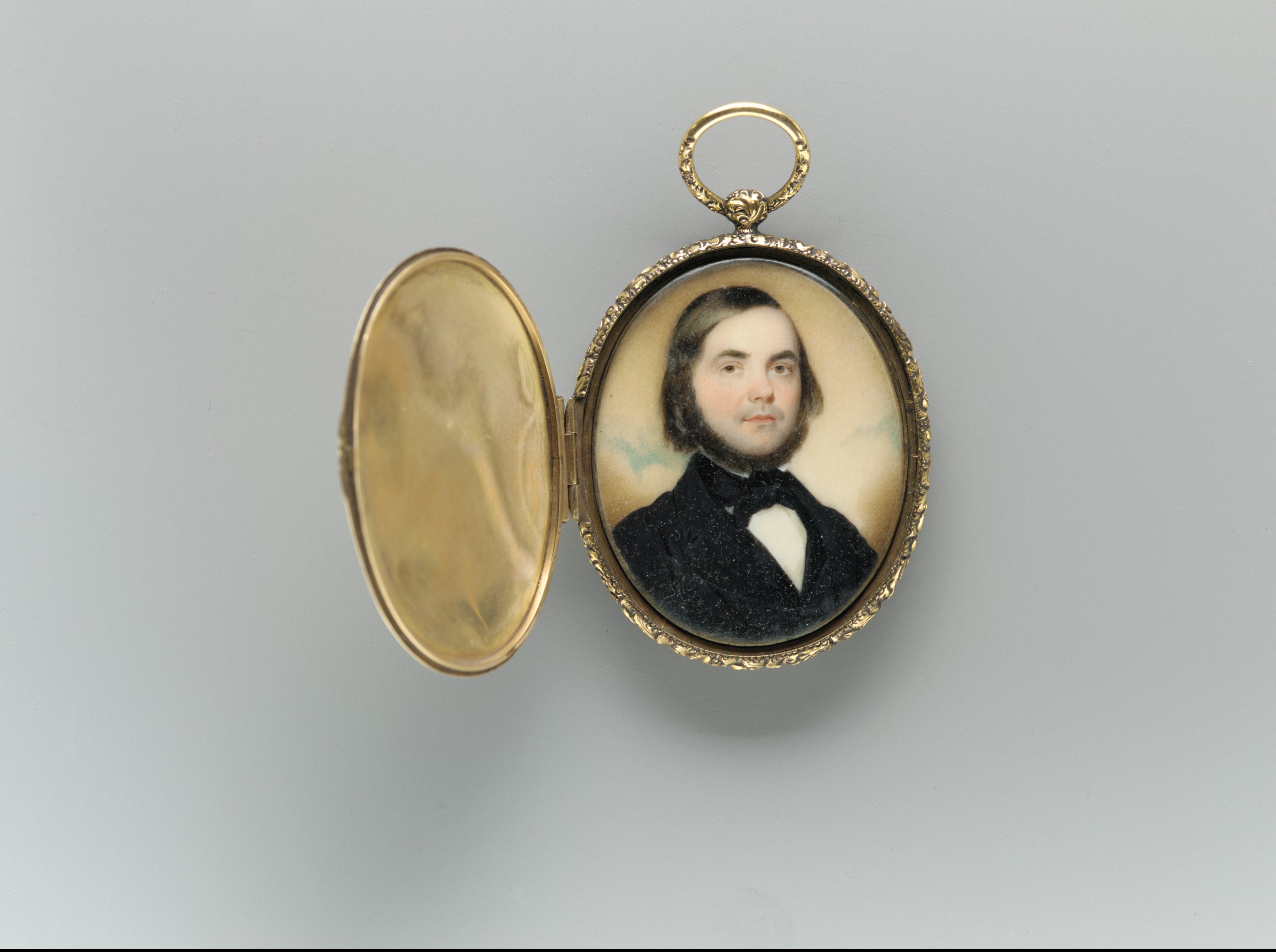
Portrait of a Gentleman: American Miniature, Guilloché Locket, and the Strategy of Intimate Power
Object Overview and Material Hierarchy
The Portrait of a Gentleman is a watercolor-on-ivory miniature housed in a hinged guilloché locket with a cast foliate bezel; the verso lens contains a fragment of fabric. Its American origin places it within the Federal and early national periods, when portraiture on ivory served as a portable, personal, and politically charged medium. The hierarchy of materials is deliberate: ivory as the painting substrate, watercolor as the image layer, gold or gilt metal as the enclosure, guilloché as the engine-turned ground, and fabric as the intimate relic. Each stratum performs a distinct function—image, protection, ornament, and touch. For Katherine Fashion Lab, this object is not merely an antique; it is a template for how luxury can encode power through scale, concealment, and the ritual of opening.
Symbolic Power: The Miniature as Portable Authority
In the American context, the portrait miniature was never a neutral keepsake. It was a declaration of affiliation, affection, and sometimes political allegiance. A gentleman’s portrait worn as a locket or brooch allowed the sitter to be carried into rooms, negotiations, and social performances where his physical presence was absent. The symbolic power lies in this paradox: the object is small enough to be hidden, yet potent enough to command attention when revealed. The hinged construction implies a threshold—an inside and an outside, a public face and a private truth. The cast foliate bezel frames the portrait with botanical ornament, a classical vocabulary of growth, lineage, and cultivated order. In luxury strategy, this is the logic of the signature object: not the loudest item, but the one that rewards the initiated.
Historical Adornment: Guilloché, Ivory, and the Discipline of Detail
The guilloché ground is a technical and aesthetic achievement. Engine-turned patterns—waves, sunbursts, basketweaves—create a moiré of light that shifts with the viewer’s angle. This is adornment as kinetic luxury: the object changes as the body moves. Ivory, meanwhile, carried associations of purity, refinement, and global trade, while also demanding extraordinary skill in watercolor application. The American miniaturist worked at a scale where a single brushstroke defined a mouth or an eye; failure was irreversible. The cast foliate bezel adds a sculptural dimension, translating two-dimensional portraiture into wearable architecture. For 2026 high-end strategy, this suggests a design principle: micro-craft as macro-signal. The consumer of true luxury does not need scale; they need evidence of hand, time, and irreversibility.
Spiritual Meaning: The Verso Lens and the Relic of Fabric
The verso lens containing fabric is the most spiritually charged element. In nineteenth-century American and European mourning and sentimental culture, fabric—hair, cloth, a fragment of a garment—functioned as a relic. It was not decorative; it was connective. The locket becomes a reliquary in miniature, holding not only the image of the gentleman but a physical trace of his body or life. This is the logic of contact magic: the belief that proximity to a material remnant transmits presence, memory, and protection. The hinged locket thus operates on two fronts—public portrait and private relic—and the wearer becomes a custodian of both. In spiritual terms, the object mediates between absence and presence, death and memory, distance and intimacy. For a luxury brand in 2026, this is the deepest well: objects that carry narrative residue rather than mere logo value.
American Context: Republican Simplicity and Hidden Elaboration
American portraiture of this period often balanced republican simplicity with private elaboration. The gentleman’s image is likely formal—coat, cravat, controlled expression—but the enclosure is ornate. This tension is strategic. In a young republic suspicious of aristocratic display, luxury retreated into the interior: the locket’s inside, the verso’s secret, the guilloché’s subtle shimmer. The object performs virtue outwardly and indulgence inwardly. This is a directly transferable model for 2026: the luxury consumer who rejects overt branding but craves coded excellence. The American miniature teaches that power can be worn without being announced.
2026 High-End Luxury Strategy: From Object to Ritual
For Katherine Fashion Lab, the Portrait of a Gentleman recommends a strategy built on four pillars. First, concealment as luxury: design pieces with hinges, covers, and reversible elements that require the wearer’s gesture to complete the experience. Second, material storytelling: use guilloché, cast metal, ivory alternatives, and textile inclusions as narrative layers, not decoration. Third, relic logic: incorporate fabric, hair, or personalized fragments that transform a product into an heirloom. Fourth, micro-scale authority: prioritize detail density over size, so that the object rewards close looking and signals membership in a discerning class. The locket’s hinge is not a mechanism; it is a ritual gate. Opening it is an act of intimacy, and intimacy is the ultimate luxury currency.
Conclusion: The Gentleman as Strategic Archetype
The Portrait of a Gentleman is a compact treatise on power, adornment, and spirit. It demonstrates that the most enduring luxury objects are those that hold contradiction: public and private, image and relic, restraint and elaboration. For Katherine Fashion Lab in 2026, the opportunity is to revive the hinged, relic-bearing, micro-crafted object as a counterpoint to digital saturation and logo fatigue. The gentleman in the locket does not shout; he waits. That patience—material, symbolic, and spiritual—is the heritage worth curating.