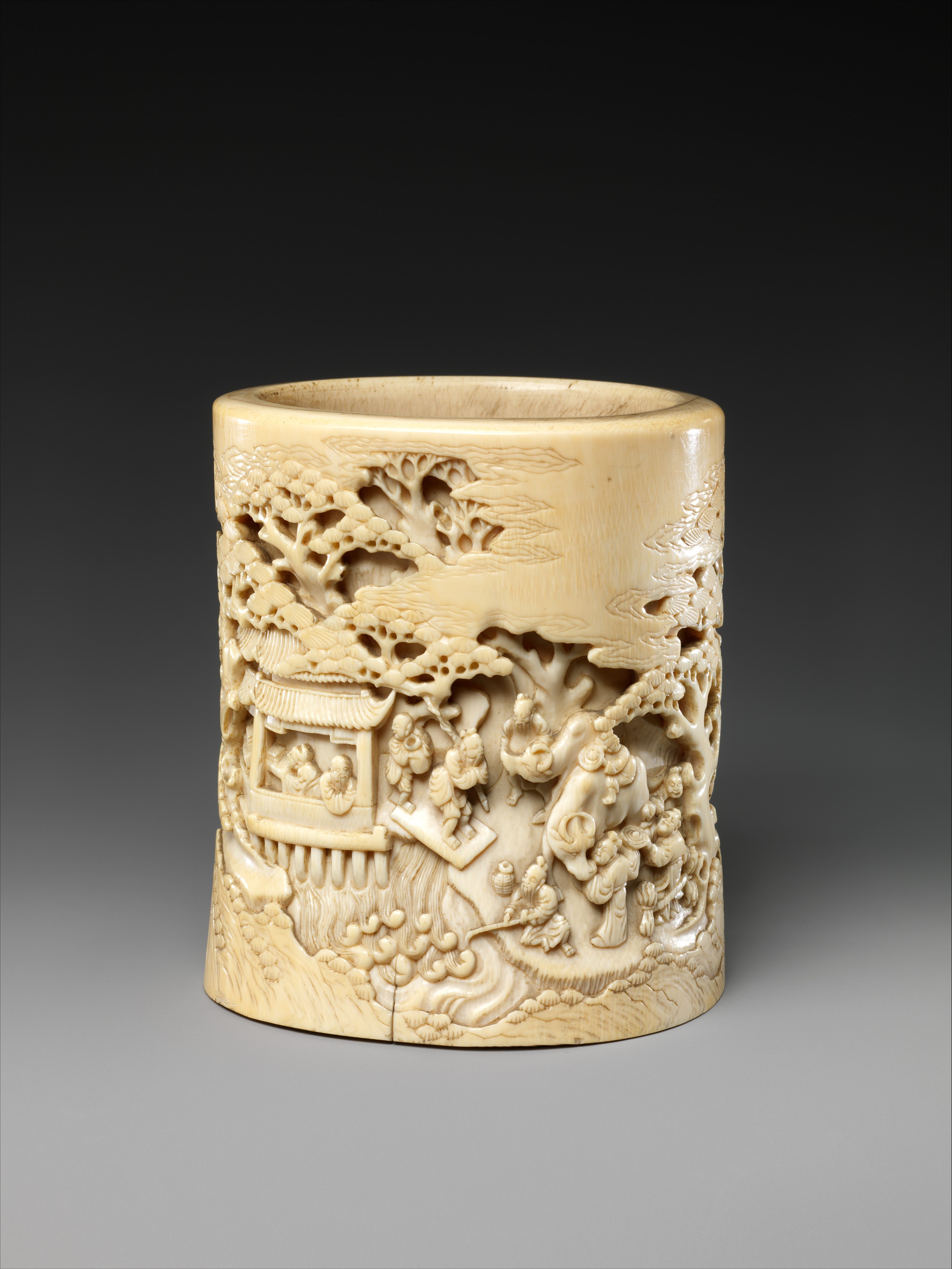
Executive Summary: The Brush Holder as Civilizational Artifact
Katherine Fashion Lab's Strategic Standalone Research initiative examines a remarkable Chinese ivory brush holder bearing a narrative scene, positioning it as a case study in how heritage objects convert symbolic capital into contemporary luxury value. For an MBA-level audience, the object is not merely an antique; it is a compressed data set of Confucian governance ideals, literati identity, and artisanal mastery. This analysis maps its symbolic power, historical adornment function, spiritual resonance, and implications for 2026 high-end luxury strategy.
Object Provenance and Materiality
The brush holder, likely produced during the late Ming or Qing dynasty (16th–19th century), is carved from a single section of ivory. In the Chinese scholarly tradition, the brush holder (bitong) was not a passive receptacle but an active participant in the scholar's studio (wenshu). Ivory, though imported from Africa or Southeast Asia via maritime trade routes, was prized for its dense, uniform grain, which allowed carvers to achieve the narrative depth and figural precision seen in this piece. The material's rarity reinforced the owner's access to global supply chains—an early modern signal of cosmopolitan status.
The narrative scene carved in relief typically depicts figures in a landscape: sages, attendants, pine trees, and pavilions. These are not decorative flourishes; they are mnemonic devices for classical texts. A brush holder with a narrative scene functioned as a portable library of moral exemplars, reminding the scholar of virtuous conduct, reclusion, or loyal service.
Symbolic Power: Confucian Governance and Literati Identity
In imperial China, the brush was the instrument of bureaucratic power. The holder that cradled it thus symbolized the scholar-official's mandate to govern through culture rather than force. Narrative scenes often drew from the Twenty-Four Filial Exemplars or the Romance of the Three Kingdoms, embedding Confucian ethics into daily ritual. For the literati, owning such an object was a performative act: it declared alignment with wen (civil virtue) over wu (martial force).
The ivory medium adds a layer of paradox. Ivory is organic, once-living, and yet carved into eternal forms. This tension between ephemerality and permanence mirrors the Confucian ideal of the gentleman who refines his character through constant self-cultivation. The brush holder's symbolic power lies in this duality: it is both a tool of transient ink and a monument to enduring values.
Historical Adornment: The Studio as Stage
By the late Ming, the scholar's studio had become a stage for aesthetic self-fashioning. Brush holders were arranged on the desk alongside inkstones, water droppers, and seals. Their adornment value was inseparable from their utility. A narrative scene carved with multiple planes of relief—figures in the foreground, mountains in the background—invited the viewer to "enter" the landscape, a practice known as woyou (lying wandering). This interactive viewing was a form of intellectual leisure, distinguishing the true literatus from the merely wealthy.
Historically, such objects were also diplomatic gifts. The Qing court presented ivory carvings to European envoys, signaling China's artistic superiority while participating in global exchange. The brush holder thus carries a dual heritage: inward-facing spiritual cultivation and outward-facing soft power.
Spiritual Meaning: Daoist Reclusion and Buddhist Compassion
Beyond Confucian duty, the narrative scene often evokes Daoist themes of retreat. A figure seated beneath a pine, gazing at a waterfall, represents the ideal of wu wei (effortless action). The brush holder becomes a spiritual anchor, a reminder that bureaucratic life is transient compared to the eternal Dao. In some examples, Buddhist motifs—lotus, arhats, or Bodhisattva figures—introduce compassion and mindfulness. The carver's chisel thus performs a kind of visual sutra, transforming ivory into a vehicle for meditation.
For the owner, daily use of the brush holder was a spiritual discipline. Each time the brush was removed or replaced, the narrative scene reasserted a moral or metaphysical lesson. This repetitive engagement is the essence of heritage: meaning is not stored in the object but activated through ritual.
2026 High-End Luxury Strategy: From Artifact to Narrative Capital
Katherine Fashion Lab operates at the intersection of heritage and innovation. For 2026, the brush holder offers three strategic pillars:
1. Narrative Scarcity. Luxury consumers increasingly demand provenance stories that cannot be replicated. The brush holder's narrative scene is a pre-modern form of storytelling—sequential, symbolic, and participatory. A 2026 collection could translate this into modular jewelry or leather goods where each component reveals a chapter of a myth, encouraging collectors to "read" their accessories.
2. Ethical Material Substitution. Ivory is now restricted under CITES and public opinion. The strategic lesson is not to replicate ivory but to honor its symbolic function through sustainable alternatives: carved bone from food waste, tagua nut, or 3D-printed biomaterials that mimic ivory's grain. The narrative scene remains the value driver; the medium becomes a statement of ecological stewardship.
3. Ritual Re-Enchantment. High-end luxury in 2026 will compete on ritual, not just product. The brush holder's power came from daily touch. Katherine Fashion Lab can design objects—vanity trays, pen cases, tech accessories—that demand a deliberate gesture. A magnetic clasp that opens like a scroll, a surface that patinates with use: these create the same repetitive, meaning-making engagement that the literati experienced.
Finally, the brush holder teaches that spiritual meaning and commercial strategy are not opposites. The most enduring luxury objects are those that function as both tools and talismans. For 2026, the winning brand will be the one that carves narrative into every interaction, turning consumption into cultivation.
Conclusion
The Chinese ivory brush holder with a narrative scene is a masterclass in symbolic density. It unites Confucian governance, Daoist retreat, Buddhist compassion, and artisanal virtuosity in a single handheld object. For Katherine Fashion Lab, its legacy is not a template for reproduction but a strategic compass: prioritize narrative over ornament, ritual over display, and ethical evolution over material nostalgia. In doing so, the brand can claim a heritage that is not merely Chinese but universally human—the desire to make daily life a work of meaning.