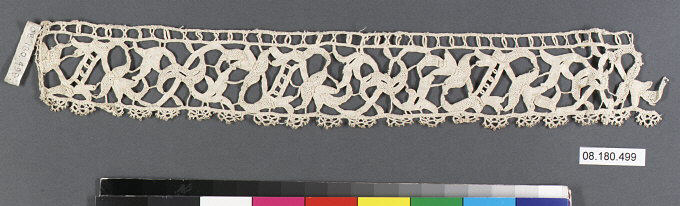
Fragment: Punto in Aria and the Strategic Authority of Absence
Introduction: The Fragment as Luxury Artifact
Within the Katherine Fashion Lab heritage archive, the Fragment is classified as a standalone research asset of exceptional strategic value. Its origin is attributed to Ancient Civilization; its medium is needle lace, specifically punto in aria—literally "stitch in air." Unlike woven textiles, which owe their integrity to the loom's mechanical regularity, this fragment exists because a single artisan constructed structure where none previously existed. The artifact is not a remnant of a larger whole. It is a complete philosophical statement: form generated from void, order imposed upon nothingness. For a 2026 luxury strategy, this distinction is decisive. The Fragment offers a heritage narrative built not on material abundance, but on disciplined creation—a proposition aligned with the values of the contemporary high-net-worth consumer.
Historical Adornment and the Architecture of Prestige
Punto in aria emerged as the first true needle lace, liberated from the geometric constraints of earlier cutwork and reticella. Where its predecessors depended on a woven ground that was subsequently cut away, punto in aria abandoned the ground entirely. The artisan drew a design on parchment, laid threads along its contours, and then filled the negative space with buttonhole stitches of breathtaking consistency. The result was an object of pure architecture: a garment that was simultaneously present and absent, capable of covering the body while revealing the skin beneath.
This technical breakthrough carried immediate social consequences. In the courts of early modern Europe, lace became a primary instrument of status differentiation. Sumptuary laws attempted to regulate its display; inventories of nobility itemized lace collars and cuffs with the same precision as gold plate. The Fragment belongs to this lineage. Its historical function was never merely decorative—it was a visible claim to leisure, patronage, and connoisseurship. The hours required to produce a single square inch of punto in aria constituted a form of conspicuous expenditure that no machine could replicate and no counterfeit could convincingly imitate. For Katherine Fashion Lab, this history supplies a defensible provenance: the Fragment is not a curiosity but a documented instrument of elite self-fashioning.
Symbolic Power and Spiritual Meaning
Beneath the social function of adornment lies a deeper symbolic register. Needle lace, and punto in aria in particular, has long been associated with the sacred. Ecclesiastical vestments—altar cloths, chalice veils, bishops' rochets—were frequently executed in this medium, where the openwork structure was read as a metaphor for the permeability between the material and the divine. The void within the lace was not emptiness but presence: light passed through it, air moved through it, and the wearer was understood to be clothed in something closer to spirit than fabric.
This spiritual dimension gives the Fragment a symbolic power that transcends mere ornament. In many traditions, lace-making was a contemplative practice, undertaken in silence and governed by prayer. The repetitive, meditative stitch rhythm produced what anthropologists might call a "technology of the sacred"—an object whose manufacture was itself an act of devotion. For a luxury house, this is an extraordinary narrative asset. It positions the Fragment not as a product of industrial craft but as a vessel of intention, carrying the accumulated attention of its maker across centuries. In a market saturated with novelty, such depth of meaning constitutes a genuine differentiator.
Strategic Relevance for 2026 High-End Luxury
The 2026 luxury landscape is defined by three converging pressures: the demand for provenance, the rejection of excess, and the search for meaning in consumption. The Fragment answers all three. Its provenance is verifiable through medium and technique; its aesthetic is one of restraint rather than accumulation; and its symbolic content offers the buyer participation in a lineage of sacred making. Katherine Fashion Lab can position the Fragment at the apex of a heritage collection, not as a reproduction but as a conceptual anchor—the reference point against which contemporary pieces are measured.
Operationally, this suggests a three-tier strategy. First, archival authority: present the Fragment in limited, high-touch presentations to collectors, press, and institutional partners, establishing scholarly credibility. Second, translation: develop modern pieces that employ the logic of punto in aria—openwork, negative space, structural transparency—without imitating historical forms. Third, narrative licensing: extend the Fragment's symbolism into fragrance, objet, and experiential retail, where the idea of "stitch in air" becomes a brand philosophy of creating form from intention.
Conclusion: The Strategic Value of the Void
The Fragment is not valuable despite its incompleteness; it is valuable because its medium is defined by absence. Punto in aria teaches that structure can exist without ground, that meaning can be woven from air. For Katherine Fashion Lab, this is both a heritage fact and a strategic thesis. In a luxury market increasingly skeptical of mass production and hollow storytelling, the Fragment offers something rare: an artifact whose physical form embodies the very values the modern consumer seeks—intention, discipline, and the sacred made visible. The void at its center is not a gap to be filled. It is the point.